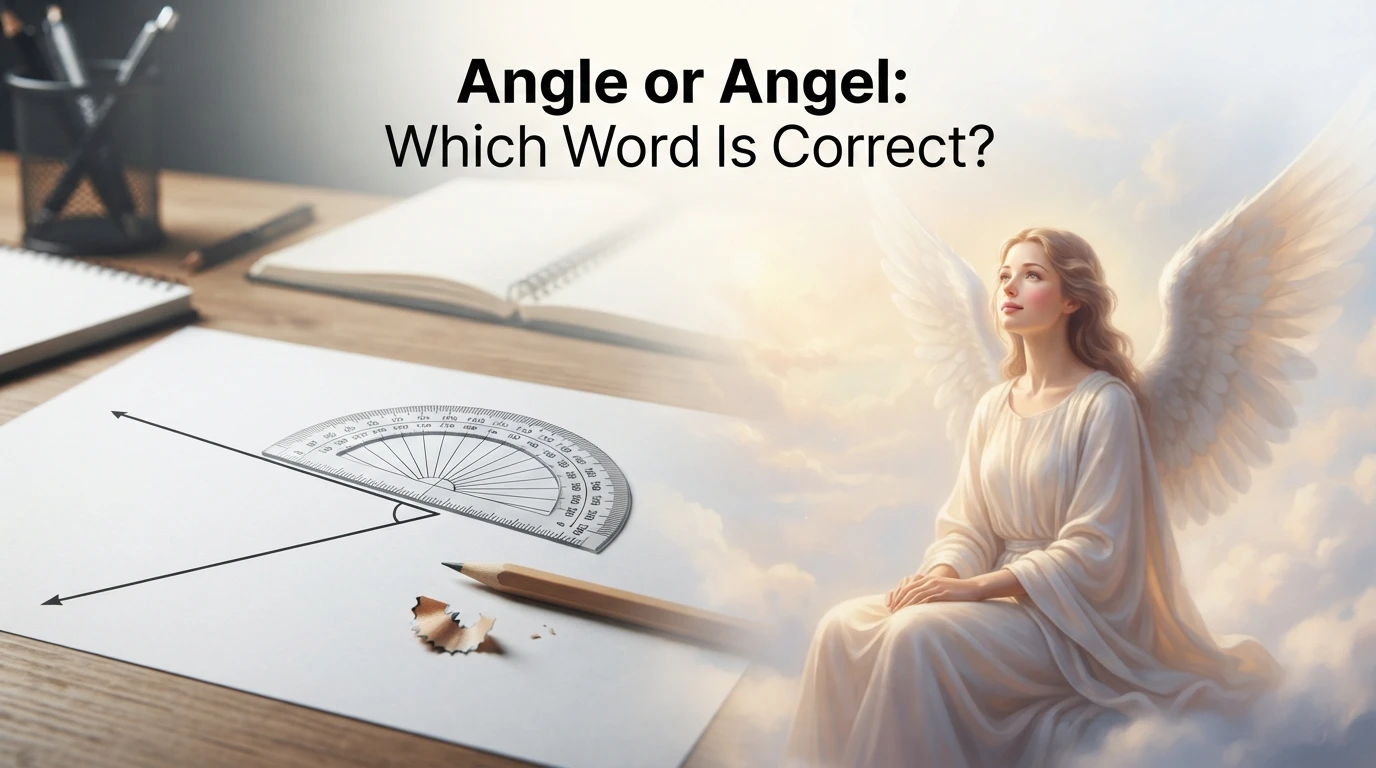
“Angle” and “angel” are both correct English words, but they have completely different meanings. Angle usually refers to a shape, direction, position, or way of looking at something, while angel refers to a spiritual being or a person who is extremely kind.
The two words are easy to confuse because they look almost the same and can sound similar in some accents. However, they belong to different parts of meaning and should not be used interchangeably.
In this guide, you will learn the difference between angle or angel, how to pronounce each word, how to use them in sentences, common spelling mistakes, and simple tricks to remember which word you need. You will also see clear examples from everyday English, math, photography, and general writing.
Quick Answer: Angle or Angel?
If you mean a shape, corner, direction, position, or viewpoint, use angle.
If you mean a spiritual being or a person described as exceptionally kind, use angel.
For example:
The triangle has three angles.
Here, angle refers to the space or measurement formed by two lines.
The child was dressed as an angel.
Here, angel refers to a spiritual being.
A simple way to remember the difference is:
Angle = shape, direction, or viewpoint.
Angel = heavenly or very kind being.
| Word | Meaning | Example |
| Angle | A corner, direction, or viewpoint | Look at the picture from another angle. |
| Angel | A spiritual being or very kind person | She is an angel to her family. |
The missing “e” in angel is not just a spelling detail. It changes the entire meaning of the word.
What Does “Angle” Mean?

Angle is a noun with several common meanings. The most basic meaning relates to two lines or surfaces that meet.
For example:
A right angle measures 90 degrees.
In mathematics and geometry, an angle is formed when two lines, rays, or segments meet at a point.
The word also has everyday meanings.
You can use angle to describe a direction:
Turn the camera to a different angle.
It can describe a viewpoint:
We need to look at the problem from another angle.
It can also describe a particular approach to a story or topic:
The reporter found an interesting angle for the article.
So, “angle” is not limited to math. It is also common in photography, journalism, design, sports, and everyday conversation.
What Does “Angel” Mean?
An angel is traditionally a spiritual or heavenly being found in several religious and cultural traditions.
For example:
The painting shows an angel with wings.
The word can also be used informally to describe a person who is extremely kind, helpful, or caring.
For example:
You brought me dinner when I was sick. You’re an angel!
In this sentence, the speaker is not saying that the person is literally a supernatural being. It is a warm way of praising someone.
The word angel is also common in names, stories, songs, art, and holiday traditions.
A child wearing white clothing and wings for a school play might be called an angel.
Angle vs. Angel: What’s the Difference?

The difference between angle and angel is mainly their meaning.
Angle relates to geometry, direction, position, perspective, or approach.
Angel relates to a spiritual being or, informally, a very kind person.
Compare these sentences:
The photographer changed the angle of the camera.
The little girl dressed as an angel.
The first sentence is about position or direction.
The second sentence is about a spiritual figure or costume.
| Feature | Angle | Angel |
| Main meaning | Direction, corner, viewpoint | Spiritual being |
| Common fields | Math, photography, writing | Religion, art, stories |
| Informal meaning | Approach or perspective | Very kind person |
| Example | Change the angle. | She is an angel. |
Although the words look similar, their meanings are completely different.
Is “Angle” a Noun or a Verb?

Angle can be both a noun and a verb.
As a noun, it can describe a geometric shape or viewpoint.
The two lines form an angle.
I like this camera angle.
As a verb, it can mean to position or direct something at a particular angle.
For example:
She angled the mirror toward the window.
It can also mean approaching something in a particular way.
For example:
The writer angled the story toward younger readers.
So, context determines whether “angle” is acting as a noun or a verb.
Is “Angel” a Noun?
Yes. Angel is primarily a noun.
It can refer to a spiritual being:
The story describes an angel watching over the family.
It can also describe someone who is very kind:
My grandmother was an angel to me.
Unlike “angle,” angel is not normally used as an everyday verb.
That makes the grammatical difference fairly easy to remember.
| Word | Common grammatical role | Example |
| Angle | Noun and verb | The lines form an angle. |
| Angel | Noun | The painting shows an angel. |
How to Use “Angle” in a Sentence
There are many natural ways to use angle.
In mathematics:
The students measured the angle with a protractor.
In photography:
Try taking the picture from a lower angle.
In everyday conversation:
I never thought about the problem from that angle.
In writing:
The article takes a different angle on the topic.
As a verb:
He angled the chair toward the window.
The common idea is position, direction, perspective, or approach.
How to Use “Angel” in a Sentence

You can use angel when talking about a spiritual being.
The story tells of an angel who protects the child.
You can also use it as a compliment.
You are an angel for helping me.
Another common use appears in art and costumes:
The children dressed as angels for the school performance.
You might also hear:
She has the patience of an angel.
This does not necessarily mean the person is literally an angel. It is a figurative compliment.
Angle in Mathematics
One of the most common meanings of angle appears in mathematics.
An angle is formed when two rays or lines meet at a point. The point where they meet is called the vertex.
Different types of angles include acute, right, obtuse, straight, reflex, and full angles.
A few basic examples:
An acute angle is less than 90 degrees.
A right angle is exactly 90 degrees.
An obtuse angle is greater than 90 degrees but less than 180 degrees.
A straight angle is 180 degrees.
The word angel has nothing to do with these mathematical concepts.
If your textbook says:
Find the missing angle.
You need angle, not angel.
Angle in Photography
Photographers frequently use the word angle to describe the position from which a picture is taken.
For example:
Try a different camera angle.
The photographer chose a low angle.
The building looks impressive from this angle.
Changing the angle can change how an object appears.
A low camera angle may make a person or building look taller. A higher angle can create a different perspective.
Again, the correct word is angle because the subject is position or viewpoint.
Angle in Writing and Journalism
The word angle also has an important meaning in writing.
A writer may choose a particular angle for a story. This means the specific approach or viewpoint used to present the subject.
For example:
The journalist approached the story from a human-interest angle.
Here, “angle” does not refer to geometry. It means the particular way the story is presented.
Blog writers use the same idea.
Suppose a writer is creating an article about healthy eating. Possible angles might include:
healthy meals for busy families
budget-friendly healthy food
easy healthy breakfasts
Each one approaches the same broad topic from a different angle.
Angel in Religion and Culture
The word angel has a long history in religious and cultural traditions. In many traditions, angels are described as spiritual beings or messengers.
The exact beliefs and descriptions differ among religions and cultures.
Angels are also common in art, literature, movies, holiday decorations, and children’s stories.
A familiar visual image is an angel with wings, although artistic representations vary widely.
For example:
The artist painted an angel above the doorway.
The word is also often used in names and expressions.
Angel can therefore appear in both serious religious contexts and everyday figurative language.
Why Do People Confuse Angle and Angel?
People often confuse these words because their spelling is very similar.
Compare them:
ANGLE
ANGEL
The only difference is the position of the letters L and E.
The meanings, however, are completely different.
Another reason for confusion is pronunciation. Depending on a speaker’s accent, the words may sound similar enough to cause uncertainty.
This is especially common for English learners who hear a word before seeing it written.
The best solution is to connect each spelling with a clear meaning.
Angle → geometry, direction, viewpoint
Angel → spiritual being, kind person
Common Mistakes With Angle or Angel
One common mistake is writing angel when you mean a geometric measurement.
Incorrect:
A triangle has three angels.
Correct:
A triangle has three angles.
Another mistake happens when someone writes angle when describing a spiritual being.
Incorrect:
The painting shows an angle with wings.
Correct:
The painting shows an angel with wings.
A third mistake occurs in photography.
Incorrect:
Take the picture from another angel.
Correct:
Take the picture from another angle.
These mistakes can look small, but they change the meaning of the sentence.
| Incorrect | Correct | Meaning |
| The triangle has three angels. | The triangle has three angles. | Geometry |
| She dressed as an angle. | She dressed as an angel. | Spiritual figure |
| Try another camera angel. | Try another camera angle. | Photography |
| Look at it from a different angel. | Look at it from a different angle. | Viewpoint |
A Simple Trick to Remember Angle and Angel
Here is an easy memory trick.
Think of the “L” in angle as a little line.
Angle → L → Lines → Geometry
An angle is commonly made by lines or rays.
For angel, think of “E” for ethereal or heavenly.
Angel → E → Ethereal → Heavenly being
Another simple trick is to remember:
Angle = math and viewpoint.
Angel = wings and kindness.
You do not need to memorize complicated rules. Connecting each spelling with one strong image can make the difference easier to remember.
Angle or Angel in Common Expressions
Both words appear in many common expressions.
With angle:
from another angle
camera angle
right angle
angle of view
angle of attack
With angel:
guardian angel
angel wings
angelic
an angel in disguise
You’re an angel.
The surrounding words usually make the meaning clear.
For example, right angle obviously belongs to geometry, while guardian angel refers to a spiritual being.
Real-Life Examples of “Angle”
Here are some everyday examples:
The photographer changed the angle before taking the picture.
The two lines meet at a sharp angle.
Look at the problem from another angle.
The ladder is standing at a safe angle.
The journalist found a new angle for the story.
Measure the angle with a protractor.
She angled the screen toward the light.
Each sentence uses angle to describe position, direction, perspective, geometry, or approach.
Real-Life Examples of “Angel”

Here are examples using angel:
The child wore an angel costume for the play.
The painting shows an angel with wings.
She helped me when I needed it most. She is an angel.
The story includes an angel who guides the main character.
My grandmother called the baby her little angel.
He thanked the nurse and said she was an angel.
In these sentences, angel refers either to a spiritual figure or to someone being praised as exceptionally kind.
Angle or Angel in American English
Both angle and angel are standard words in American English.
Their meanings are not different between American and British English in any major everyday sense.
American English uses angle for geometry, photography, viewpoints, and approaches.
It uses angel for spiritual beings and figurative descriptions of kind people.
For example:
The camera angle is perfect.
She dressed as an angel.
Therefore, this is not mainly a British-versus-American spelling issue. The important issue is choosing the word that matches your intended meaning.
Tips for Choosing the Correct Word
When you are unsure between angle or angel, first think about the meaning.
If you are talking about:
math → angle
geometry → angle
camera position → angle
viewpoint → angle
approach to a topic → angle
If you are talking about:
heavenly being → angel
religious figure → angel
wings → angel
very kind person → angel
This simple meaning-based approach is much more reliable than trying to remember the spelling alone.
Before you write the word, ask:
Am I talking about a direction or viewpoint?
If yes, choose angle.
Am I talking about a heavenly being or a very kind person?
If yes, choose angel.
Frequently Asked Questions About Angle or Angel
What is the difference between angle and angel?
Angle refers to a geometric measurement, direction, position, viewpoint, or approach. Angel refers to a spiritual or heavenly being and can also describe a very kind person.
Is it “three angles” or “three angels”?
In geometry, the correct phrase is “three angles.” For example, “A triangle has three angles.” Angels would refer to more than one spiritual being.
How do you remember angle vs angel?
Remember angle with lines, math, and viewpoints. Remember angel with wings, heaven, and kindness. A simple memory trick is Angle = geometry; Angel = heavenly being.
Is “angle” a noun or a verb?
Angle can be both a noun and a verb. As a noun, it can mean a geometric measurement or viewpoint. As a verb, it can mean to position or direct something at an angle.
Can “angel” describe a person?
Yes. Angel can be used figuratively to describe someone who is very kind, helpful, or caring. For example, “You helped me when I needed you. You’re an angel.”
Are angle and angel pronounced the same?
They can sound very similar, especially for some English learners and in some accents, but they are different words with different meanings. Seeing the spelling and understanding the context helps you choose correctly.
Conclusion
When choosing between angle or angel, remember that these words may look similar, but their meanings are completely different. Angle is used for geometry, direction, position, viewpoint, photography, and approaches to a topic. Angel refers to a spiritual or heavenly being and can also be a warm way to describe a very kind person.
The easiest memory trick is simple: angle = lines, math, and viewpoints; angel = wings, heaven, and kindness. For example, you measure an angle, but you may draw an angel.
If you are writing about a triangle, camera, perspective, or direction, choose angle. If you are writing about a heavenly being, costume, or exceptionally kind person, choose angel. Once you connect each spelling with its meaning, this common spelling confusion becomes much easier to avoid.

Hi, I’m Iqra, a passionate writer and grammar enthusiast dedicated to making English grammar simple, clear, and easy to understand. Through my work on grammar books and educational content, I help students, writers, and English learners improve their vocabulary, sentence structure, punctuation, and everyday communication skills. My goal is to turn confusing grammar rules into practical, easy-to-follow lessons that readers can confidently use in real life. I believe learning grammar doesn’t have to be difficult—it can be simple, useful, and even enjoyable. Through helpful guides, examples, and carefully explained grammar tips, Iqra aims to make learning English more accessible for everyone.