The correct choice between Mondays or Monday’s depends on what you want to say. Use Mondays when talking about more than one Monday or something that happens every Monday. Use Monday’s to show ownership or to make a contraction, such as “Monday’s meeting” or “Monday’s going to be busy.”
Many people confuse these forms because they sound the same when spoken. However, the apostrophe changes the meaning of the word. Knowing when to use each form can help you write better emails, school assignments, social media posts, and everyday messages.
In this guide, you will learn the difference between Mondays and Monday’s, how to use both forms correctly, and which common mistakes to avoid. You will also find simple examples, grammar rules, and answers to frequently asked questions.
Quick Answer: Mondays or Monday’s
Use Mondays for plural meaning, repeated events, or habits. Use Monday’s for possession or as a contraction of “Monday is” or “Monday has” when the sentence supports that meaning.
| Word | Meaning | Example |
| Mondays | More than one Monday or a weekly habit | I work on Mondays. |
| Monday’s | Something belonging to or associated with Monday | Monday’s meeting starts at nine. |
| Monday’s | Short for “Monday is” | Monday’s going to be busy. |
| Monday’s | Short for “Monday has” in suitable sentences | Monday’s been a long day. |
The easiest way to remember the difference is to ask yourself a question: Am I talking about Mondays in general, or am I showing possession or shortening a phrase? That simple check will help you choose the correct form.
What Does Mondays Mean?
Mondays is the plural form of Monday. It refers to more than one Monday or to Mondays in general. There is no apostrophe because the word is simply naming multiple days.
Monday is the first day of the workweek for many people in the United States, although the calendar week traditionally begins on Sunday in many American calendars. People often use the plural form when talking about weekly routines, work schedules, school days, or personal habits.
For example, you might say, “I go to the gym on Mondays.” This means that you usually go to the gym on that day each week.
Here are some more examples:
- I have English classes on Mondays.
- Our office is busy on Mondays.
- She visits her grandmother on Mondays.
- We usually publish new articles on Mondays.
- The store offers special deals on Mondays.
- My favorite show airs on Mondays.
Notice that none of these sentences needs an apostrophe. The word Mondays tells readers that the statement refers to repeated Mondays or multiple Mondays.
You can also use Mondays when describing how you feel about that day.
For example, “Mondays are difficult for me” means that you often find that day difficult. It does not mean that something belongs to Monday.
Remember that adding an s is enough to make Monday plural. You do not need an apostrophe to form the plural of a day of the week.
What Does Monday’s Mean?
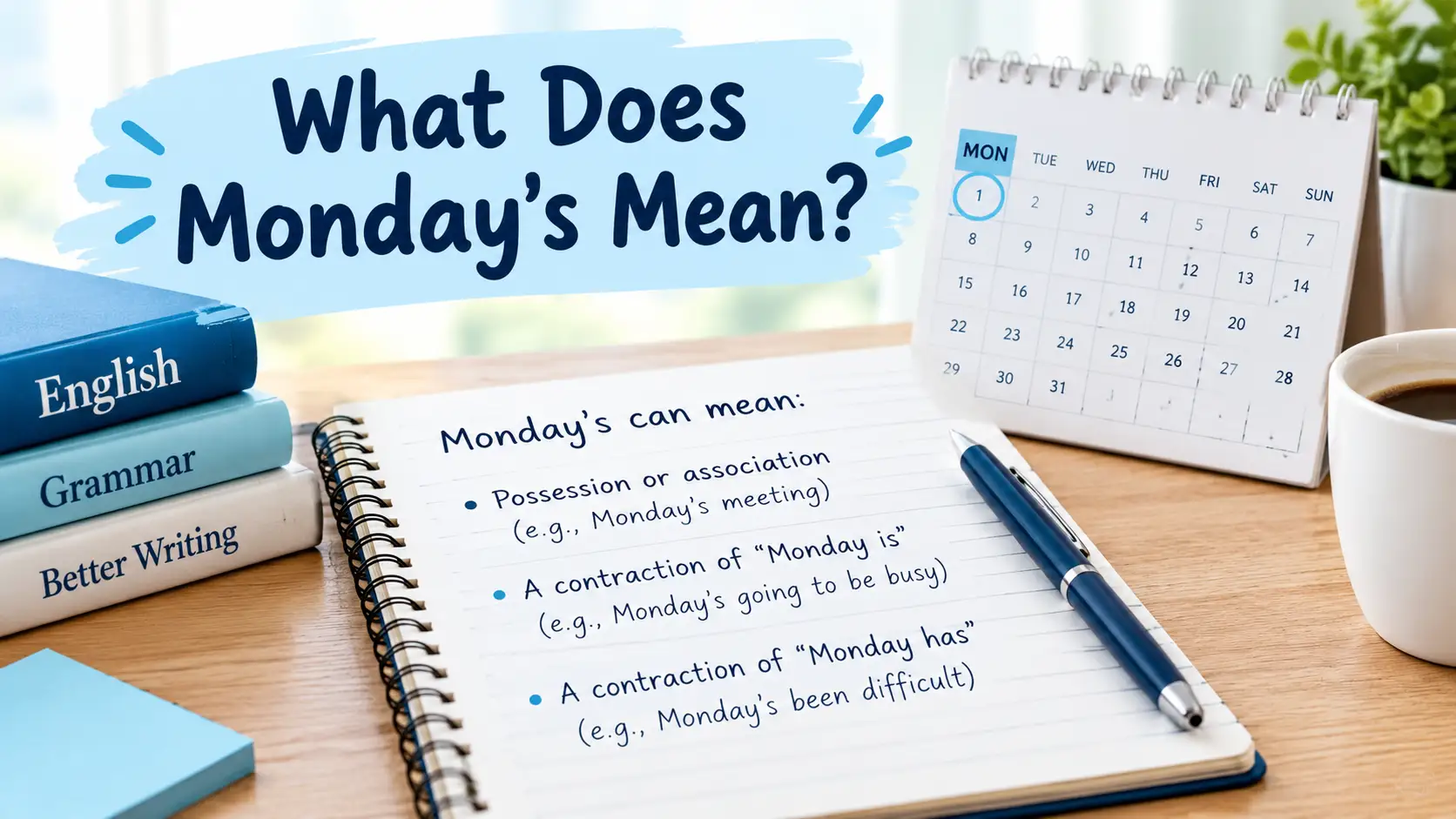
Monday’s is the possessive form of Monday or a contraction of certain phrases. Its meaning depends on the words around it.
First, Monday’s can show that something belongs to, happens on, or is associated with a particular Monday.
For example:
- Monday’s meeting was very helpful.
- Monday’s weather looks pleasant.
- Monday’s homework is easy.
- Monday’s schedule has changed.
- Monday’s lesson was interesting.
In these sentences, the apostrophe shows a relationship between Monday and another noun. The meeting is associated with Monday, the homework is assigned for Monday, and the schedule belongs to or applies to Monday.
Second, Monday’s can be a contraction.
For example, “Monday’s going to be busy” means “Monday is going to be busy.”
Similarly, “Monday’s been difficult” means “Monday has been difficult.”
The surrounding words help you understand which meaning is intended. If Monday’s appears before a noun, it often shows possession or association. If it appears before a phrase such as “going to be,” it may stand for “Monday is.”
Grammar Rules for Mondays or Monday’s
The main grammar rule is simple: use an apostrophe only when the sentence requires possession or a contraction.
When you want to talk about repeated events, use Mondays. When you want to connect a particular Monday to a meeting, deadline, schedule, or other thing, use Monday’s.
Consider these examples:
| Sentence | Correct form | Why? |
| I exercise every __ _. | Mondays | It describes a weekly habit. |
| The ___ meeting was canceled. | Monday’s | It refers to a meeting associated with Monday. |
| ___ are usually busy at work. | Mondays | It refers to Mondays in general. |
| ___ going to be a long day. | Monday’s | It means “Monday is.” |
| I enjoy quiet ___ . | Mondays | It refers to multiple Mondays. |
| The ___ deadline has changed. | Monday’s | It refers to a deadline associated with Monday. |
These examples show that the correct form depends on the sentence, not on how the word sounds.
One useful trick is to remove the apostrophe mentally and see If the sentence is talking about a repeated day. If it is, Mondays is probably the right choice. If the sentence shows ownership or can be expanded into “Monday is” or “Monday has,” Monday’s may be correct.
However, always read the complete sentence before making your decision.
When Should You Use Mondays?
Use Mondays when talking about regular activities, repeated events, or more than one Monday.
This form is especially common when describing routines. Words such as “every,” “most,” “many,” and “on” often appear in sentences that use the plural form.
For example, “I work from home on Mondays” describes a repeated routine. It does not refer to one specific Monday.
Here are several situations where Mondays is the correct choice.
Weekly routines: “We attend a team meeting on Mondays.”
School schedules: “The library is closed on Mondays.”
Work habits: “My busiest days are Mondays and Fridays.”
Personal preferences: “I dislike early mornings on Mondays.”
General observations: “Mondays can feel stressful after a relaxing weekend.”
In each example, Mondays refers to a repeated day or a general group of Mondays.
You can also use Mondays when comparing days of the week.
For example, “Mondays are busier than Thursdays at our office.” This sentence compares two types of days based on a regular pattern.
Do not add an apostrophe just because the word appears near another noun. The purpose of the word matters more than its position.
For instance, “Monday meetings” and “Monday’s meeting” can both be correct, but they have slightly different meanings.
“Monday meetings” can describe meetings that take place on Mondays in general. “Monday’s meeting” usually refers to one particular meeting associated with a specific Monday.
When Should You Use Monday’s?
Use Monday’s when you need the possessive form or a contraction.
The possessive form is useful when you want to connect Monday with something happening that day. The contraction is useful in informal writing when “Monday is” or “Monday has” can be shortened.
Here are the main uses.
To describe a meeting: “Monday’s meeting starts at 10 a.m.”
To describe a deadline: “Monday’s deadline gives us enough time to prepare.”
To describe a schedule: “Monday’s schedule includes three appointments.”
To describe weather: “Monday’s weather may affect our travel plans.”
To shorten “Monday is”: “Monday’s going to be exciting.”
To shorten “Monday has”: “Monday’s been exhausting.”
The first four examples use the possessive form. The last two use contractions.
In formal writing, you may prefer to write “Monday is going to be exciting” instead of “Monday’s going to be exciting.” Both forms can be grammatically correct, but the full form is often clearer in formal reports and professional documents.
It is also important to understand that Monday’s does not always mean literal ownership. A meeting cannot own Monday. Instead, the apostrophe connects the meeting to that day.
For this reason, some grammar guides describe this use as a possessive or genitive form that indicates a relationship or association.
Mondays vs. Monday’s: Real-Life Examples
Seeing the two forms in everyday situations makes the difference easier to understand.
Imagine that you work in an office and have a regular meeting every week.
You could write, “We have meetings on Mondays.” This tells readers that the meetings happen repeatedly.
However, if you are talking about one meeting scheduled for a particular Monday, you could write, “Monday’s meeting has been moved to the afternoon.”
The first sentence uses the plural form. The second uses the possessive form.
Here are more comparisons:
| With Mondays | With Monday’s |
| Mondays are busy at my office. | Monday’s workload is heavy. |
| I study English on Mondays. | Monday’s English lesson was helpful. |
| We travel on Mondays. | Monday’s trip was enjoyable. |
| Mondays make me feel productive. | Monday’s plan looks promising. |
| Our shop opens early on Mondays. | Monday’s opening time is 8 a.m. |
Notice how the meaning changes in each pair. The plural form describes repeated days or general experiences. The possessive form connects something to one Monday.
You can use both forms in the same paragraph without any problem.
For example: “Mondays are usually busy at our office. However, Monday’s meeting was canceled this week, so we had more time to finish our work.”
This paragraph is grammatically correct because each form serves a different purpose.
Monday’s as a Contraction of Monday Is or Monday Has
One of the most confusing parts of this topic is that Monday’s can represent two different contractions.
It can mean “Monday is.”
For example:
- Monday’s going to be sunny.
- Monday’s a good day to start.
- Monday’s too busy for another appointment.
The expanded versions are “Monday is going to be sunny,” “Monday is a good day to start,” and “Monday is too busy for another appointment.”
Monday’s can also mean “Monday has” when the sentence structure allows it.
For example:
- Monday’s been stressful.
- Monday’s brought several new challenges.
- Monday’s already passed.
These mean “Monday has been stressful,” “Monday has brought several new challenges,” and “Monday has already passed.”
A useful way to check the contraction is to replace Monday’s with “Monday is” or “Monday has.” If the sentence still makes sense, the contraction is likely correct.
For example, “Monday’s meeting starts at nine” does not normally mean “Monday is meeting starts at nine.” Therefore, Monday’s is possessive in this sentence.
However, “Monday’s going to be busy” works as “Monday is going to be busy.”
This simple replacement test is helpful when editing emails, articles, and social media posts.
Common Mistakes When Using Mondays or Monday’s
Even confident writers sometimes use the wrong form because the words sound alike. Fortunately, most mistakes are easy to fix once you understand the rule.
Mistake 1: Using Monday’s for a weekly habit
Incorrect: I go shopping on Monday’s.
Correct: I go shopping on Mondays.
Why? The sentence describes a repeated activity. There is no possession or contraction, so the apostrophe is unnecessary.
Mistake 2: Forgetting the apostrophe in a possessive phrase
Incorrect: Mondays meeting starts at noon.
Correct: Monday’s meeting starts at noon.
Why? The sentence refers to a meeting associated with one Monday. The apostrophe shows that relationship.
Mistake 3: Using Mondays to describe one specific day
Incorrect: Mondays schedule has changed.
Correct: Monday’s schedule has changed.
Why? The sentence describes a schedule associated with a particular Monday, not multiple Mondays.
Mistake 4: Assuming every apostrophe means ownership
Incorrect: Monday’s are my favorite days.
Correct: Mondays are my favorite days.
Why? The sentence describes Mondays in general. It does not show possession, and it does not contain a contraction.
Mistake 5: Confusing a plural with a possessive
Incorrect: I prefer Mondays weather.
Correct: I prefer Monday’s weather.
Why? The sentence refers to the weather associated with Monday. The apostrophe is needed.
A good editing habit is to check every apostrophe in your writing. Ask If it shows possession or replaces missing letters. If neither explanation fits, you may need the plural form instead.
Is Mondays or Monday’s Correct in American English?
Both forms are correct in American English, but they are used for different purposes. The same basic distinction applies in British English.
In the United States, people commonly write “I work on Mondays” to describe a regular work schedule. They write “Monday’s appointment” to identify an appointment associated with a particular Monday.
British English follows the same standard distinction:
- “I work on Mondays.”
- “Monday’s appointment is at noon.”
There is no special American rule that removes the apostrophe from Monday’s or adds one to Mondays.
Capitalization is another important point. The names of days are capitalized in standard English, so write Monday, Mondays, and Monday’s—not monday, mondays, or monday’s in ordinary sentences.
The correct choice is based on meaning and grammar, rather than on which variety of English you use.
Tips for Remembering the Difference
If you often confuse Mondays and Monday’s, use these easy tips when writing.
Tip 1: Look for a repeated habit. If the sentence describes something that happens every week, Mondays is usually the right choice.
Example: “I publish new articles on Mondays.”
Tip 2: Look for a noun connected to one day. If you are referring to a particular meeting, deadline, schedule, or event, Monday’s may be appropriate.
Example: “Monday’s deadline is approaching.”
Tip 3: Try expanding the contraction. Replace Monday’s with “Monday is” or “Monday has.”
Example: “Monday’s going to be busy” becomes “Monday is going to be busy.”
Tip 4: Remove unnecessary apostrophes. Apostrophes do not normally form plurals in English.
Example: “I enjoy Mondays” is correct, while “I enjoy Monday’s” is incorrect in this context.
Tip 5: Read the whole sentence aloud. Listening to the meaning can help you identify If you are describing repeated Mondays, referring to a specific day, or shortening a phrase.
These checks take only a few seconds. With practice, choosing between the two forms becomes much easier.
Frequently Asked Questions About Mondays or Monday’s
1. Is it Mondays or Monday’s?
Both are correct, depending on the meaning. Use Mondays for repeated days or more than one Monday. Use Monday’s to show possession or as a contraction of “Monday is” or “Monday has.”
2. Should I write every Monday or every Mondays?
Write “every Monday.” The word “every” is followed by a singular noun. For example, “I exercise every Monday.”
3. Is “on Mondays” grammatically correct?
Yes. “On Mondays” is correct when describing a repeated activity or routine. For example, “We have English classes on Mondays.”
4. Is Monday’s meeting correct?
Yes. “Monday’s meeting” is correct when referring to a meeting associated with a particular Monday. The apostrophe indicates the relationship between the day and the meeting.
5. Can Monday’s mean Monday is?
Yes. For example, “Monday’s going to be busy” means “Monday is going to be busy.” The contraction is common in informal writing and conversation.
6. Do I need an apostrophe in Mondays?
No, not when you are simply making Monday plural. Write “Mondays are busy” or “I work on Mondays.” Use the apostrophe only when possession or a contraction is intended.
Conclusion: Mondays or Monday’s
Understanding the difference between Mondays and Monday’s is a simple way to improve your English grammar. Although the two forms sound alike, they have different meanings and uses.
Use Mondays when talking about repeated activities, weekly habits, or more than one Monday. For example, “I study English on Mondays” describes a regular routine.Use Monday’s when showing possession or association, as in “Monday’s meeting,” or when shortening “Monday is” or “Monday has,” as in “Monday’s going to be busy.”
When you are unsure, check the meaning of the complete sentence. Ask yourself If you are describing a repeated day, connecting something to a particular Monday, or using a contraction.With a little practice, you will learn to choose the correct form naturally. Remember the main rule: Mondays means more than one Monday, while Monday’s shows possession or a contraction.

Fazal Abbas
Fazal Abbas is a passionate English grammar writer with over 2 years of experience creating clear, helpful, and easy-to-understand grammar content. He specializes in confusing words, common grammar mistakes, word usage, sentence structure, and practical English tips.
With a simple teaching style, Fazal explains difficult grammar topics in easy English that students, writers, and everyday learners can understand. His goal is to make English grammar less confusing and more useful in real-life communication.
Through GrammarBook, Fazal shares practical examples, clear explanations, and useful tips to help readers improve their English with confidence. He believes that learning grammar should be simple, friendly, and enjoyable.