If you have ever paused mid-sentence wondering If to type “more so” or “moreso,” you are not alone. This is one of those tricky word pairs that trips up even experienced writers.
Spell checkers do not always flag it, and because it sounds like one smooth word when spoken aloud, many people assume it should be written that way too.
In this article, you will learn exactly why “more so” is the correct choice, how to use it properly in a sentence, what mistakes to avoid, and how to remember the rule for good. By the end, you will never second-guess this phrase again.
Quick Answer
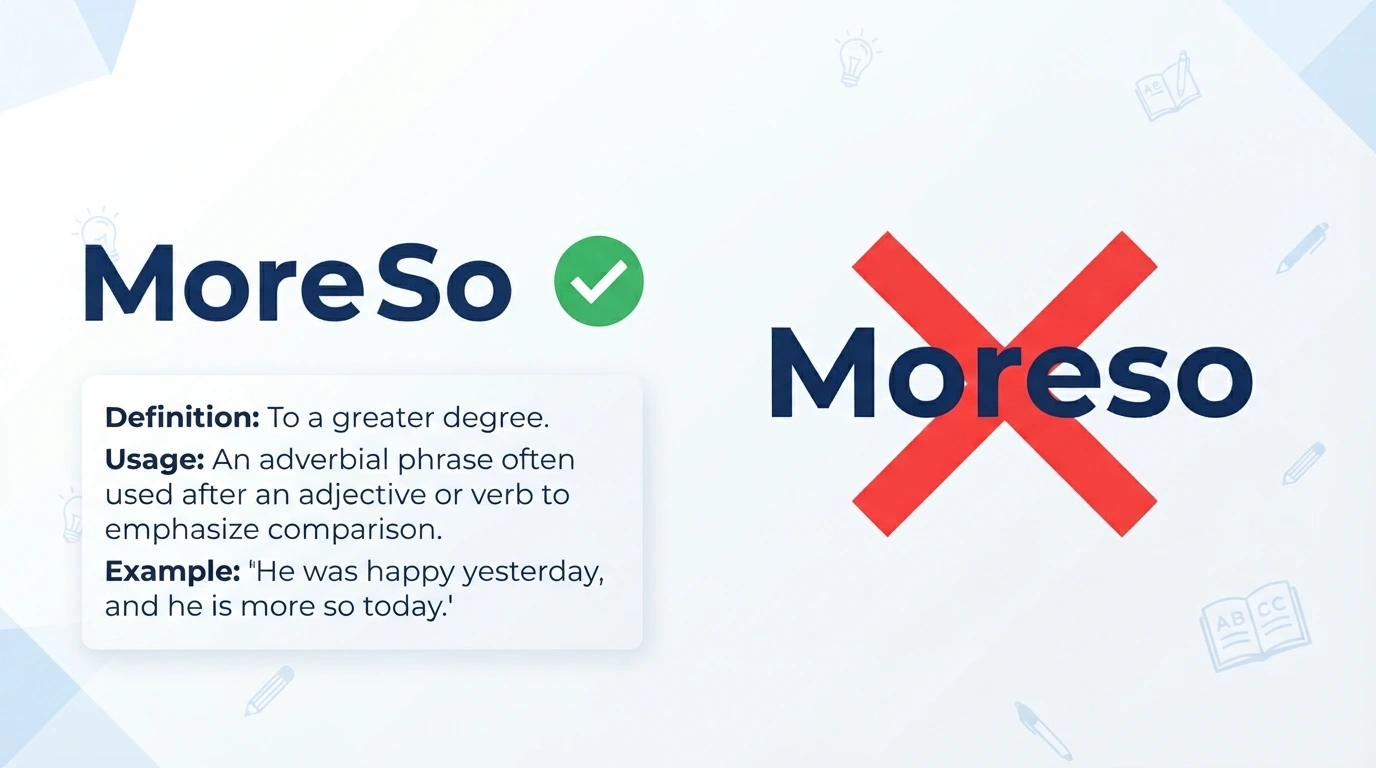
The correct form is “more so”, written as two separate words. “Moreso” is a common misspelling that has crept into casual writing, but it is not recognized as standard English by major dictionaries or style guides.
If you want to sound polished in an email, essay, or article, always write “more so” as two words.
Meaning or Definition
“More so” is a phrase, not a single word. It combines the word “more,” which shows a greater degree or amount, with “so,” which refers back to something already mentioned. Together, “more so” means “to a greater extent” or “even more than before.”
For example:
- “I was nervous about the interview, but I am more so now that it is tomorrow.”
- “She loves reading, and her sister is more so.”
In both examples, “more so” points back to an idea already stated and adds emphasis to it. This is exactly why it functions as two words instead of one. Each word carries its own grammatical job. “More” is an adverb showing degree, and “so” is a pronoun-like word standing in for the earlier idea. When two words each do separate work in a sentence, English almost always keeps them apart.
Grammar or Correct Usage
Understanding the grammar behind “more so” makes the spelling rule much easier to remember. Here is how it works.
“More” is a comparative adverb. It tells you that something is happening to a greater degree. “So” is a substitute word that replaces something mentioned earlier in the sentence, similar to how “it” or “that” can stand in for a noun. When you combine them, you get a phrase that says, “This is true to an even greater degree than what was just described.”
Because “more so” is built from two separate grammatical pieces, it should never be squeezed into a single word. Compare this to phrases like “in fact” or “at least.” These are also made of two words that work together, and no one would write them as “infact” or “atleast” in formal writing (even though “infact” is another common typo online).
Here is a simple table showing how “more so” typically appears in sentences:
| Sentence Pattern | Example |
| Statement + “more so” + reason | He was tired, more so because he had not slept well. |
| Statement + “even more so” | She is talented, and her brother is even more so. |
| “more so than” comparison | I enjoy hiking more so than swimming. |
Notice that “more so” often appears near the end of a sentence or clause, reinforcing a point that was just made. This placement is another clue that it is a phrase built from two functioning words, not a single adjective or adverb.
Common Mistakes
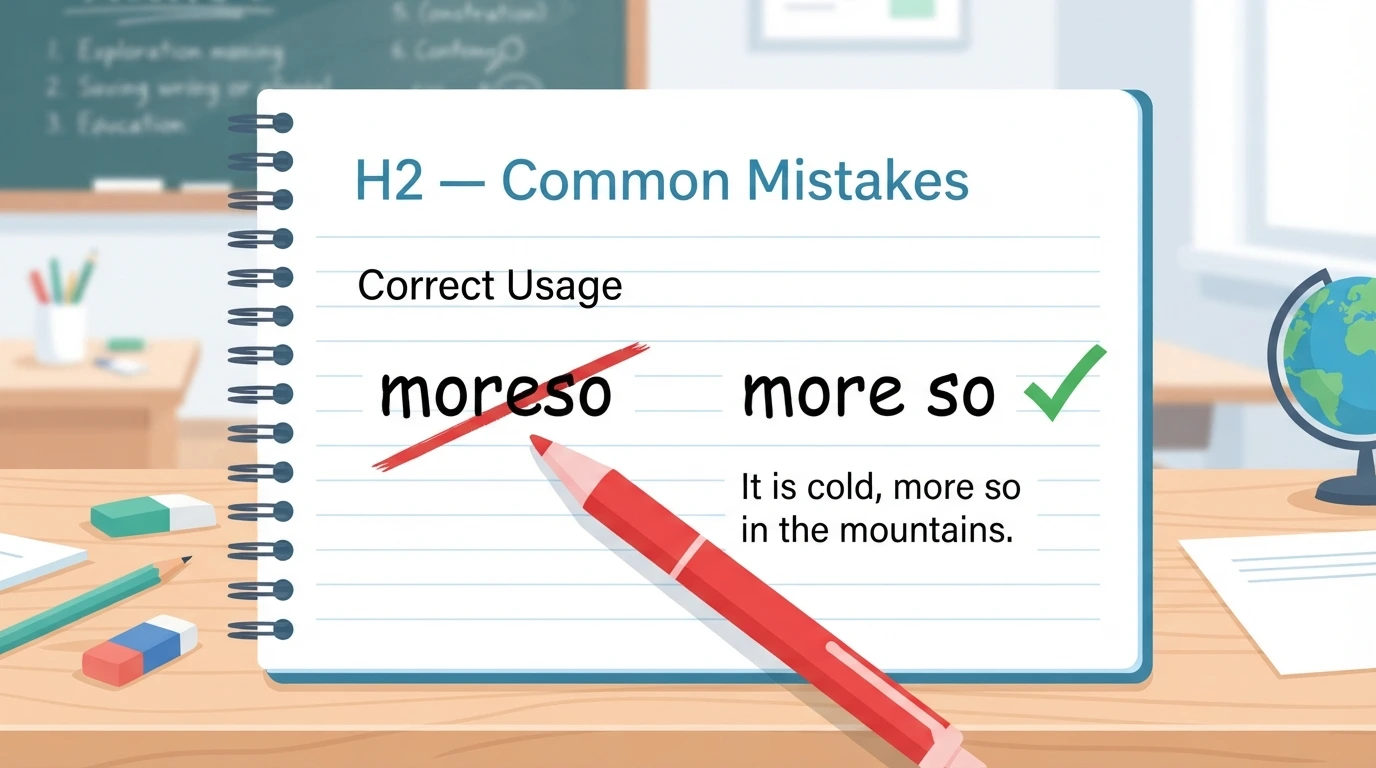
Even careful writers slip up with “more so.” Here are the most common mistakes people make, along with how to fix them.
Mistake 1: Writing it as one word (“moreso”).
This is by far the most frequent error. Because the phrase is often spoken quickly, it can sound like a single word. But written English keeps “more” and “so” apart.
Incorrect: “I like tea, moreso than coffee.”
Correct: “I like tea, more so than coffee.”
Mistake 2: Using “more so” when a simple “more” would work better.
“More so” should refer back to something already stated. If there is nothing earlier in the sentence for “so” to point to, plain “more” is usually the better choice.
Weak: “I need more so information.”
Better: “I need more information.”
Mistake 3: Confusing “more so” with “moreover.”
“Moreover” is a transition word meaning “in addition” or “furthermore.” It introduces a new point. “More so” instead intensifies a point already made. These two words are not interchangeable.
Incorrect: “The report was late. More so, it contained errors.”
Correct: “The report was late. Moreover, it contained errors.”
Mistake 4: Overusing “more so than” as a stiff comparison.
While grammatically correct, “more so than” can sound formal or clunky in casual writing. Often a simpler comparative works just as well.
Formal: “I enjoy running more so than cycling.”
Simpler: “I enjoy running more than cycling.”
Real-Life Examples
Seeing “more so” used correctly in everyday context can help the rule stick. Here are several natural examples.
- Work email: “The client was pleased with the first draft, but they were more so with the final version.”
- Casual conversation: “I was excited before the trip, and I am even more so now that we are almost there.”
- Academic writing: “The results support the original theory, more so than the alternative explanation.”
- Social media caption: “Grateful for this community, more so during hard times like these.”
- Product review: “The upgraded model performs well, more so in low-light conditions than the older version.”
In each case, “more so” refers back to a quality or feeling already introduced earlier in the sentence, then adds emphasis. This backward-pointing function is the heart of what makes the phrase work.
Current Usage or Trends

Language changes over time, and it is fair to ask If “moreso” might eventually become accepted as an alternative spelling, the way some compound words evolve from two words into one (think “today,” which used to be written “to day”). As of now, however, major dictionaries, including Merriam-Webster and Oxford, do not list “moreso” as a standard variant. It appears occasionally in informal writing, text messages, and social media posts, but professional style guides, news organizations, and academic publications consistently use “more so.”
Search engine data also shows that many people type “moreso” out of habit or uncertainty, which is exactly why clarifying this topic matters. If you are writing for a blog, resume, school assignment, or business communication, sticking with “more so” protects your credibility and keeps your writing consistent with accepted standards.
Tips or Best Practices
Here are some simple ways to make sure you always get this phrase right.
- Remember that “so” is doing a job in the sentence. It is standing in for something you already said. If you can mentally replace “so” with the full idea it refers to, you know it needs to stay a separate word.
- Read your sentence aloud and pause slightly between “more” and “so.” If the pause feels natural, that is a sign the words belong apart.
- Use your word processor’s find-and-replace tool to search for “moreso” before submitting important documents, then swap it for “more so.”
- When in doubt, try replacing “more so” with “even more” or “to a greater degree.” If the sentence still makes sense, “more so” is likely the right choice, written as two words.
- Keep “moreover” and “more so” separate in your mind. “Moreover” adds a new idea. “More so” strengthens an idea you already gave.
Here is a quick comparison table to keep these related words straight:
| Word or Phrase | Meaning | Example |
| More so | To a greater degree (refers back) | She is kind, more so than her coworkers. |
| Moreover | In addition, furthermore | The plan is costly. Moreover, it is risky. |
| Even more so | Stronger emphasis version of “more so” | He was proud before, even more so now. |
| More than | Basic comparison | I trust her more than him. |
FAQs
Is “moreso” ever correct?
No. “Moreso” is considered a misspelling in standard English. The correct and widely accepted form is always “more so,” written as two separate words.
Why do so many people write “moreso” by mistake?
Because the phrase is often spoken quickly and blends together in casual speech, it sounds like one word. Spell checkers also do not always catch the error since “moreso” resembles other legitimate compound words.
Can I use “more so” to start a sentence?
It is uncommon and can sound awkward. “More so” typically works best when it refers back to something already mentioned earlier in the same sentence or the previous one, so starting fresh with it usually needs rewording.
What is the difference between “more so” and “moreover”?
“More so” intensifies or emphasizes a point already made. “Moreover” introduces an additional, related point. They serve different grammatical purposes and are not interchangeable.
Is “more so” formal or informal?
“More so” fits comfortably in both formal and informal writing. It works well in academic papers, business communication, and everyday conversation alike.
How can I quickly check my writing for this mistake?
Use the find-and-replace function in your word processor to search for “moreso” before finalizing any document. This catches the error instantly so you can correct it to “more so.”
Conclusion
The takeaway here is simple: “more so” is always written as two words, never combined into “moreso.” This small phrase carries real grammatical weight, with “more” showing degree and “so” referring back to an idea you already introduced.
Mixing them into one word breaks that structure and signals a spelling error to careful readers.
Next time you want to emphasize that something is true to an even greater extent, reach for “more so,” write it as two words, and read your sentence back to make sure “so” is genuinely pointing to something you said earlier. With this rule in mind, you will write with more confidence, and your readers will notice the polish.

Fazal Abbas
Fazal Abbas is a passionate English grammar writer with over 2 years of experience creating clear, helpful, and easy-to-understand grammar content. He specializes in confusing words, common grammar mistakes, word usage, sentence structure, and practical English tips.
With a simple teaching style, Fazal explains difficult grammar topics in easy English that students, writers, and everyday learners can understand. His goal is to make English grammar less confusing and more useful in real-life communication.
Through GrammarBook, Fazal shares practical examples, clear explanations, and useful tips to help readers improve their English with confidence. He believes that learning grammar should be simple, friendly, and enjoyable.