If you are wondering about kneck or neck, the correct spelling is neck. Kneck is a misspelling and is not the standard spelling of the English word. Neck is the body part that connects your head to your shoulders, and it is also used in several common expressions and phrases.
Quick Answer
The correct word is neck, not kneck.
Neck is the standard English spelling for the part of the body between your head and shoulders.
For example:
My neck hurts after sleeping in an uncomfortable position.
Kneck is an incorrect spelling. Although some people may type kneck because the k sound is heard in other words such as knee or knock, the word neck does not begin with a silent k.
| Word | Correct? | Meaning |
| Neck | Yes | The part of the body connecting the head and shoulders |
| Kneck | No | A common misspelling of neck |
The easiest rule is simple:
Always spell it N-E-C-K: neck.
What Does Neck Mean?

Neck is a noun that usually refers to the part of the body connecting the head to the rest of the body.
For example:
- She wore a scarf around her neck.
- My neck feels stiff this morning.
- He turned his neck to look behind him.
The neck contains important structures, including bones, muscles, blood vessels, nerves, and parts of the airway and digestive system.
In everyday English, however, you usually do not need to think about anatomy to use the word correctly. You can simply use neck when talking about the body part.
The word can also have other meanings. For example, the narrow part of a bottle is called its neck:
- The bottle has a long neck.
The narrow part of some musical instruments, such as a guitar, can also be called the neck:
- He held the guitar by its neck.
So, neck can describe a narrow connecting part, not just the human body part.
Why Is Neck Correct and Kneck Wrong?
The spelling neck comes from the standard English spelling of the word. There is no silent k at the beginning.
This can be confusing because English has several words that begin with kn, where the k is silent.
For example:
- knee
- knife
- knock
- know
- knot
- knock
In these words, the k is written but not pronounced.
Because of this pattern, someone may incorrectly think that neck should be spelled kneck.
But neck does not follow the kn- spelling pattern.
The correct spelling is:
N-E-C-K
Not:
K-N-E-C-K
And not:
K-N-E-C-K or KNECK.
The standard English word is simply neck.
Is Kneck a Word?
In standard modern English, kneck is not the normal spelling of the body part.
If you write kneck in an essay, email, school assignment, article, or professional document, it will generally be treated as a spelling mistake.
The correct form is neck.
For example:
Incorrect: I have pain in my kneck.
Correct: I have pain in my neck.
Incorrect: She wore a necklace around her kneck.
Correct: She wore a necklace around her neck.
Incorrect: He hurt his kneck while playing football.
Correct: He hurt his neck while playing football.
When checking your writing, replace kneck with neck.
How to Spell Neck Correctly

The spelling is very short:
N-E-C-K
You can break it into the sounds:
neck
The word begins with the letter N, not KN.
A useful way to practice is to write a few common words containing neck:
- neck
- necktie
- necklace
- neckline
- neckband
- neckwear
All of these words keep the spelling neck.
For example:
- She bought a beautiful necklace.
- He wore a red necktie.
- The shirt has a wide neckline.
Learning related words can help reinforce the correct spelling.
Neck vs. Kneck in a Sentence
The easiest way to understand the difference is to compare correct and incorrect sentences.
| Incorrect | Correct |
| My kneck hurts. | My neck hurts. |
| She touched her kneck. | She touched her neck. |
| He injured his kneck. | He injured his neck. |
| The shirt covers my kneck. | The shirt covers my neck. |
| She wore a scarf around her kneck. | She wore a scarf around her neck. |
| He turned his kneck slowly. | He turned his neck slowly. |
In every example, neck is the correct spelling.
The mistake does not change the intended meaning, but it makes the writing incorrect.
Common Mistakes With Neck
The most common mistake is adding a k before the n.
Incorrect:
Kneck
Correct:
Neck
Another mistake is confusing neck with words that have a silent k, such as knee.
For example:
- My knee hurts.
- My neck hurts.
Notice the difference.
Knee begins with kn.
Neck begins with n.
You should not copy the spelling pattern of knee and apply it to neck.
Another common mistake is confusing neck with nack or other phonetic spellings. These are not standard spellings for the body part.
The correct spelling remains neck.
Why Do People Search for Kneck or Neck?
People often search for kneck or neck because they are unsure about the spelling.
This type of question is common when a word sounds slightly different from how it looks.
English spelling can be difficult because pronunciation does not always tell you exactly which letters to write.
For example, learners may wonder whether the beginning should be:
N-E-C-K
or:
K-N-E-C-K
The answer is always neck when referring to the standard English word.
This is a spelling question rather than a difference between two words with different meanings.
That means you do not need to choose based on context. Unlike word pairs such as accept and except, only neck is the standard spelling for this meaning.
Neck and Knee: Why the Spellings Are Different
The words neck and knee are both body-part words, but their spelling patterns are different.
Neck starts with N.
Knee starts with KN, with a silent K.
Compare:
- neck
- knee
The first letters are different even though both words refer to parts of the upper body.
You may also know other kn- words:
- knife
- knock
- know
- knit
- knot
These words have a silent k.
But neck is not part of that group.
A helpful spelling habit is to memorize the complete word instead of trying to predict the spelling from similar words.
Neck in Everyday English
The word neck is very common in everyday English.
You may hear it in conversations about clothing, health, sports, animals, furniture, and many other topics.
For example:
- My neck is sore.
- He turned his neck.
- She wore a scarf around her neck.
- The collar is tight around my neck.
- He has a long neck.
- The necklace was around her neck.
Because the word is so common, learning its correct spelling is useful for both speaking and writing.
Common Expressions With Neck
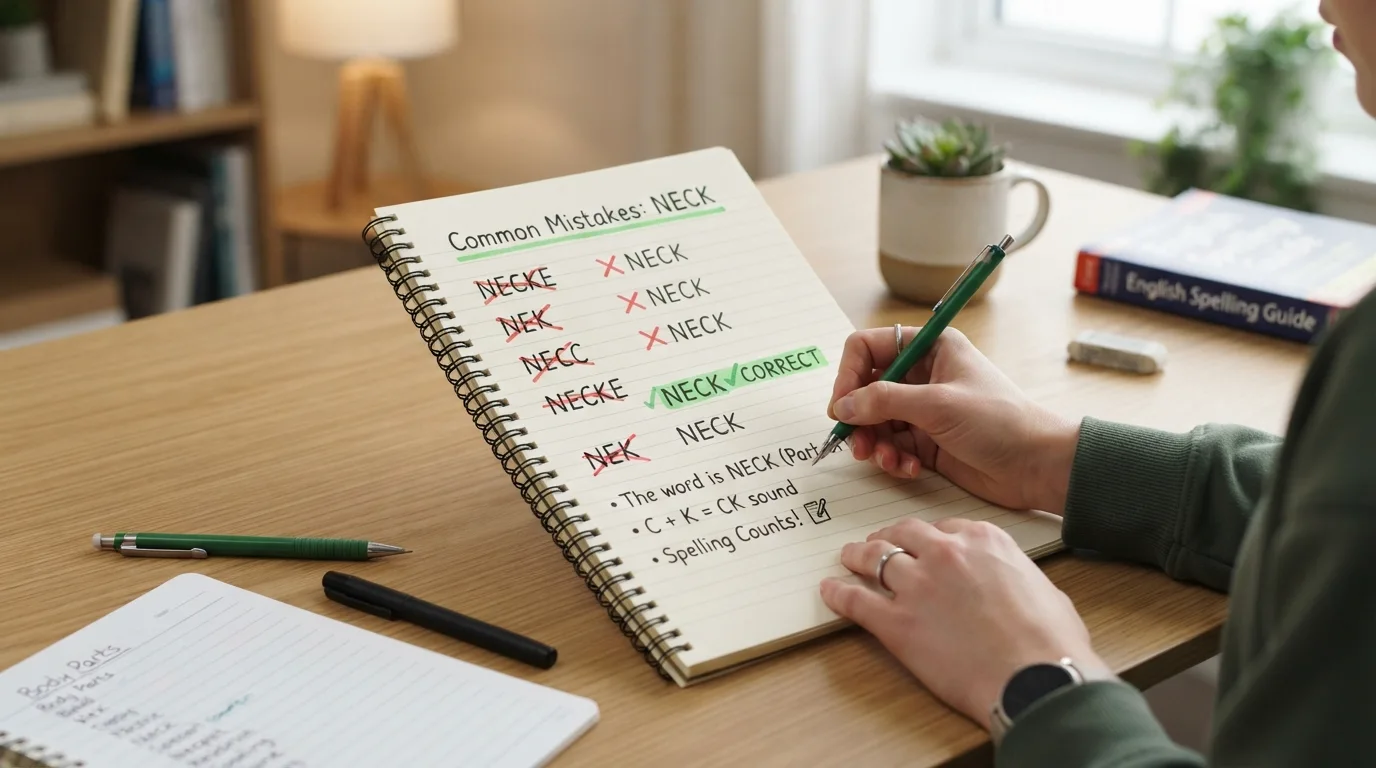
Neck also appears in many common English expressions.
One familiar expression is “neck and neck.”
When two people or teams are neck and neck, they are very close in a competition.
For example:
- The two runners were neck and neck near the finish line.
This means neither runner had a clear advantage.
Another expression is “stick your neck out.”
This means to take a risk or put yourself in a difficult position.
For example:
- I am sticking my neck out by recommending this plan.
There is also “save your neck,” which means to protect yourself from trouble or danger.
For example:
- He blamed someone else to save his neck.
These expressions use neck in a figurative way, but the spelling is still neck.
Neck in Clothing
The word neck is also important when talking about clothing.
A neckline is the shape or edge of a piece of clothing around the neck.
For example:
- The dress has a round neckline.
A necktie is a type of tie worn around the neck, especially with a shirt.
For example:
- He wore a blue necktie to work.
You may also hear:
- high neck
- low neckline
- neck warmer
- neck scarf
- neckband
All of these words are based on neck, not kneck.
Neck in Animals
The word neck is not limited to humans.
We also use it to describe the area between an animal’s head and body.
For example:
- The giraffe has a very long neck.
- The horse moved its neck.
- The bird stretched its neck.
This is another common use of the word.
The spelling remains the same:
neck
You would never normally spell it kneck when describing an animal.
Neck as a Connecting Part
English also uses neck to describe a narrow part that connects one section to another.
For example, a bottle may have a narrow upper section called its neck.
You can say:
- The bottle has a long neck.
Musical instruments can also have a neck.
For example:
- The guitarist placed his hand on the neck of the guitar.
In geography, neck can sometimes describe a narrow strip of land connecting larger areas.
These meanings all share a basic idea: a narrow connecting section.
Neck in Medical and Health Writing
In medical and health writing, neck is also the standard term for the area between the head and torso.
You may see phrases such as:
- neck pain
- neck stiffness
- neck muscles
- neck injury
- neck strain
- neck movement
For example:
- Poor posture can contribute to neck discomfort.
If you are writing about health, always spell the word neck.
If a person has a serious neck injury, especially after a major accident, it is important not to move the person’s neck unnecessarily and to seek emergency medical help.
The spelling question itself is simple, but the word appears frequently in health information, so using the correct spelling matters.
Neck or Kneck: Pronunciation
The pronunciation of neck is straightforward.
It is pronounced approximately like:
nek
The k sound comes at the end of the word.
The spelling is:
N-E-C-K
The final k is pronounced.
This is different from words such as knee, where the initial k is silent.
Compare:
neck → the k is at the end and pronounced.
knee → the k is at the beginning and silent.
This pronunciation difference can help you remember the spelling.
British vs. American English
There is no important spelling difference between American and British English for neck.
In both varieties, the standard spelling is:
neck
You do not normally write kneck in either American or British English.
The word has the same basic meaning in both forms of English.
For example:
American English: My neck hurts.
British English: My neck hurts.
The spelling stays the same.
Neck in Compound Words
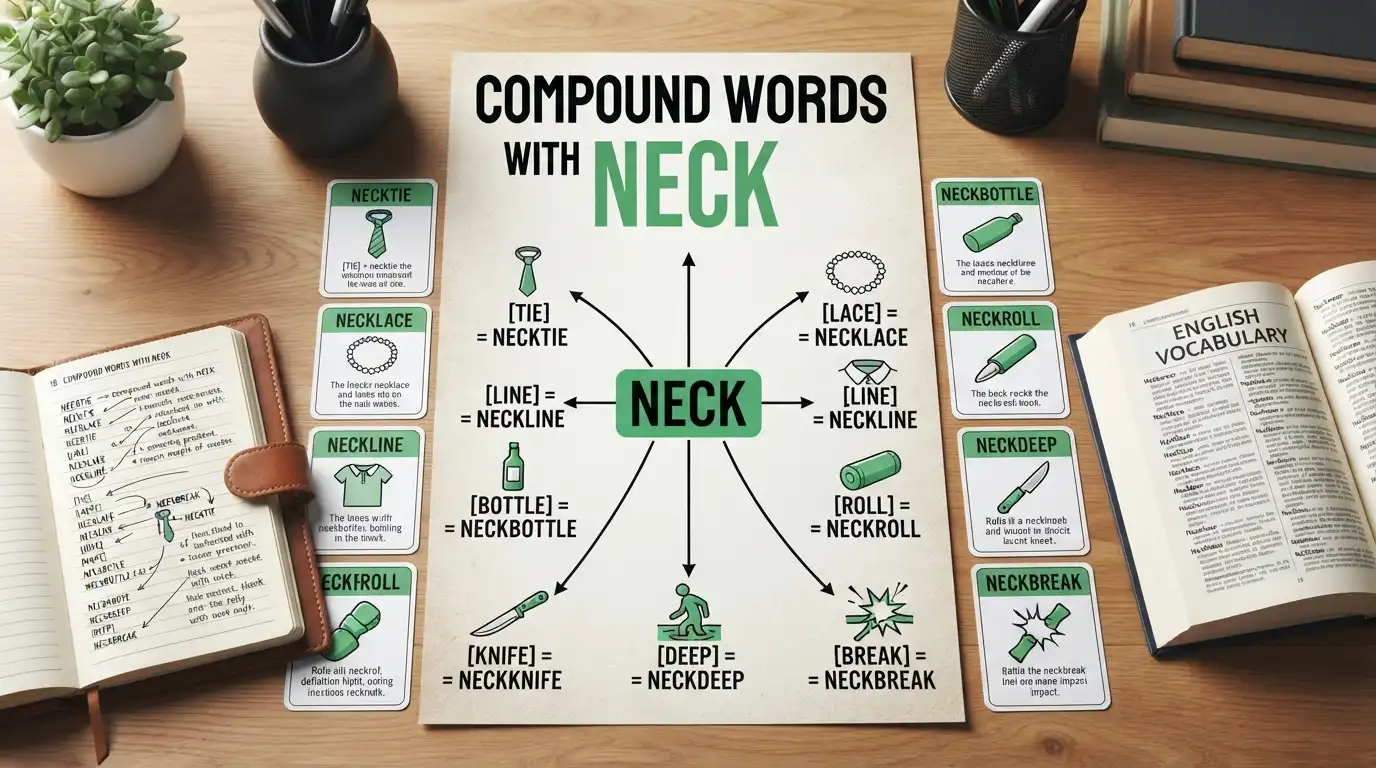
A compound word combines neck with another word to create a related term.
Some common examples include:
- necklace
- neckline
- necktie
- neckwear
- neckband
- neckwear
- neckcloth
These words all begin with neck, not kneck.
For example:
- She received a necklace as a gift.
- The shirt has a narrow neckline.
- He wore a necktie to the wedding.
Learning these related words can make the correct spelling easier to remember.
A Simple Memory Trick for Neck
Here is an easy way to remember the spelling:
Neck starts with N, just like “neck.”
Do not add K before the N.
You can also remember:
K comes at the end of neck.
The word is:
N + E + C + K
Not:
K + N + E + C + K
Think of the word as having one K, and that K is at the end.
This is especially helpful if you often confuse neck with knee.
Remember:
knee → KN
neck → N
That small difference can prevent the spelling mistake.
Frequently Asked Questions About Kneck or Neck
Is it neck or kneck?
The correct spelling is neck. Kneck is a misspelling in standard English. When you mean the body part between the head and shoulders, always write neck.
Is kneck a real word?
Kneck is not the standard spelling of the English word for the body part. In normal English writing, use neck instead. A spelling checker will usually flag kneck as an error.
Why is neck not spelled kneck?
English spelling does not always follow the patterns of similar-sounding words. Although knee and knife begin with kn, neck begins with n. The standard spelling is neck.
How do you spell neck correctly?
The correct spelling is N-E-C-K. The word has four letters. The k comes at the end, not at the beginning.
What is the meaning of neck?
Neck usually means the part of the body connecting the head to the shoulders and torso. The word can also describe a narrow connecting part of an object, such as a bottle or guitar.
What is the plural of neck?
The plural of neck is necks. For example: The giraffes have long necks. The word simply takes -s in its plural form.
Conclusion
When choosing between kneck or neck, always use neck. The standard English spelling is N-E-C-K, with the k at the end. Kneck is a common misspelling, often caused by confusion with words such as knee, knife, and know, which begin with the silent kn pattern.
The word neck is used for the body part between the head and shoulders, but it can also describe a narrow connecting part of an object. It appears in many everyday words and expressions, including necklace, neckline, necktie, and neck and neck.
The easiest memory trick is simple: neck starts with N and ends with K. Whenever you mean this body part, write neck, not kneck. Once you remember that pattern, this spelling choice becomes easy.

Fazal Abbas
Fazal Abbas is a passionate English grammar writer with over 2 years of experience creating clear, helpful, and easy-to-understand grammar content. He specializes in confusing words, common grammar mistakes, word usage, sentence structure, and practical English tips.
With a simple teaching style, Fazal explains difficult grammar topics in easy English that students, writers, and everyday learners can understand. His goal is to make English grammar less confusing and more useful in real-life communication.
Through GrammarBook, Fazal shares practical examples, clear explanations, and useful tips to help readers improve their English with confidence. He believes that learning grammar should be simple, friendly, and enjoyable.