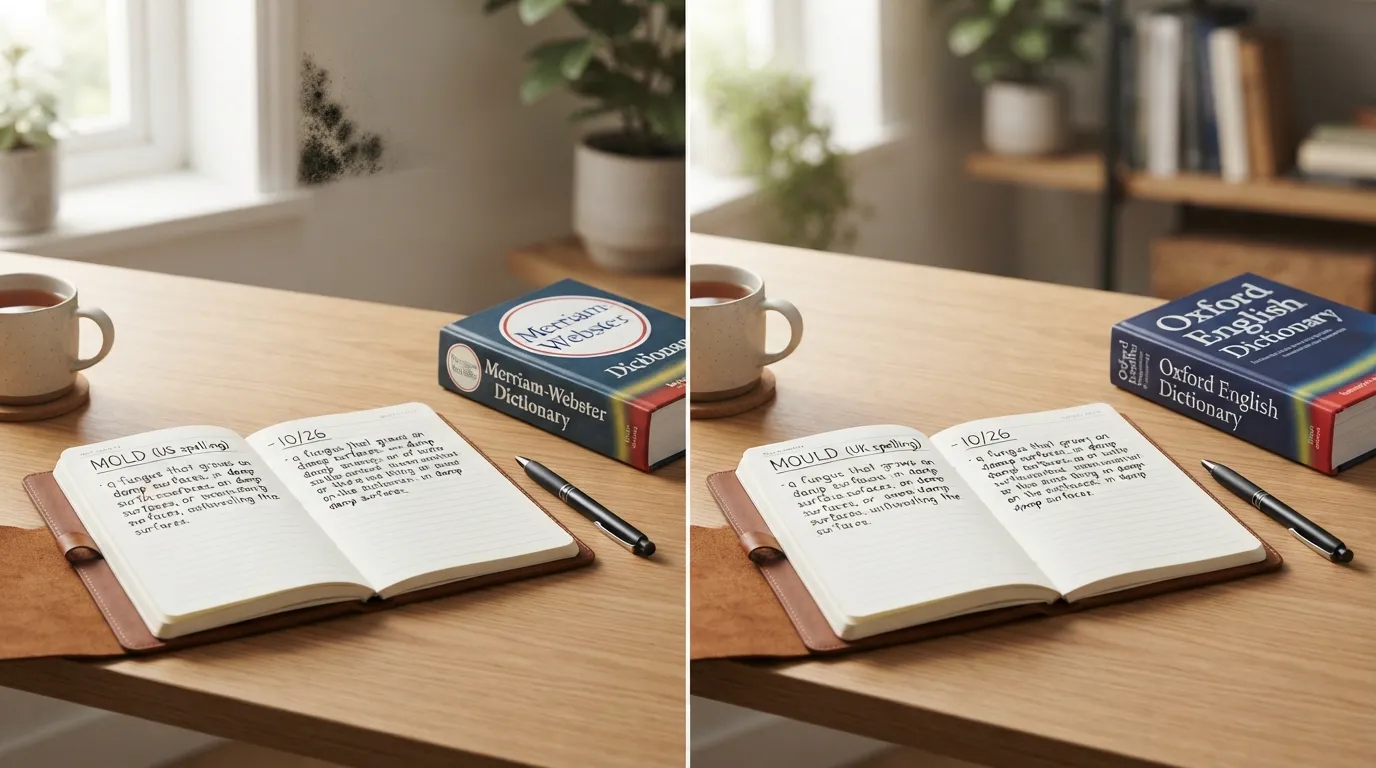
If you are wondering If mould or mold is the correct spelling, both are correct. The difference is mainly based on the type of English being used. Mold is the standard spelling in American English, while mould is commonly used in British English and several other English-speaking regions.
Both words can refer to a type of fungus that grows in damp places, or to a container or shape used to form something.
Understanding the difference is useful when writing for an American or international audience. You may see “mold” on a U.S. website and “mould” on a British website, even though both writers are talking about the same thing. In this guide, you will learn what mould or mold means, when to use each spelling, how the words are pronounced, and how to avoid common mistakes.
Quick Answer: Mould or Mold?
The short answer is simple: mold is the preferred spelling in American English, while mould is the preferred spelling in British English.
The two spellings generally have the same meaning and pronunciation. The main difference is regional spelling.
For example, an American writer would normally say, “There is mold growing on the wall.” A British writer would usually write, “There is mould growing on the wall.”
The same difference appears when the word means a form or container used to shape something. An American recipe may say, “Pour the chocolate into the mold.” A British recipe may use “mould” instead.
| Word | Common English Variety | Example |
| Mold | American English | There is mold in the bathroom. |
| Mould | British English | There is mould in the bathroom. |
| Mold | American English | Pour the mixture into the mold. |
| Mould | British English | Pour the mixture into the mould. |
So, neither spelling is automatically wrong. The best choice depends on your audience and the type of English you are using.
What Does Mould or Mold Mean?

Mould or mold has more than one meaning. The most common meaning is a type of fungus that grows on surfaces, especially when there is moisture.
You may see mold on old food, walls, ceilings, bathroom tiles, wood, or other damp materials. Mold can appear in different colors, including black, green, white, gray, or orange.
For example:
“Black mold was found near the leaking pipe.”
Here, “mold” means a fungus.
The word can also describe a hollow container or shape used to give another material a particular form. For example, a baker might pour melted chocolate into a mold to create a specific shape.
The word can also be used as a verb. To mold something means to shape it. It can describe physically shaping an object or influencing a person, idea, or situation.
For example:
“Teachers can help mold young minds.”
In this sentence, “mold” does not mean fungus. It means to influence or shape someone’s development.
| Meaning | Example | Explanation |
| Fungus | Mold grew on the damp wall. | A fungus growing on a surface |
| Container or shape | Put the clay into the mold. | A form used to shape material |
| Shape something | Heat can mold the plastic. | To give something a particular shape |
| Influence | Experiences can mold a person’s character. | To shape development or behavior |
The surrounding sentence usually makes the meaning clear.
Mould vs. Mold in American and British English
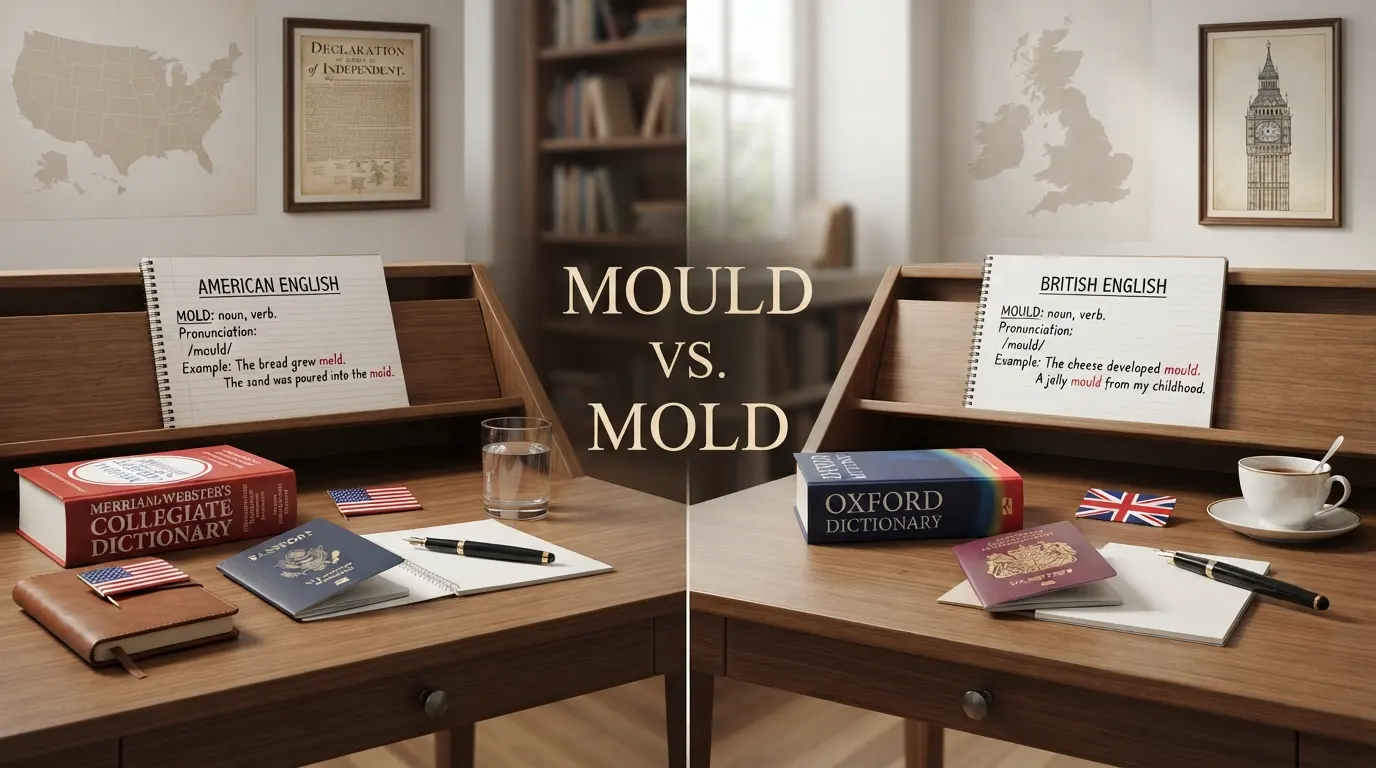
The most important difference between mould or mold is regional spelling.
American English usually removes the letter “u” from words such as “mould.” British English generally keeps it.
This pattern can also be seen in words such as “colour” and “color,” “favour” and “favor,” and “labour” and “labor.”
In the United States, mold is the standard spelling. In the United Kingdom, mould is standard.
Canada can use both patterns, although British-style spellings are common in many Canadian contexts. Other English-speaking regions may also use “mould,” depending on local language conventions.
If you are writing a website for American readers, consistency is important. Use mold throughout the article rather than switching between “mold” and “mould.”
If your website targets British readers, use mould consistently.
| Region or Style | Preferred Spelling |
| United States | Mold |
| United Kingdom | Mould |
| American English | Mold |
| British English | Mould |
| International writing | Choose one style and stay consistent |
Neither spelling changes the basic meaning. The difference is primarily spelling convention.
How Do You Pronounce Mould or Mold?

Mould and mold are pronounced the same way in standard English.
They sound like the word “mold” in American English.
The spelling can therefore be confusing for learners because the British spelling contains an extra “u,” but that letter does not create a different pronunciation.
For example:
“Mold is growing behind the cabinet.”
“Mould is growing behind the cabinet.”
When spoken aloud, the two sentences sound the same.
This is an important point for English learners. If you hear someone use the word but are not sure which spelling they use, the pronunciation will not tell you If the speaker prefers “mold” or “mould.” You need to know the person’s regional English style or see the word written down.
Grammar and Correct Usage of Mold
Mold can function as a noun or a verb in English.
As a noun, it can refer to fungus or a container used for shaping something.
For example:
“Mold can grow in areas with moisture.”
“The baker placed the mixture into a mold.”
As a verb, “mold” means to shape something.
For example:
“The artist molded the clay by hand.”
The word can also have a figurative meaning.
For example:
“Parents often help mold a child’s values.”
Here, “mold” means to influence or shape development rather than physically changing an object.
The British spelling follows the same grammatical rules, but the spelling becomes mould.
| Grammar Role | American English | British English |
| Noun: fungus | mold | mould |
| Noun: shape/container | mold | mould |
| Verb: shape | mold | mould |
| Verb: influence | mold | mould |
This makes the word fairly easy to use once you understand its meanings.
Common Mistakes With Mould or Mold

One common mistake is thinking that mould and mold have different meanings. In most everyday cases, they are simply different regional spellings.
Another mistake is mixing American and British spelling in the same piece of writing without a reason. For example, using “mold” in one paragraph and “mould” in another can make an article look inconsistent.
A third mistake is assuming that “mold” always means fungus. The word can also refer to a physical form or the act of shaping something.
Consider these examples:
“The mold on the bread should not be eaten.”
Here, “mold” means fungus.
“The artist poured the material into a mold.”
Here, “mold” means a form or container.
“The experience helped mold her personality.”
Here, “mold” is a verb meaning to influence or shape.
Context is therefore very important.
Another mistake is using the word “mold” when you actually mean “model.” A model is a representation or example, while a mold is a form used to shape something.
Real-Life Examples of Mould or Mold
Seeing the word in real sentences makes its different meanings easier to understand.
Here are several examples using American spelling:
“The homeowner noticed mold around the window.”
In this example, mold means fungus.
“The cake was made in a round mold.”
Here, the word refers to a container or form.
“The teacher helped mold her students into confident learners.”
In this sentence, “mold” is a verb that means to influence or shape.
“Moisture can create conditions where mold grows.”
Here, mold again refers to fungus.
Now consider British spelling:
“The homeowner noticed mould around the window.”
“The cake was made in a round mould.”
“The teacher helped mould her students into confident learners.”
The meaning remains essentially the same. Only the spelling changes.
Mold as a Fungus
When people talk about mold in homes, they usually mean a group of fungi that can grow in damp environments.
Mold can grow on many materials when conditions are suitable. Common locations include bathrooms, basements, kitchens, around leaking pipes, and areas affected by water damage.
Mold growth can sometimes look like spots, patches, or a fuzzy coating. It may have different colors and textures.
However, appearance alone is not always enough to identify a particular type of mold accurately.
If you discover mold in your home, controlling moisture is an important part of preventing continued growth. Fixing leaks, drying wet areas, improving ventilation, and addressing water damage can help reduce conditions that support mold growth.
People with significant concerns about indoor mold, especially after major water damage, may choose to consult an appropriate professional.
The word “mold” itself does not identify a specific species. It is a broad everyday term.
Mold as a Shape or Container
Another important meaning of mold is a form used to shape a material.
Molds are used in many industries and everyday activities.
For example, chocolate can be poured into a mold to create decorative shapes. Clay can be shaped using molds. Plastic, metal, concrete, and other materials can also be formed using different types of molds.
The idea is simple: the mold provides a particular shape, and the material takes that shape.
For example:
“The factory uses a metal mold to create the parts.”
“The baker used a heart-shaped mold.”
“The artist pressed the clay into the mold.”
In British English, these sentences would normally use mould instead.
This meaning is completely different from mold as fungus, but context makes the difference clear.
Mold as a Verb
The verb mold means to shape or influence something.
It can describe a physical action.
For example:
“The worker molded the clay into a bowl.”
It can also describe an abstract process.
For example:
“Early experiences can mold a person’s habits.”
In the second sentence, no physical object is being shaped. Instead, experiences are influencing the person’s development.
The figurative use of “mold” is common in education, personal development, leadership, parenting, and writing.
For example:
“Good teachers can mold students into independent thinkers.”
“Life experiences can mold the way people see the world.”
The British spelling is “mould” in these examples.
Mould or Mold: Which One Should You Use?
The right spelling depends on your target audience.
If you are writing for people in the United States, use mold. This is especially important for websites, school assignments, business documents, and other content intended for an American audience.
If you are writing for a British audience, use mould.
If your audience is international, either spelling can work. However, consistency is more important than switching between the two.
For an American English website, writing “mold” throughout your article will usually be the clearest choice.
For example, choose:
“Signs of Mold in Your Home”
rather than:
“Signs of Mould in Your Home”
if your website follows American English.
On the other hand, a British publication would normally write:
“Signs of Mould in Your Home.”
There is no need to treat one spelling as universally correct. English has many regional spelling differences.
How to Remember the Difference
A simple way to remember the difference is to connect mold with American English.
Think:
American English = mold
British English = mould
The British version keeps the extra “u.”
This is similar to other spelling differences:
“color” → American English
“colour” → British English
“favor” → American English
“favour” → British English
“labor” → American English
“labour” → British English
“mold” → American English
“mould” → British English
Once you recognize this spelling pattern, it becomes easier to identify which version belongs to which English variety.
Mould or Mold in Everyday Writing
The word appears in many everyday situations.
You might see it in home maintenance articles, food safety discussions, cooking instructions, manufacturing information, science lessons, or personal development writing.
For example, a home article may say:
“Check areas with high moisture for signs of mold.”
A cooking article may say:
“Grease the mold before adding the mixture.”
A manufacturing article may say:
“The material is heated before being placed into the mold.”
A personal development article may say:
“Family experiences can mold a person’s habits.”
These examples show why understanding context matters.
The spelling remains “mold” in American English even though the meaning changes.
Mould or Mold: Quick Comparison
The following table makes the main difference easy to remember.
| Question | Mold | Mould |
| Is it correct? | Yes | Yes |
| Common in American English? | Yes | No, less common |
| Common in British English? | Less common | Yes |
| Can it mean fungus? | Yes | Yes |
| Can it mean a shaping form? | Yes | Yes |
| Can it be a verb? | Yes | Yes |
| Is pronunciation different? | No | No |
The important point is that these are not two completely different English words. They are regional spelling variants with the same basic meanings.
Tips for Using Mould or Mold Correctly
First, identify your audience. If your readers are mainly American, use “mold.” If they are mainly British, use “mould.”
Second, remain consistent. Do not change spelling halfway through an article unless you are specifically discussing the difference between the two forms.
Third, look at the meaning from context. If the word describes growth on food or a wall, it probably refers to fungus. If it describes a container or form, it refers to something used to shape another material.
Fourth, remember that the word can also be a verb. “Mold” does not always describe a physical object.
Finally, do not confuse “mold” with unrelated words such as “model.” Check the sentence meaning before choosing a word.
FAQs About Mould or Mold
Is mould or mold correct?
Both are correct. “Mold” is the standard spelling in American English, while “mould” is standard in British English and some other varieties of English.
Is mold American or British?
“Mold” is the standard American English spelling. British English generally uses “mould.”
Does mould mean the same as mold?
Yes. In most contexts, “mould” and “mold” have the same meanings. The main difference is regional spelling.
How do you pronounce mould?
“Mould” is pronounced the same as “mold” in standard English. The extra “u” in the British spelling does not create a different pronunciation.
Can mold be a verb?
Yes. As a verb, “mold” means to shape something physically or influence its development. For example, “The experience helped mold his character.”
Should I use mold or mould in an American English article?
Use “mold” when writing in American English. Keeping American spelling consistent throughout your article makes the writing clearer and more natural for U.S. readers.
Conclusion
The difference between mould or mold is mainly a difference in regional English spelling. Mold is the standard American English form, while mould is commonly used in British English. Both forms can describe fungus, a shape or container, or the act of shaping something.
The best choice depends on your audience. If you are writing for American readers, choose “mold.” If you are writing for British readers, choose “mould.” Most importantly, keep your spelling consistent throughout the same piece of writing.
Once you understand this simple difference, using the word becomes much easier. Pay attention to the context, remember the regional spelling, and choose the form that matches the English variety you are using.

Fazal Abbas
Fazal Abbas is a passionate English grammar writer with over 2 years of experience creating clear, helpful, and easy-to-understand grammar content. He specializes in confusing words, common grammar mistakes, word usage, sentence structure, and practical English tips.
With a simple teaching style, Fazal explains difficult grammar topics in easy English that students, writers, and everyday learners can understand. His goal is to make English grammar less confusing and more useful in real-life communication.
Through GrammarBook, Fazal shares practical examples, clear explanations, and useful tips to help readers improve their English with confidence. He believes that learning grammar should be simple, friendly, and enjoyable.