Many English learners and even native speakers mix up bit or bite because these two words look and sound almost the same. But they mean very different things. If you have ever paused mid-sentence wondering which one fits, you are not alone.
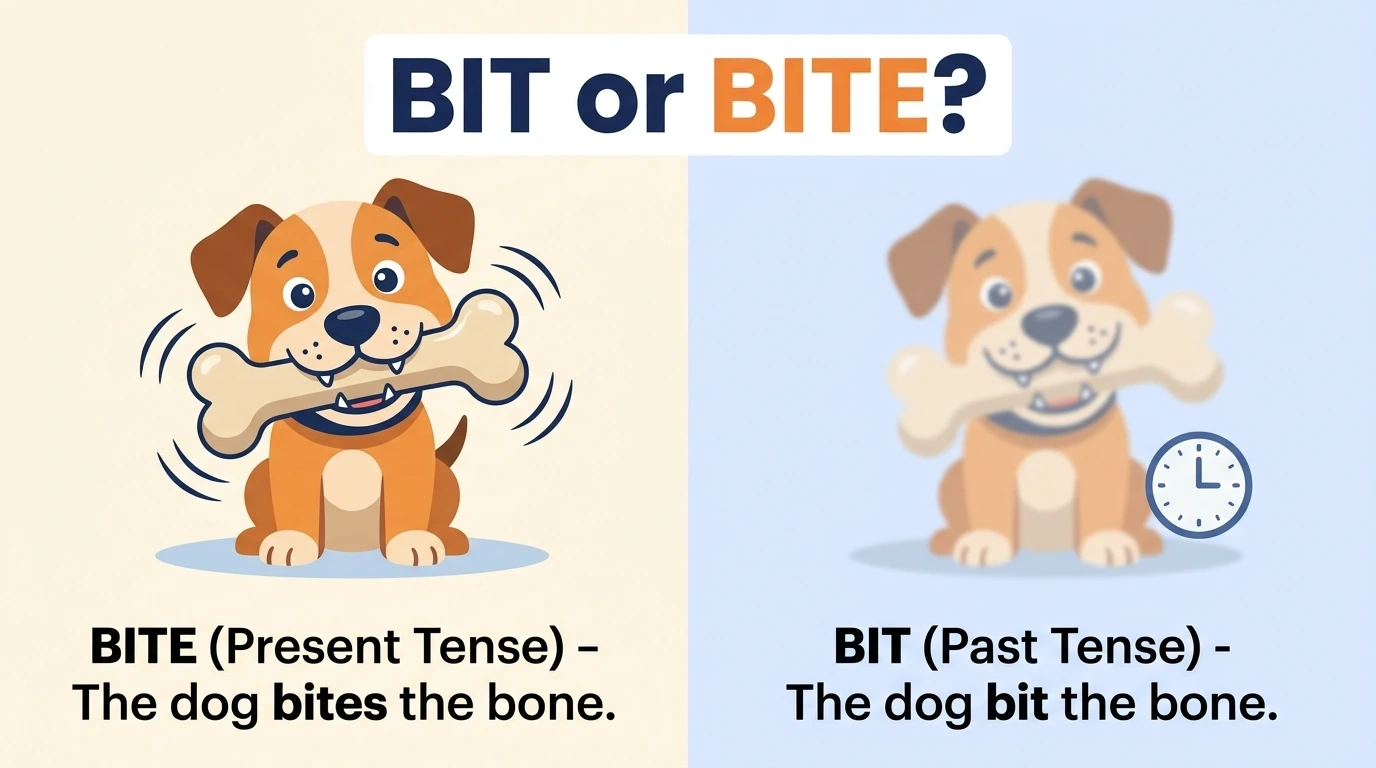
In short: “bit” is the past tense of “bite,” and it also means a small amount of something. “Bite” is the action of using your teeth to cut into something, or it can be used as a noun for that action. Once you see the pattern, the confusion disappears fast.
This guide breaks down the meaning, grammar, and real-life use of both words in simple, clear English. By the end, you will never second-guess yourself again.
Quick Answer
Here is the short version before we go deeper.
| Word | Type | Meaning | Example |
| Bite | Verb (present) | To cut or grip with teeth | The dog will bite if scared. |
| Bit | Verb (past tense of bite) | Cut or gripped with teeth (past action) | The dog bit the mailman yesterday. |
| Bit | Noun | A small piece or small amount | Can I have a bit of your sandwich? |
| Bite | Noun | An act of biting, or a small meal | I need a quick bite before class. |
So the key rule is: bite happens now or in general, while bit already happened. And separately, “bit” can also just mean “a small piece.”
Meaning and Definition
Let’s look at each word closely, because they carry more than one meaning depending on how they are used.
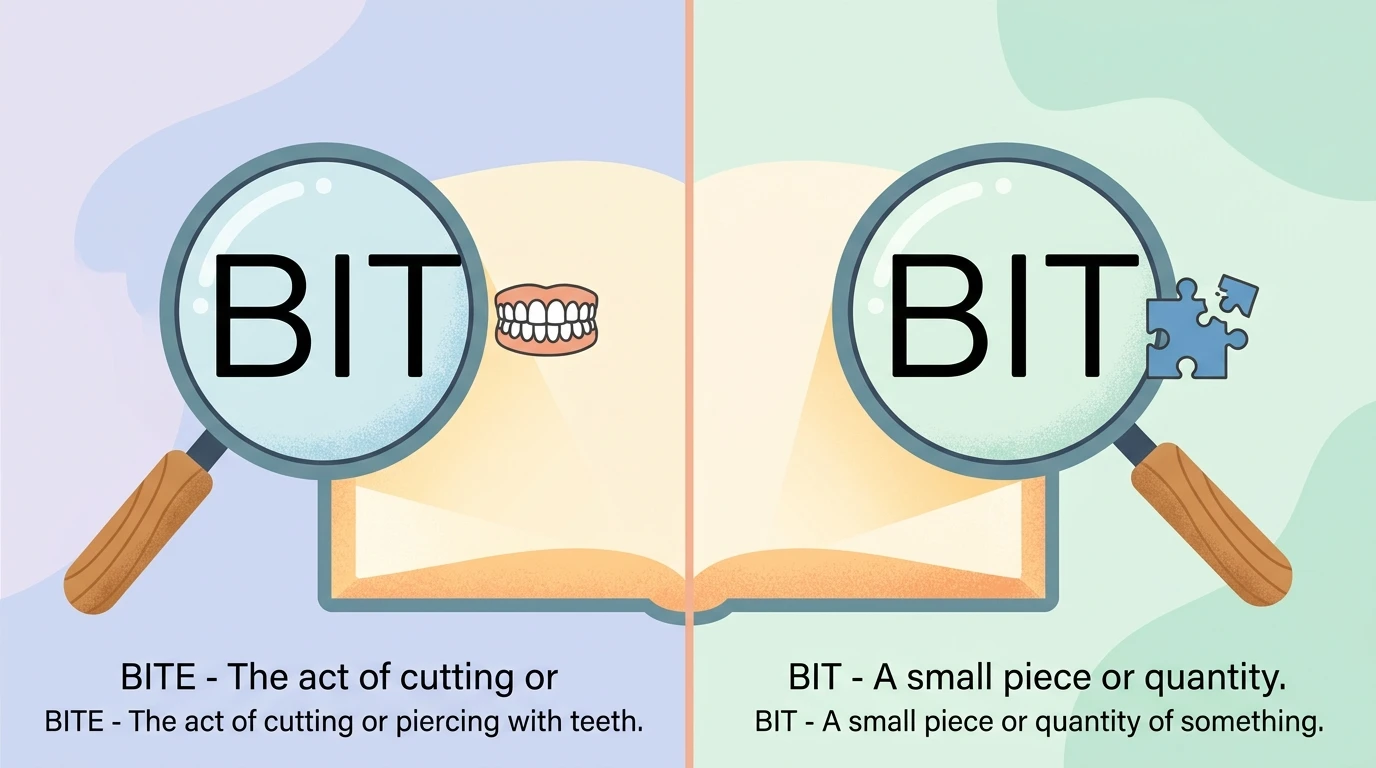
Bite is most often a verb. It describes the act of using teeth to grip, cut, or tear something. A dog can bite a bone. A mosquito can bite your arm. You can bite into an apple. Bite can also work as a noun, meaning the actual mark or wound left behind, like a “mosquito bite” or a “snake bite.” It can even mean a small amount of food, as in “I’ll just have a bite of your fries.”
Bit, on the other hand, has two main jobs. First, it is the simple past tense of “bite.” If the biting already happened, you use “bit.” For example, “She bit her nails during the exam.” Second, “bit” means a small piece, portion, or amount of anything, not just food. You can say “a bit of advice,” “a bit of luck,” or “a bit of rain.” This second meaning has nothing to do with teeth at all, which is exactly where a lot of the confusion starts.
There is also a technical meaning of “bit” in computing, where it stands for “binary digit,” the smallest unit of data a computer uses. That meaning is unrelated to biting, but it shows how flexible this small word really is.
Grammar and Correct Usage
Understanding verb tense is the fastest way to master bit or bite.
“Bite” follows this pattern: bite (present), bit (past), bitten (past participle). So you would say:
- “I bite my nails when I’m nervous.” (present)
- “I bit my nails yesterday.” (past)
- “I have bitten my nails since childhood.” (past participle, used with “have” or “has”)
This is what grammar teachers call an irregular verb, because it doesn’t just add “-ed” like regular verbs do. Words like “eat/ate/eaten” or “write/wrote/written” follow the same irregular pattern, so if you already know those, “bite/bit/bitten” will feel familiar.
Now, when “bit” is used as a noun meaning a small amount, tense doesn’t apply at all, because it isn’t a verb in that sentence. You might say “Give me a bit of time” or “That was a bit strange,” and here “bit” simply describes size or degree.
A simple memory trick: if you can replace the word with “a small amount of” or “somewhat,” it’s the noun “bit.” If the sentence is about teeth, action, or something happening, check the timing to decide between “bite” and “bit.”
Common Mistakes
Even confident English speakers slip up here. Below are the most frequent mistakes and how to fix them.
| Mistake | Why It’s Wrong | Correct Version |
| “The dog bite me yesterday.” | “Yesterday” signals past tense, so “bite” is wrong here. | “The dog bit me yesterday.” |
| “I have bit my tongue.” | The past participle form should be “bitten,” not “bit.” | “I have bitten my tongue.” |
| “Wait a bite.” | This should use the noun form “bit,” meaning a small amount of time. | “Wait a bit.” |
| “She bit into her sandwich right now.” | “Right now” needs present tense. | “She bites into her sandwich right now.” |
| “I need to bit something to eat.” | “Bit” cannot be used as an infinitive verb. | “I need to bite something to eat.” |
Most of these errors happen because people rely on how the word sounds rather than checking the tense of the sentence. Reading the full sentence first, then picking the verb form, solves almost every mistake on this list.
Real-Life Examples
Seeing these words in natural sentences helps the rule stick better than any explanation alone.
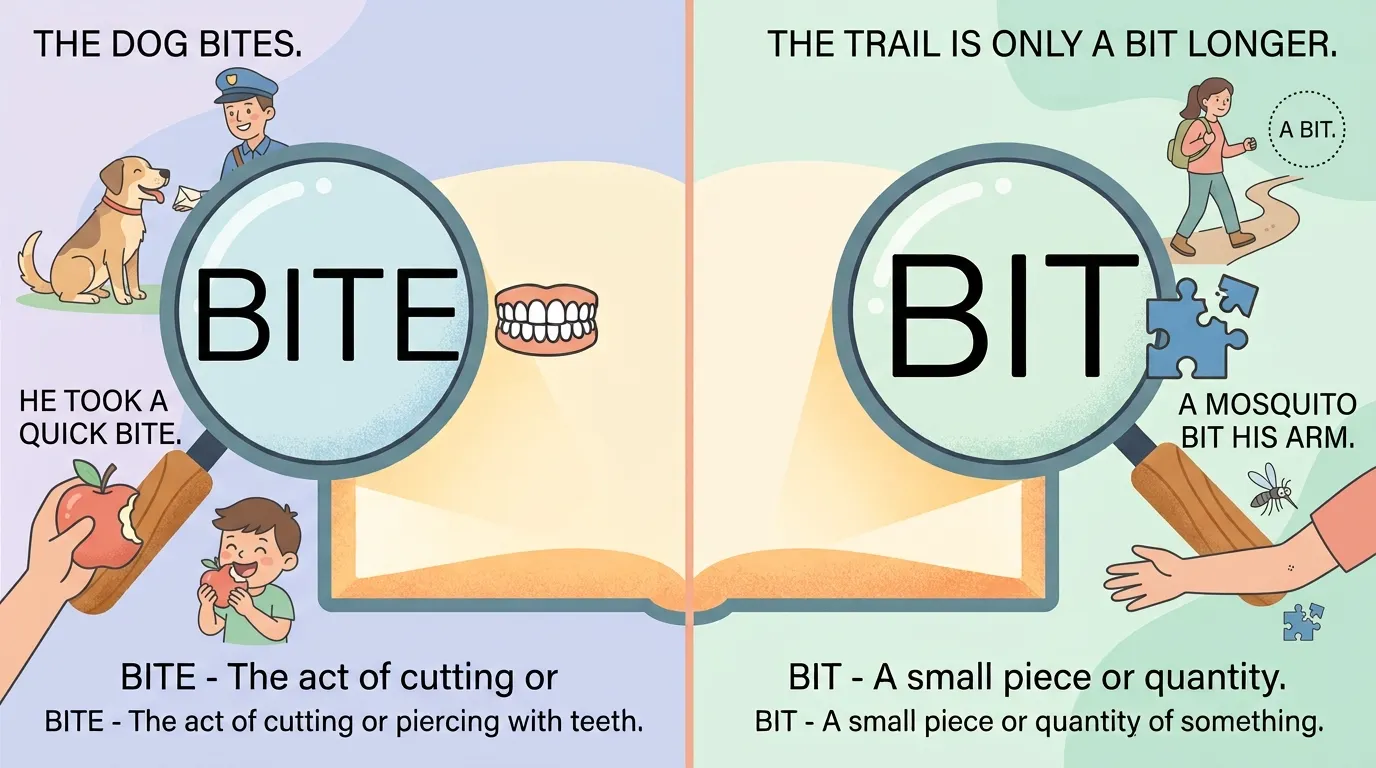
Using “bite” as a present action: “Be careful, that snake might bite if you get too close.” Here, the action has not happened yet, so present tense fits.
Using “bit” as a past action: “The snake bit the hiker near the trail last week.” The event is already over, so past tense is correct.
Using “bit” as a small amount: “Could you turn the volume down just a bit?” No teeth involved here, just a request for a smaller amount of sound.
Using “bite” as a noun for food: “Let’s grab a quick bite before the movie starts.” This is a common, casual way to talk about eating something small and fast.
Using “bitten” correctly: “She has been bitten by mosquitoes all summer.” This past participle form pairs with “has been,” showing something that happened repeatedly over time.
Notice how context, not sound, decides which word belongs in each sentence.
Tips and Best Practices
A few simple habits will help you use bit or bite correctly every time.
First, always ask: is this happening now, or did it already happen? If it’s already done, lean toward “bit.” If it’s ongoing or general, use “bite.”
Second, check whether teeth or biting are even involved. If the sentence is about size, degree, or a small portion, “bit” as a noun is likely your answer, no tense needed.
Third, practice the three forms together like a song: bite, bit, bitten. Repeating irregular verbs out loud in their three forms is one of the fastest ways language teachers help students remember them.
Fourth, read your sentence back once you finish writing it. Confusing tense is one of the easiest things to catch on a second read, especially in emails, essays, or messages where tone matters.
Finally, remember that native speakers make this mistake too, especially when typing quickly. Slowing down for just a second before hitting send can prevent an easy, avoidable error.
FAQs
1. Is “bit” always the past tense of “bite”?
Not always. “Bit” is the past tense of “bite” when talking about biting, but it also means “a small amount” as a separate noun, with no connection to teeth or tense.
2. What is the difference between “bit” and “bitten”?
“Bit” is simple past tense, used alone, like “He bit the apple.” “Bitten” is the past participle, used with helping verbs like “has,” “have,” or “was,” as in “He has bitten the apple” or “The apple was bitten.”
3. Can “bite” be used as a noun?
Yes. “Bite” as a noun can mean the act of biting, a wound from a bite, or a small amount of food, such as “I felt a bite on my ankle” or “Let’s have a bite to eat.”
4. Why do people confuse “bit” and “bite” so often?
The confusion mostly comes from similar spelling and sound, plus the fact that “bit” has two unrelated meanings, one tied to biting and one meaning “a small piece,” which adds extra layers to sort through.
5. Is “a bit” the same as “a little”?
Yes, in most everyday speech, “a bit” and “a little” are interchangeable, both meaning a small amount, as in “I’m a bit tired” or “I’m a little tired.”
6. Does “bit” ever mean something unrelated to size or biting?
Yes. In computing and technology, “bit” refers to a binary digit, the smallest unit of digital data, completely separate from the everyday meanings discussed above.
Conclusion
Choosing between bit or bite comes down to two simple checks: timing and meaning. If biting already happened, use “bit.”
If it’s happening now, ongoing, or a general truth, use “bite.” And when you’re not talking about teeth at all, remember that “bit” often just means a small amount of something, like time, luck, or advice.
With the tense pattern bite, bit, bitten memorized, and a quick mental check on context, you’ll use both words correctly without hesitation. Keep this guide handy, reread your sentences before sending them, and this common English mix-up will stop tripping you up for good.

Hi, I’m Iqra, a passionate writer and grammar enthusiast dedicated to making English grammar simple, clear, and easy to understand. Through my work on grammar books and educational content, I help students, writers, and English learners improve their vocabulary, sentence structure, punctuation, and everyday communication skills. My goal is to turn confusing grammar rules into practical, easy-to-follow lessons that readers can confidently use in real life. I believe learning grammar doesn’t have to be difficult—it can be simple, useful, and even enjoyable. Through helpful guides, examples, and carefully explained grammar tips, Iqra aims to make learning English more accessible for everyone.