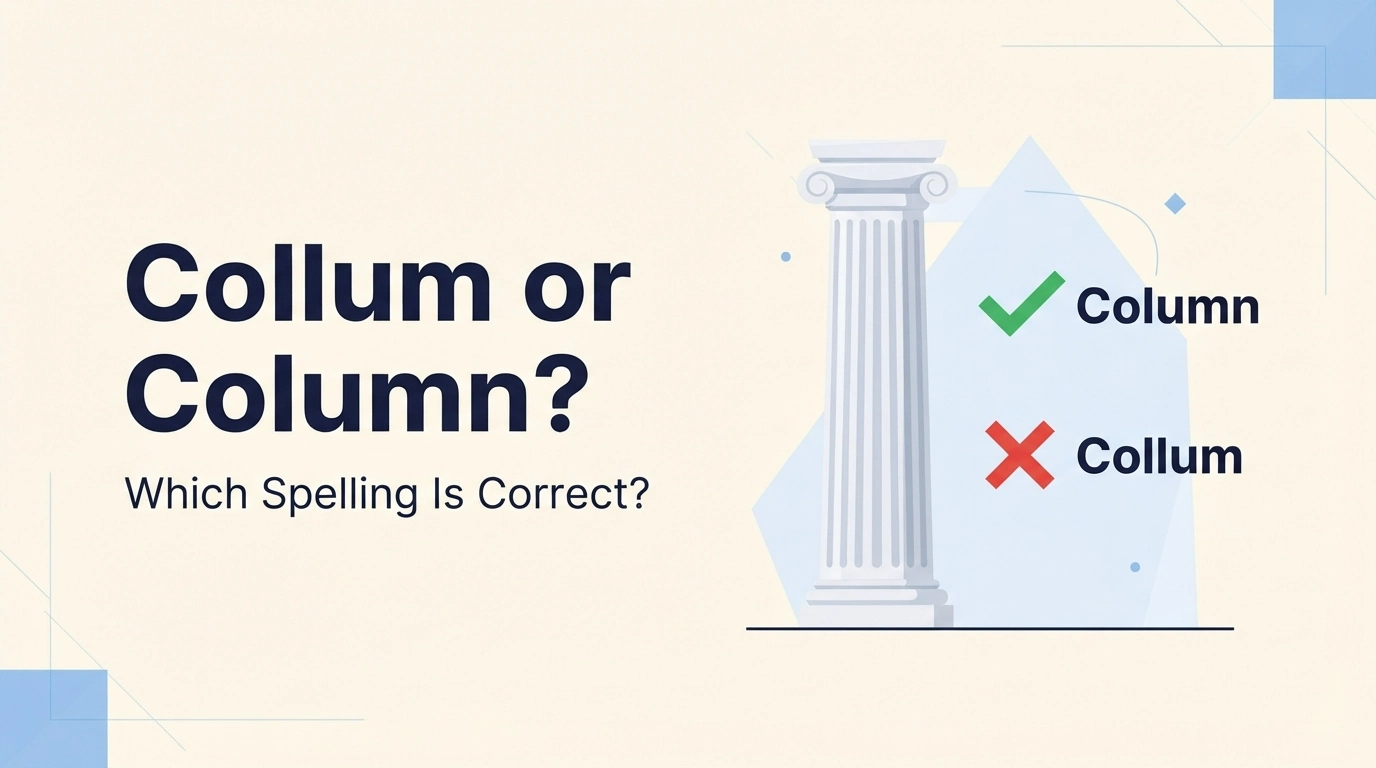
Column is the correct spelling. When you wonder about collum or column, always pick column. Collum is a common typing mistake, and it is not a normal English word.
Have you ever written a word and thought, “That looks wrong”? Column does that to many people. It has a silent letter at the end, and the sound “col-um” makes you want to add another L.
In this guide, you will learn what column means, why people type collum, and where the word came from. You will also see real examples, common mistakes, and simple memory tricks. Whether you write emails, school papers, blog posts, or spreadsheets, this word shows up often, so it pays to get it right.
Quick Answer: Collum or Column
The right spelling is column. It ends with the letters “umn,” and the last N stays silent when you say the word. You say it like “KOL-um,” but you still write the N. Collum, colum, and coloumn are all wrong when you write in English.
Here is a simple table to make it clear.
| Spelling | Correct? | What to Know |
| column | Yes | The standard spelling in American and British English |
| collum | No | A common mistake; in Latin it means “neck” |
| colum | No | Missing the final N |
| collumn | No | Has an extra L |
| coloumn | No | Has an extra O |
Spell checkers usually catch these errors. If you see a red line under your word, change it to column, and the line should go away.
What Does Column Mean?

Column is a noun. It has a few different meanings, but they share one idea. A column is something tall and narrow, or something that lines up one item after another.
The first meaning most people learn comes from buildings. A column is a tall pillar that holds up a roof or a part of a building. You can see columns on old temples, courthouses, banks, and even some homes. Some are plain, and some have fancy carvings. Famous examples include Nelson’s Column in London and Trajan’s Column in Rome.
The second meaning comes from newspapers and magazines. A column is a regular article written by one person, often with a strong voice or opinion. The writer is called a columnist. Many online writers use the word the same way.
The third meaning is about lists and data. In a table or spreadsheet, a column runs up and down. A row runs from side to side.
Here are the most common meanings, each with an example.
| Meaning | Example Sentence |
| A pillar in a building | The old library has tall stone columns at the front. |
| A regular article in a paper or magazine | She writes a weekly column about gardening. |
| A vertical line of data in a table | Type the dates in the first column. |
| A line of people, animals, or vehicles | A column of ants marched across the porch. |
| Something tall and thin | A column of smoke rose from the campfire. |
| The backbone (spinal column) | The doctor checked his spinal column. |
| A strip of text on a page | The page has two columns of text. |
As you can see, the word shows up in school, work, health, and daily life. That is one more reason to spell it correctly.
Why People Write “Collum”

Many people type collum. There are a few good reasons, and none of them mean you are a weak speller.
The biggest reason is sound. When you say column, you say “KOL-um.” Nothing in that sound tells you there is an N at the end. Your brain hears the sound and looks for a spelling that matches. Many words end with the “um” sound, like album, forum, and museum. So your brain may guess that column ends the same way and drop the N.
The second reason is the double L habit. English has many words that start with “coll,” such as college, collect, collar, and collide. After seeing these often, your eyes may accept collum as normal. The first part of column sounds just like the start of college, so the mix-up is easy to make.
The third reason is speed. People type fast, and a silent letter is easy to skip. Phones and computers fix many errors, but they do not fix all of them. Sometimes the wrong word slips through, and you do not notice until later.
The good news is that this mistake is easy to fix once you know the pattern. You will see some simple tricks for that later in this guide.
Is Collum a Real Word?
This part confuses people the most. Collum is a real word, but not in the way most people think. It is not an English spelling of column.
Collum is a Latin word that means “neck.” Doctors and scientists still use Latin words in anatomy, so you may see collum in medical or biology books. For example, the neck of the thigh bone has a Latin name that includes collum. Collum can also be a family name. It may show up as a business or brand name too. In those cases, the spelling is fixed, and you should keep it exactly as written.
But if you are writing about a pillar, a newspaper article, or a line of data in a spreadsheet, collum is wrong. The word you need is column.
Latin collum and English column are different words with different meanings. They only look and sound a little alike. Think of them as two separate words that happen to be neighbors in the dictionary of your memory.
If you write for school, work, or the web, using collum in place of column can make readers think you made an error. That can hurt trust, especially in a resume, report, or article.
Where the Word Column Comes From

Column has a long history. It comes from the Latin word columna, which meant pillar. The word traveled into English through French many centuries ago.
At first, the word was mostly about pillars in buildings. Over time, people used it for other things that looked tall and narrow. It came to describe strips of printed text, lines of soldiers, and rising clouds of smoke. I do not have a reliable date for when each meaning began, so it is best to say only that the word is old and its meanings grew over time.
The history also explains the silent N. The N in column comes from the old Latin form columna. English dropped the ending but kept the N in the spelling. That is why you still write it, even though you do not say it.
Knowing this can help you remember the word. Column is not a random spelling. It is a very old word that kept its shape through many years of use.
How to Say Column Correctly
Say it in two beats: KOL-um. The first part sounds like the start of “college.” The second part sounds like the end of “album.” The final N is silent.
Many English words follow this same pattern, where an N comes after an M and stays quiet. Look at these words:
- autumn
- hymn
- solemn
- condemn
If you can spell those, you can spell column. They all end in “mn,” and they all use a silent N.
Here is a fun twist. The N wakes up in related words. In columnist, you say the N: KOL-um-nist. So if you ever forget the spelling, say columnist out loud. You will hear the N, and it will remind you that column needs one too.
Column Grammar and Correct Usage

Column is a noun. The plural is columns, and you just add an S. There are no tricky changes.
“Column is a noun you can use in many ways: ‘the first column,’ ‘a column in the paper,’ or ‘a column about money.’ It can also work like a describing word, as in ‘column width’ or ‘column heading.'” A related word, columnar, means shaped like a column, though you will rarely need it.
Do not capitalize column unless it starts a sentence or is part of a name, like Nelson’s Column. In a normal sentence, keep it lowercase.
People also mix up column and row. Remember it this way: a column stands up like a pillar, and a row lies across like a line of seats. In a spreadsheet, columns go up and down. Rows go left to right.
Journalists also use a term called “column inch,” which measures space in a printed column. You may never need it, but it shows how widely the word is used.Finally, do not confuse column with colon. A colon is the punctuation mark (:). It is also a part of the body. It is a different word with a different spelling and meaning.
Common Mistakes
The most common mistake is writing collum. The second is writing colum, which is missing the last N. Both happen because the word does not sound the way it looks.
Other wrong spellings show up too. Some people write collumn, with two L’s and the N. Others write coloumn, adding an extra O. This can happen because words like colour and color have that O-U pattern, and the brain mixes them up. Column has no extra vowels. It is just c-o-l-u-m-n.
Another mistake is saying the N out loud, as in “col-UMN.” Most speakers do not say it that way in the base word. Saying “KOL-um” is standard.
People also mix up column and row. A teacher might say, “Add the numbers in the second column.” If you look across instead of up and down, you will get the wrong numbers. This mistake is about meaning, not spelling, but it happens a lot.
Here are a few wrong-and-right pairs to study:
Wrong: “Please sort the collum by date.” Right: “Please sort the column by date.”
Wrong: “She writes a weekly colum for the paper.” Right: “She writes a weekly column for the paper.”
Wrong: “The temple has tall coloumns.” Right: “The temple has tall columns.”
British vs American English

Some words change between the two styles, like color and colour, or center and centre. Column is not one of them. Both American and British English spell it the same way. The word columnist is also the same in both.
That makes life easier. You can use the spelling column in any English writing, in any country, and it will be right. The only thing that may vary a little is how people say certain sounds, but the spelling never changes.
Real-Life Examples
Seeing a word in real situations helps it stick. Here are some everyday examples that use column the right way.
A student might write in an email, “I put my answers in the second column of the chart.” A manager might say, “Please add a new column for the due dates.” A blogger might write, “My weekly column goes out every Friday morning.”
In the news, you may read, “The mayor wrote a column about the new park.” A history book might say, “The tall marble columns held up the roof for hundreds of years.” In a science class, a teacher may explain, “Your spinal column protects the nerves in your back.”
Even a hiking story can use it. “A thin column of smoke rose from the valley.” That sentence paints a picture, and it uses the word correctly.
Now imagine each of those sentences with collum. “The tall marble collums held up the roof.” It looks off, right? Your eye may catch it right away, and so will your readers. That small bump can pull people out of the story or make your work look rushed.
Try writing three sentences of your own with the word column. Use one for a building, one for a list, and one for a newspaper. This small habit can lock in the spelling.
Tips to Remember the Spelling
Good memory tricks make spelling much easier. Try these.
First, use the silent N family. Say the words autumn, hymn, solemn, and column together. They all end in “mn” and share the same silent N. When you learn them as a group, each one helps you remember the others.
Second, say columnist out loud. The N is clear in that word. If you can hear it in columnist, you will remember it in column.
Third, picture one tall pillar. A column has just one L, like one tall, straight pillar. If you see two L’s, it should feel wrong. One pillar, one L.
Fourth, break it into parts when you write. Say “col” and then “umn.” Writing it in two chunks can slow you down just enough to add the N.
Fifth, write it three times on paper. It sounds old-fashioned, but it works. Your hand remembers spelling better than you might expect.
Sixth, check your work. Before you send an email or post an article, do a quick search for the word “collum” in your document. It takes a few seconds and can save you from an embarrassing slip.
Where You See Columns Today

Columns are all around us, and that is why people search for this spelling so often.
In spreadsheets like Excel and Google Sheets, columns are labeled with letters, such as A, B, and C. Databases store information in columns and rows too. If you work with data, you will type the word all the time.
On websites, designers talk about two-column or three-column layouts. This just means the page is split into tall strips. Magazines and newspapers use the same idea to make text easier to read.
Writers still publish columns, both in print and online. A columnist may share advice, opinions, or funny stories every week. Many readers follow their favorite columnists the way they follow a favorite show.
In buildings, columns still hold up porches, bridges, and public halls. Even modern architects use them, sometimes for looks and sometimes for strength.
Because the word appears in so many places, one small spelling error can spread fast. Learning it once helps you in school, work, and daily writing.
FAQs
Is collum a real English word?
No. Collum is a Latin word that means “neck.” It is not an English spelling of column. You may see it in medical terms or as a name, but not as the word for a pillar, a news article, or a spreadsheet line.
How do you spell column correctly?
The correct spelling is c-o-l-u-m-n. It has one L, and it ends with “umn.” The last N is silent when you say the word, but you must still write it.
Why is the N silent in column?
The N comes from the old Latin word columna. English kept the letter in the spelling but does not say it in the base word. Words like autumn, hymn, and solemn work the same way.
Is it colum or column?
It is column. Colum is missing the final N and is a spelling mistake. If you can remember the word columnist, where you hear the N, you can avoid this error.
What is the difference between a column and a row?
A column runs up and down, like a pillar. A row runs across, from left to right. In a spreadsheet, the letters at the top name the columns, and the numbers on the side name the rows.
What does columnist mean?
A columnist is a writer who creates a regular column for a newspaper, magazine, or website. Columnists often share opinions, advice, or stories on a certain topic.
Final Thoughts on Collum or Column
The answer to collum or column is simple: use column. It is the correct spelling in American English, British English, and every other English style. Collum is a Latin word for “neck,” and it does not belong in everyday English writing.
Remember that column can mean a pillar, a newspaper article, a line of data, or a tall, thin shape. The N at the end is silent, just like in autumn and hymn. If you forget, say columnist out loud and listen for the N.
A few small habits go a long way. Practice the word in a few sentences, use the tips in this guide, and check your work before you hit send. Spelling gets easier with time, and every word you master makes your writing stronger. Next time you type this word, you will know exactly what to do.

Hi, I’m Iqra, a passionate writer and grammar enthusiast dedicated to making English grammar simple, clear, and easy to understand. Through my work on grammar books and educational content, I help students, writers, and English learners improve their vocabulary, sentence structure, punctuation, and everyday communication skills. My goal is to turn confusing grammar rules into practical, easy-to-follow lessons that readers can confidently use in real life. I believe learning grammar doesn’t have to be difficult—it can be simple, useful, and even enjoyable. Through helpful guides, examples, and carefully explained grammar tips, Iqra aims to make learning English more accessible for everyone.