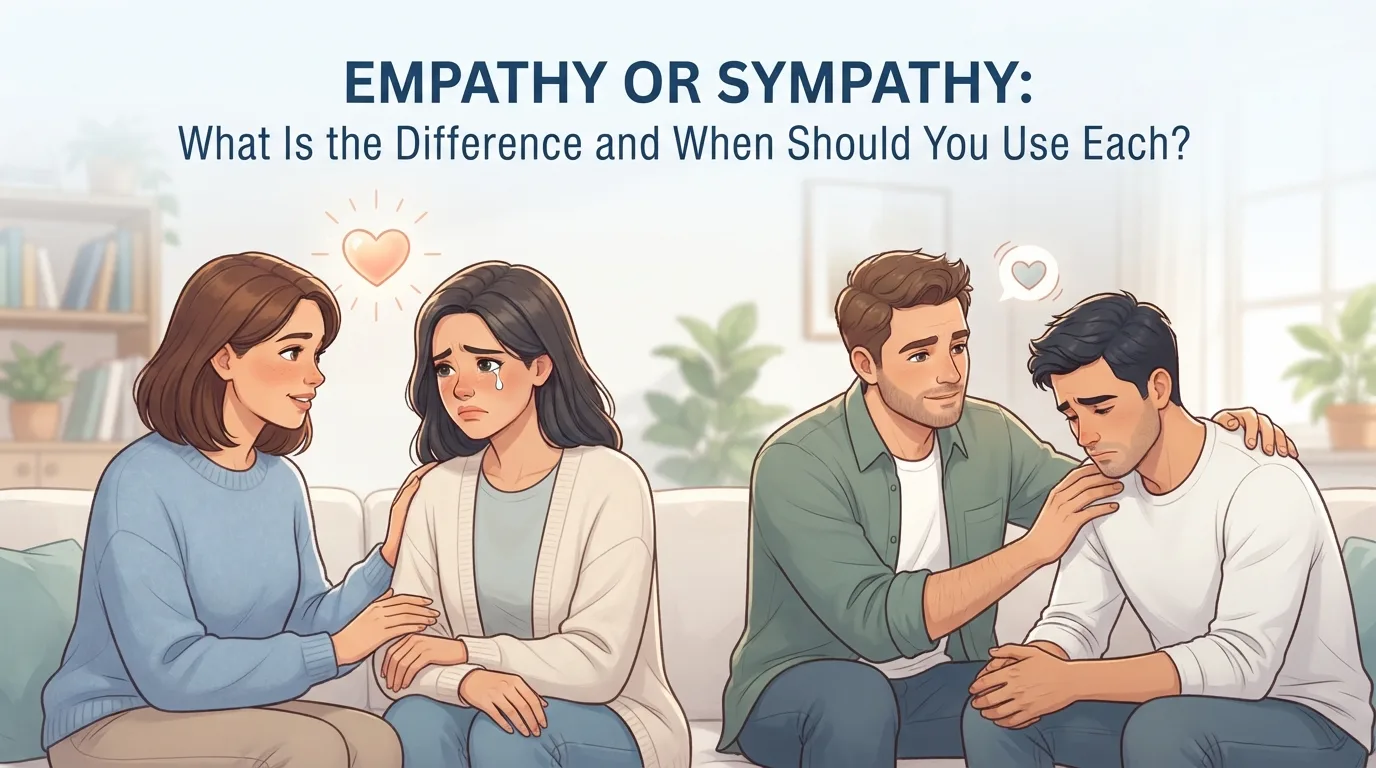
When someone is going through a hard time, you may want to show that you care, but empathy or sympathy can express that care in different ways.
Empathy means trying to understand and share another person’s feelings, while sympathy means recognizing that someone is suffering and feeling concern for them.
Knowing the difference can help you choose the right word in conversations, writing, school, and everyday life.
Quick Answer: Empathy or Sympathy?
The easiest way to remember the difference is this: empathy is about understanding another person’s feelings, while sympathy is about feeling concern for another person’s situation.
For example, imagine your friend fails an important exam. If you say, “I know how disappointing that must feel. I remember feeling the same way when I failed a test,” you are showing empathy.
If you say, “I’m sorry you failed. I hope things get better for you,” you are showing sympathy.
Both responses can be kind and caring. The main difference is how you connect with the other person’s emotions.
| Word | Simple Meaning | Main Focus | Example |
| Empathy | Understanding another person’s feelings | Sharing or understanding emotions | “I understand why you feel hurt.” |
| Sympathy | Feeling concern for someone | Caring about someone’s difficulty | “I’m sorry you’re going through this.” |
A useful memory trick is “empathy puts you in their shoes.” Sympathy lets you recognize that someone is having a difficult experience.
What Does Empathy Mean?
Empathy is the ability to understand another person’s feelings, thoughts, or emotional experience. It involves trying to see a situation from that person’s point of view rather than only looking at it from your own perspective.
When you show empathy, you do not necessarily have to agree with someone. You also do not have to experience exactly the same thing. Instead, you try to understand what the person may be feeling.
For example, your coworker may be nervous before an important presentation. You could say, “I can understand why you’re nervous. Speaking in front of everyone can feel stressful.”
You are recognizing the emotion and trying to understand the person’s experience.
Empathy can be especially helpful when someone wants to feel heard. Sometimes people do not need advice right away. They simply want another person to listen and understand.
Empathy can appear in many forms. You might listen carefully, ask thoughtful questions, acknowledge someone’s feelings, or share a similar experience when it is genuinely helpful.
There is also an important difference between understanding someone’s feelings and agreeing with their behavior. You can understand why someone is angry without saying that everything they did while angry was correct.
What Does Sympathy Mean?
Sympathy means feeling concern, sadness, or compassion for someone who is experiencing a problem, loss, pain, or difficult situation.
For example, if your neighbor loses a family member, you might say, “I’m very sorry for your loss.” This is a sympathetic response.
Sympathy often creates a little more emotional distance than empathy. You recognize that another person is suffering, but you are not necessarily trying to experience the situation from their point of view.
Consider another example. Your friend tells you that her car broke down on the way to work. You might respond, “That’s really unfortunate. I hope you can get it fixed soon.”
That is sympathy because you are showing concern about her difficult situation.
Sympathy is also common in formal situations. People often use sympathetic words when offering condolences after a death or expressing concern after an accident, illness, disappointment, or other hardship.
| Situation | Empathetic Response | Sympathetic Response |
| Friend loses a job | “I can imagine how upsetting this feels.” | “I’m sorry you lost your job.” |
| Someone fails an exam | “I know how disappointing that can feel.” | “I’m sorry the exam didn’t go well.” |
| Friend is nervous | “I’d probably feel nervous in your position too.” | “I hope everything goes well.” |
| Someone experiences a loss | “I can understand how deeply this may hurt.” | “I’m so sorry for your loss.” |
| Coworker has a difficult day | “It sounds like today was really stressful.” | “I’m sorry you had such a difficult day.” |
Empathy or Sympathy: The Main Difference
The difference between empathy or sympathy becomes easier when you focus on emotional connection.
Empathy asks, in effect, “What might this person be feeling, and can I understand that experience?”
Sympathy asks, “This person is suffering. How can I show that I care?”
Empathy usually involves a deeper attempt to understand another person’s emotional experience. Sympathy recognizes the person’s difficulty and responds with concern or compassion.
Imagine that your friend receives disappointing news.
An empathetic response might be:
“I can see why you’re hurt. You worked so hard for this.”
A sympathetic response might be:
“I’m really sorry this happened to you.”
Neither sentence is automatically better in every situation. The right choice depends on what the person needs and what you genuinely mean.
One common mistake is thinking that sympathy is uncaring. That is not true. Sympathy can be warm, respectful, and deeply meaningful, especially when someone is grieving.
Likewise, empathy does not mean that you have experienced exactly the same situation. You can empathize with someone’s feelings even when your own life experience is different.
Empathy vs. Sympathy in Everyday Conversations
The difference becomes clearer when you see how these words work in real conversations.
Suppose a friend says:
“I didn’t get the job I really wanted.”
A sympathetic answer could be:
“I’m sorry. I know you were hoping to get it.”
An empathetic answer could be:
“That must feel really disappointing after all the preparation you put into the interview.”
The first response shows concern. The second focuses more closely on the friend’s emotional experience.
Now imagine a child is scared about starting a new school.
A sympathetic response might be:
“Don’t worry. You’ll be okay.”
An empathetic response might be:
“Starting at a new school can feel scary when you don’t know anyone yet.”
The empathetic response acknowledges the child’s fear instead of immediately trying to make the feeling disappear.
This is one reason empathy can make conversations feel more personal. It communicates that you are paying attention to what the other person is experiencing.
Empathy or Sympathy in Grammar and Correct Usage
Both empathy and sympathy are nouns. Their related adjective forms are empathetic and sympathetic.
You can use empathy when talking about the ability or act of understanding another person’s feelings.
Examples include:
“Her empathy helped her understand how the new student felt.”
“He showed empathy toward his friend.”
“Good teachers often use empathy when helping students.”
“Empathy can make difficult conversations easier.”
Sympathy is used when talking about feelings of concern or compassion for someone who is suffering.
Examples include:
“She expressed sympathy after hearing the sad news.”
“His sympathy was comforting during a difficult time.”
“We sent our sympathy to the family.”
“She felt sympathy for the injured animal.”
The words can sometimes appear with similar verbs, but their meanings remain different.
| Correct Expression | Meaning |
| show empathy | Try to understand another person’s feelings |
| have empathy | Have the ability to understand others’ emotions |
| feel empathy | Experience an emotional understanding of another person |
| show sympathy | Express concern for someone’s suffering |
| express sympathy | Communicate sadness or concern |
| feel sympathy | Feel concern or compassion for someone |
A useful phrase is “sympathy for someone” because sympathy is commonly directed toward a person experiencing difficulty.
For empathy, you will often see phrases such as “empathy with someone” or “empathy for someone’s experience.” The exact construction depends on the sentence.
Is Empathy Always the Same as Feeling What Someone Feels?
Not exactly.
People sometimes describe empathy as “feeling what another person feels,” but that can be an oversimplification.
You may understand someone’s sadness without becoming equally sad yourself. You may also understand fear even if the particular situation does not frighten you.
For example, imagine that someone is afraid of public speaking. You may not have that fear yourself, but you can understand why standing before a large audience could make someone nervous.
Empathy involves perspective and emotional understanding. It does not require an identical personal experience.
This distinction matters because everyone has different backgrounds, personalities, and experiences. Assuming that you know exactly what another person feels can sometimes lead to misunderstanding.
Instead of saying, “I know exactly how you feel,” a more careful response can be:
“I can imagine this is really difficult for you.”
That leaves room for the other person to explain their own feelings.
Can You Have Sympathy Without Empathy?
Yes.
A person can feel concern for someone without deeply understanding what that person is experiencing.
For example, you may hear that someone lost their home in a natural disaster. You may feel sadness and concern for them even though you have never experienced anything similar.
That is sympathy.
You can also show sympathy through simple words:
“I am sorry you’re going through this.”
“I hope things improve soon.”
“My thoughts are with you.”
“I’m sorry for your loss.”
These expressions can be appropriate even when you cannot fully understand the person’s experience.
In some situations, sympathy may actually be the most natural response because the person’s circumstances are far outside your own experience.
Can You Have Empathy Without Sympathy?
Yes, and this is an important distinction.
Understanding another person’s feelings does not automatically mean approving of their actions or feeling sorry for them.
For example, a teacher might understand why a student is angry after receiving a low grade. The teacher can recognize the student’s frustration while still believing that the grade was fair.
Similarly, you might understand why someone made a particular decision without agreeing that the decision was right.
Empathy is about understanding. It is not the same as approval.
This is useful in families, schools, workplaces, friendships, and other relationships because understanding someone’s emotions can help people communicate without automatically taking their side.
Common Mistakes With Empathy and Sympathy
One common mistake is using sympathy when you really mean empathy.
For example:
“I have sympathy for what you’re feeling.”
This sentence can be grammatically correct, but it may communicate concern rather than the deeper idea of understanding someone’s emotional experience.
Another common mistake is assuming that empathy means agreeing with someone.
It does not.
You can understand a person’s feelings while disagreeing with their opinion or behavior.
People also sometimes use the phrase “I know exactly how you feel.” Although this may be intended as an empathetic statement, it can sometimes sound dismissive. You may not know exactly how another person feels.
A better approach is to listen first.
Another mistake is immediately giving advice. Someone who is upset may want to be heard before they want a solution.
Instead of quickly saying, “You should do this,” you can first say, “That sounds really hard.”
This simple change can make a conversation feel more supportive.
Real-Life Examples of Empathy and Sympathy
Here are several situations that show the difference between the two words.
Example 1: A failed exam
Sympathy:
“I’m sorry you didn’t get the grade you wanted.”
Empathy:
“I can understand why you’re disappointed. You studied so much for this exam.”
Example 2: A breakup
Sympathy:
“I’m sorry you’re going through a breakup.”
Empathy:
“It makes sense that you’re hurting. Losing someone who was part of your daily life can feel very difficult.”
Example 3: A stressful workday
Sympathy:
“I’m sorry you had such a stressful day.”
Empathy:
“It sounds like you had too many things happening at once. I can understand why you’re exhausted.”
Example 4: A family loss
Sympathy:
“I’m so sorry for your loss.”
Empathy:
“I can imagine how painful this time must be for you.”
In serious situations such as grief, a simple sympathetic statement may be more appropriate than trying to describe another person’s feelings for them.
Empathy and Sympathy in School and the Workplace
Both concepts are important in schools and workplaces because people regularly deal with stress, disappointment, disagreements, and personal challenges.
A teacher may use empathy to understand why a student is struggling with an assignment. Instead of assuming the student is lazy, the teacher may ask questions and listen.
A manager may show empathy when an employee is dealing with a difficult situation. Understanding the employee’s perspective can help create a more respectful conversation.
Sympathy also has an important place. If a coworker experiences a family loss, saying “I’m sorry for your loss” is a respectful expression of sympathy.
In professional communication, the best response often depends on the situation. A serious event may call for a short, sincere expression of sympathy. A longer conversation about feelings may benefit from empathy and careful listening.
How to Show Empathy Without Sounding Fake
Empathy does not have to involve complicated words.
Simple sentences are often more natural.
You can start by listening instead of interrupting. Then acknowledge what the person has said.
For example:
“That sounds really difficult.”
“I can understand why you feel upset.”
“It seems like this has been weighing on you.”
“Thank you for telling me.”
“Do you want to talk about it?”
These responses do not pretend that you know everything about the person’s experience.
Another useful habit is asking open questions. Instead of asking only, “Are you okay?” you might ask, “How are you feeling about what happened?”
Most importantly, let the other person speak. Empathy is not a speech you give. It is often shown through attention, patience, and genuine listening.
How to Show Sympathy Respectfully
Showing sympathy can be simple and sincere.
When someone is experiencing a difficult event, you might say:
“I’m sorry you’re going through this.”
“That sounds very difficult.”
“I hope things get easier soon.”
“I’m thinking of you during this difficult time.”
“I’m so sorry for your loss.”
Avoid making the person’s experience about yourself. For example, immediately responding with a long story about your own problem may take attention away from the person who needs support.
You also do not need to solve every problem. Sometimes a kind sentence and a listening ear are enough.
Empathy or Sympathy: Which Word Should You Use?
The right word depends on what you are trying to express.
Use empathy when you want to talk about understanding or connecting with another person’s feelings and perspective.
Use sympathy when you want to express concern, compassion, or sadness about another person’s difficult situation.
For example, if you are writing about emotional intelligence, empathy may be the better word.
If you are writing a condolence message, sympathy is often the natural choice.
| If You Mean… | Choose |
| Understanding someone’s feelings | Empathy |
| Seeing a situation from another person’s perspective | Empathy |
| Recognizing someone’s emotional experience | Empathy |
| Feeling concern for someone’s suffering | Sympathy |
| Expressing condolences | Sympathy |
| Showing compassion after a difficult event | Sympathy |
The words are closely related, but they are not interchangeable in every sentence.
Where Did Empathy Come From?
The modern word empathy has roots in the Greek word empatheia, connected with feeling or experiencing emotion. The English term developed much later and became associated with the idea of understanding another person’s feelings.
The word gained an important place in psychology and discussions of human behavior during the 20th century. Today, empathy is commonly discussed in areas such as education, communication, counseling, relationships, leadership, and social behavior.
The history of the word also helps explain why empathy is more than simply being nice. It refers to a person’s ability to understand another person’s inner experience.
Where Did Sympathy Come From?
Sympathy comes from Greek roots meaning roughly “feeling with” or experiencing a shared feeling. The word entered English centuries ago and has long been associated with compassion, concern, and emotional connection.
Today, sympathy is often used when someone experiences misfortune or loss.
For example, people may express sympathy after a death, accident, natural disaster, or personal hardship.
Although the words have related histories and meanings, modern English generally uses empathy and sympathy for different ideas.
Empathy or Sympathy in American English
Both empathy and sympathy are standard words in American English.
There is no major American-versus-British spelling difference between them. The same spellings are used in both varieties of English.
The important issue is meaning rather than spelling.
American English examples include:
“She showed empathy toward the new student.”
“He expressed sympathy after the accident.”
“Empathy is important in healthy communication.”
“Her sympathy meant a lot to the family.”
So, if you are writing for a U.S. audience, you can use either word as long as it matches the meaning you want.
Frequently Asked Questions About Empathy or Sympathy
What is the simple difference between empathy and sympathy?
Empathy means trying to understand another person’s feelings or perspective. Sympathy means feeling concern or compassion for someone who is experiencing difficulty. Both show care, but empathy focuses more on understanding the person’s emotional experience.
Is empathy better than sympathy?
Empathy and sympathy serve different purposes, so one should not automatically be treated as better. Empathy can help someone feel understood, while sympathy can provide comfort and show concern. The most appropriate response depends on the situation and what the person needs.
Is “I’m sorry for your loss” empathy or sympathy?
“I’m sorry for your loss” is generally an expression of sympathy. It communicates sadness and concern for someone who has experienced a death. It does not necessarily claim that you understand exactly what the person is feeling.
Does empathy mean agreeing with someone?
No. Empathy means understanding or trying to understand someone’s feelings and perspective. You can understand why a person feels angry, disappointed, or afraid without agreeing with their actions, opinions, or decisions.
Can sympathy be a positive thing?
Yes. Sympathy can be a caring and respectful response to another person’s suffering. Expressions such as “I’m sorry you’re going through this” can provide emotional support and show that you recognize someone’s difficult situation.
Which word should I use in a formal sentence?
Choose empathy when you mean emotional understanding or perspective-taking. Choose sympathy when you mean concern or compassion for someone’s suffering. Looking at the exact meaning of your sentence is more important than choosing one word as a general rule.
Conclusion
Understanding empathy or sympathy becomes much easier when you remember their main difference. Empathy focuses on understanding another person’s feelings and perspective, while sympathy focuses on showing concern for someone who is experiencing difficulty.
Both words describe caring responses, but they are not always interchangeable. Empathy can help people feel understood, while sympathy can offer comfort during difficult moments.
When someone shares a problem with you, listen carefully before deciding what to say. Sometimes they need someone to understand their feelings. At other times, a simple expression of concern is enough.
The next time you are unsure whether to use empathy or sympathy, ask yourself one question: Am I talking about understanding someone’s feelings, or am I expressing concern for what they are going through? That simple question will usually lead you to the right word.

Hi, I’m Iqra, a passionate writer and grammar enthusiast dedicated to making English grammar simple, clear, and easy to understand. Through my work on grammar books and educational content, I help students, writers, and English learners improve their vocabulary, sentence structure, punctuation, and everyday communication skills. My goal is to turn confusing grammar rules into practical, easy-to-follow lessons that readers can confidently use in real life. I believe learning grammar doesn’t have to be difficult—it can be simple, useful, and even enjoyable. Through helpful guides, examples, and carefully explained grammar tips, Iqra aims to make learning English more accessible for everyone.