
If your period is late or has stopped and you are wondering If you are pregnant or menopause, symptoms alone may not give you a clear answer.
Pregnancy can cause a missed period, nausea, breast tenderness, fatigue, and frequent urination, while perimenopause can cause irregular periods, hot flashes, sleep problems, and mood changes. A pregnancy test is the practical first step if pregnancy is possible.
Quick Answer: Pregnant or Menopause?
The biggest difference is that pregnancy can happen when ovulation and fertility are still possible, while menopause means periods have stopped permanently. However, the years leading up to menopause, called perimenopause, can make periods unpredictable.
This is why a missed period does not automatically mean menopause. During perimenopause, you may skip a period for a while and then have another one. You can also still become pregnant during this transition.
If you have had unprotected sex or contraception failed, taking a home pregnancy test can help answer the question. Home tests look for human chorionic gonadotropin (hCG), a hormone produced during pregnancy.
True menopause is confirmed only after 12 full months without a menstrual period or spotting. Until that point, pregnancy may still be possible.
What Does Pregnant or Menopause Mean?
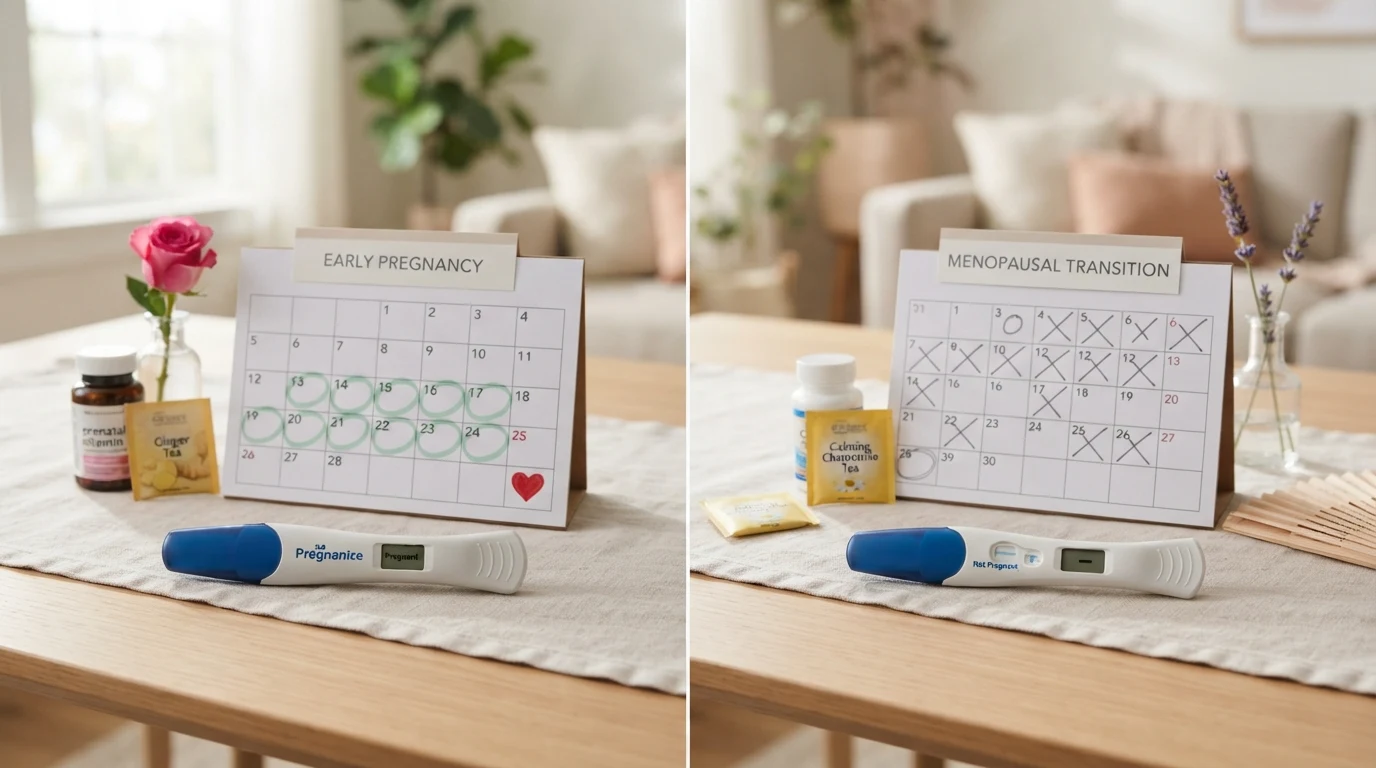
The phrase pregnant or menopause usually describes a common question: “My period is late or has stopped. Am I pregnant, or am I entering menopause?”
These are two very different conditions.
Pregnancy begins when a fertilized egg develops inside the uterus. Early pregnancy can cause hormonal changes that lead to symptoms such as a missed period, tiredness, breast tenderness, nausea, food cravings, mood changes, and more frequent urination. Not everyone experiences the same symptoms.
Menopause is a natural stage of life when menstrual periods stop permanently and pregnancy is no longer possible naturally. The transition before menopause is called perimenopause. During this stage, hormone levels change and periods can become irregular.
The important point is that perimenopause is not the same as menopause.
A woman can be in her 40s or 50s, have irregular periods, and still become pregnant. Therefore, if pregnancy is possible, it should not be ruled out simply because periods have become irregular.
Pregnancy Symptoms and Menopause Symptoms Can Overlap
One reason this question can be confusing is that some symptoms occur in both situations.
For example, tiredness, mood changes, breast changes, headaches, and changes in menstrual patterns can have several possible causes.
Pregnancy commonly causes a missed period, nausea or vomiting, breast tenderness, fatigue, food cravings or aversions, mood changes, headaches, and frequent urination.
Menopause and perimenopause can cause irregular periods, hot flashes, night sweats, sleeping difficulties, vaginal dryness, urinary changes, mood changes, and problems with concentration or memory.
Here is a simple comparison:
| Symptom or sign | Pregnancy | Perimenopause / menopause |
| Missed period | Common | Common during the transition |
| Irregular periods | Possible | Very common during perimenopause |
| Nausea | Common in early pregnancy | Not a typical menopause symptom |
| Breast tenderness | Common | Can happen with hormonal changes |
| Fatigue | Common | Can happen, especially with poor sleep |
| Hot flashes | Not a typical early pregnancy sign | Common |
| Night sweats | Not a typical early pregnancy sign | Common |
| Frequent urination | Can occur | Urinary problems can occur around menopause |
| Vaginal dryness | Not a typical early pregnancy sign | Common around menopause |
| Food cravings or aversions | Common | Not a typical menopause sign |
| 12 months without a period | Not a sign by itself | Defines menopause when no other cause is present |
This table is only a general guide. Symptoms cannot reliably diagnose pregnancy or menopause on their own.
How Early Pregnancy Can Feel
Early pregnancy can look different from one person to another. Some people notice several symptoms, while others notice very few.
One of the most recognizable signs is a missed menstrual period. However, a late period can have many causes, so it does not prove pregnancy.
Other early pregnancy symptoms may include nausea, vomiting, tiredness, tender or swollen breasts, headaches, food cravings, food aversions, mood changes, and frequent urination.
Nausea is often called “morning sickness,” but it does not necessarily happen only in the morning. It can occur at different times of the day.
Fatigue can also appear early. Hormonal changes during pregnancy contribute to this feeling, and some people notice unusual tiredness before they realize they are pregnant.
Still, none of these symptoms should be used alone to diagnose pregnancy.
For example, feeling tired does not automatically mean pregnancy. Stress, poor sleep, illness, medications, and hormonal changes can also cause tiredness.
How Perimenopause and Menopause Can Feel

Perimenopause is the transition leading to menopause. It often begins with changes in menstrual patterns.
A period that used to arrive regularly may become shorter, longer, heavier, lighter, closer together, or farther apart. These changes can happen because ovarian hormone production is changing.
Hot flashes are another well-known symptom. A hot flash may feel like a sudden wave of heat, often involving the face, neck, or upper body. Sweating can follow, and some people may feel cold afterward.
Night sweats may also interrupt sleep. Poor sleep can then contribute to daytime tiredness, low energy, or difficulty concentrating.
Other symptoms can include vaginal dryness, changes in sexual interest, urinary problems, mood changes, joint or muscle discomfort, and trouble sleeping. Not every woman experiences all of these symptoms.
Menopause itself is different from perimenopause. According to the National Institute on Aging, menopause is reached after a full year without a menstrual period or spotting.
Pregnancy vs. Menopause: Key Differences
Looking at the overall pattern can make the situation easier to understand.
If your period is late and you also have nausea, breast tenderness, unusual fatigue, food aversions, or frequent urination, pregnancy is one possibility.
If your periods have been changing for months or years and you also have hot flashes, night sweats, vaginal dryness, and sleep problems, the symptoms may fit the menopausal transition.
But there is an important overlap.
A person in perimenopause can still become pregnant. This means symptoms associated with perimenopause should not be treated as proof that pregnancy is impossible.
| Question | More consistent with pregnancy | More consistent with perimenopause |
| Was there recent unprotected sex? | Yes | Does not rule out pregnancy |
| Is nausea present? | Can occur | Less typical |
| Are hot flashes frequent? | Less typical | Common |
| Have periods become irregular over months? | Less typical | Common |
| Are there new food aversions? | Can occur | Less typical |
| Are night sweats common? | Less typical | Common |
| Has there been 12 months with no period? | Pregnancy test may still be needed if symptoms or bleeding occur | Consistent with menopause if no other cause |
These patterns are clues, not a diagnosis.
A Missed Period Does Not Always Mean Menopause
A missed period can be caused by many things.
Pregnancy is one possibility. Menopause and perimenopause are others. Hormonal birth control, stress, certain medical conditions, medications, changes in weight, excessive exercise, and other factors can also affect menstrual cycles.
That is why it can be risky to assume that a missed period has only one explanation.
If pregnancy is possible, a pregnancy test is often a useful first step.
If the test is negative but periods remain absent or unusual, speaking with a healthcare professional can help identify the reason.
This is especially important when menstrual changes are new, severe, or unusual for you.
When Should You Take a Pregnancy Test?
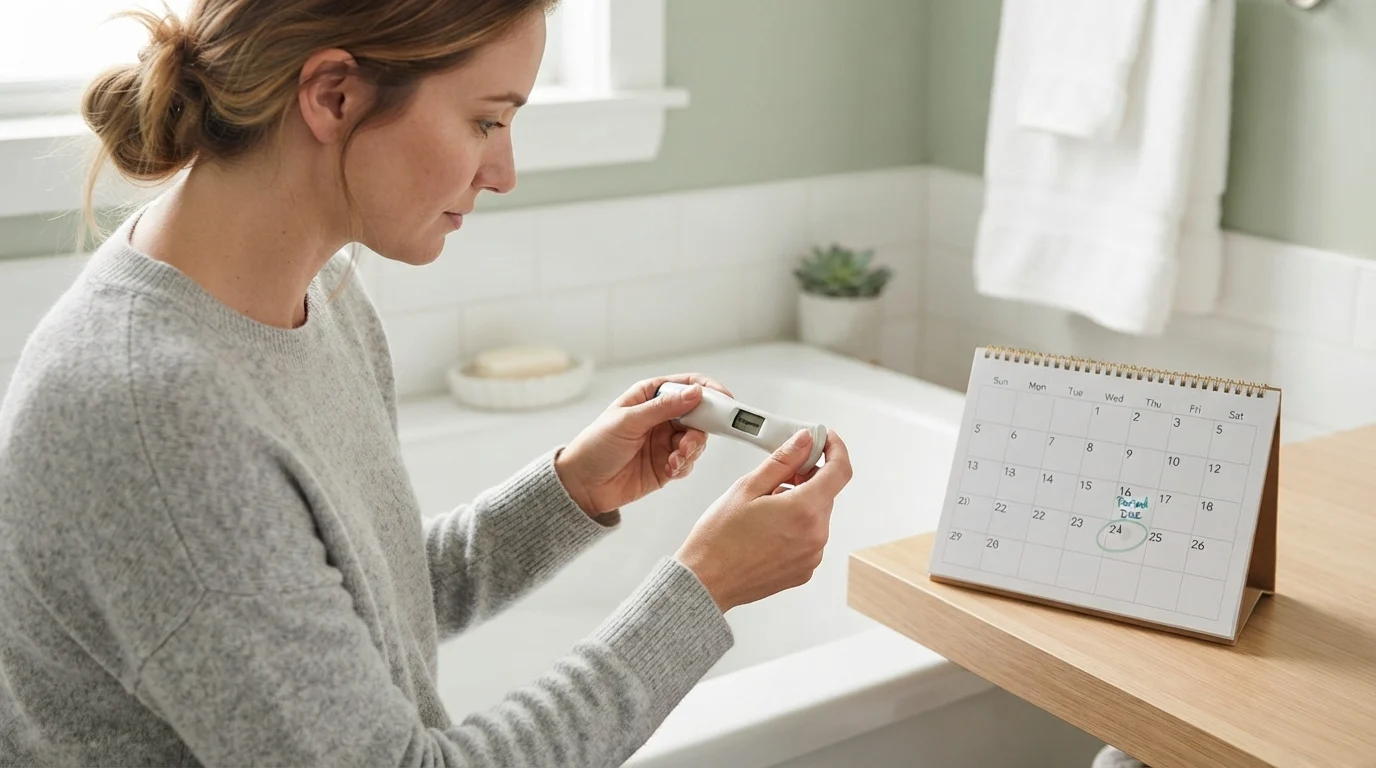
Home pregnancy tests detect hCG in urine. This hormone rises after pregnancy begins.
The FDA explains that testing too early can produce a false-negative result because there may not yet be enough hCG for the test to detect. For more reliable results, the FDA advises testing 1–2 weeks after a missed period and following the instructions provided with the test.
Some tests are designed to detect pregnancy earlier, but early testing can still miss a pregnancy.
If you get a negative result but still think you could be pregnant, repeating the test several days later may provide a clearer answer because hCG normally rises quickly during early pregnancy.
A positive home pregnancy test generally means pregnancy is likely, but you should contact a healthcare professional for appropriate follow-up.
Can You Get Pregnant During Perimenopause?
Yes.
This is one of the most important facts to understand when comparing pregnant or menopause.
During perimenopause, periods can become irregular, but ovulation can still happen. Because ovulation can occur before a menstrual period, pregnancy can still occur even when periods are unpredictable.
Menopause is different because it means the menstrual cycle has stopped permanently.
The National Institute on Aging states that you know you have reached menopause when you have gone 12 months without a period or spotting. Until then, pregnancy prevention may still be needed if you do not want to become pregnant.
This distinction is especially important for someone who thinks an irregular cycle automatically means fertility has ended.
What If the Pregnancy Test Is Negative?
A negative test can be reassuring, but timing matters.
If you test too early, the test may not detect enough hCG even if you are pregnant. The FDA notes that some women may still receive a negative pregnancy test on the first day of a missed period, especially if they test too early.
If your period does not arrive, consider repeating the test according to the test instructions or talking with a healthcare professional.
If repeated tests remain negative and your periods continue to be absent or irregular, there may be another reason.
Possible causes of missed periods include hormonal changes, menopause, pregnancy, certain health conditions, medications, and other factors.
A healthcare professional can consider your age, menstrual history, symptoms, medications, and overall health when deciding If further testing is needed.
When Menstrual Changes Should Be Checked
Irregular periods can happen during perimenopause, but some types of bleeding should not simply be ignored.
The National Institute on Aging recommends discussing symptoms with a healthcare professional if periods become very heavy, happen unusually close together, last more than a week, or involve spotting between periods or after sex. Bleeding or spotting after a full year without periods should also be checked.
These changes do not automatically mean something serious is wrong. They simply deserve proper evaluation.
It is also helpful to keep track of your periods. Write down when bleeding starts, how long it lasts, how heavy it is, and any symptoms such as hot flashes, nausea, breast tenderness, or pelvic discomfort.
This information can help a healthcare professional understand your pattern.
Can Menopause Symptoms Be Treated?
Menopause is a natural stage of life, so not everyone needs treatment.
Some people have mild symptoms, while others have symptoms that interfere with sleep, work, relationships, or daily activities.
Lifestyle changes may help some symptoms. The National Institute on Aging notes that options can include lifestyle changes, nonhormonal medicines, and hormone treatment, depending on the individual situation.
For example, keeping a bedroom cool may help with night sweats. Regular physical activity can also support general health.
Treatment decisions should be made with a healthcare professional because medical history, symptoms, age, and personal risks all matter.
Avoid starting hormone medicines or other treatments simply because symptoms appear similar to menopause.
Common Mistakes When Comparing Pregnancy and Menopause
One common mistake is assuming that a missed period automatically means menopause.
A missed period can happen for many reasons, including pregnancy.
Another mistake is assuming that hot flashes automatically mean pregnancy is impossible. Someone going through perimenopause can still become pregnant.
A third mistake is relying only on symptoms.
Symptoms can provide clues, but they cannot reliably distinguish pregnancy from every other cause of menstrual changes.
Another mistake is taking a pregnancy test very early and assuming a negative result always rules out pregnancy. Testing too early can cause a false-negative result.
Finally, some people assume menopause has happened after a few months without a period. True menopause is defined after 12 months without a period or spotting.
Real-Life Examples of Pregnant or Menopause Questions
Imagine a woman in her late 40s who has always had regular periods. Over the last six months, her periods have become unpredictable, and she now has hot flashes and night sweats. These symptoms may fit perimenopause.
However, if she has had sex without reliable contraception and her period is late, pregnancy may still need to be considered because fertility can continue during perimenopause.
Now consider someone who has missed a period and suddenly develops nausea, breast tenderness, unusual fatigue, and food aversions. These can be early pregnancy symptoms, although they are not proof of pregnancy.
A home pregnancy test can help provide an answer.
Another example is someone who has had no period or spotting for 12 months. If there is no other explanation, this meets the usual definition of menopause.
These examples show why age and symptoms alone cannot always answer the question.
What to Do If You Are Unsure
This can make your healthcare visit more useful.If you are wondering whether you are pregnant or experiencing menopause, start with one important question: Could you be pregnant?
This information can help your healthcare professional understand what may be happening.If pregnancy is possible, take a home pregnancy test at the appropriate time and follow the instructions carefully. This information can help your healthcare professional better undersIf the result is positive, contact a healthcare professional to confirm the pregnancy and learn about the next steps in your care.
If the test is negative but your period still does not come, consider taking another test after a few days or speaking with a healthcare professional, especially if pregnancy is still possible.
If your symptoms seem more consistent with perimenopause, keep track of your menstrual cycle and any changes you notice, such as hot flashes, night sweats, sleep problems, or mood changes. This information can help your healthcare professional better understand your symptoms.
Do not assume that every new symptom is caused by menopause. A healthcare professional can help determine If the changes are part of the menopausal transition or have another cause.
FAQs About Pregnant or Menopause
Can menopause symptoms feel like pregnancy?
Yes. Some symptoms can overlap, especially fatigue, breast changes, mood changes, and changes in menstrual patterns. However, hot flashes and night sweats are more commonly associated with perimenopause, while nausea, food aversions, and frequent urination can occur during early pregnancy.
Can you be pregnant during perimenopause?
Yes. Perimenopause does not mean pregnancy is impossible. Ovulation can still occur even when periods become irregular. If pregnancy is not desired, contraception may still be needed until menopause has been reached.
How do I know if I am in menopause?
Menopause is generally confirmed after you have gone 12 full months without a menstrual period or spotting. The years before that are called perimenopause and may include irregular periods and other symptoms.
Can a pregnancy test be negative when you are pregnant?
Yes. Testing too early can result in a false-negative because hCG may not yet be high enough for the test to detect. If pregnancy is still possible, follow the test instructions and consider repeating the test later.
Does a missed period always mean pregnancy?
No. A missed period can have many causes, including pregnancy, perimenopause, stress, certain health conditions, medications, and other hormonal changes. A pregnancy test can help when pregnancy is possible.
When should I talk to a doctor about missed or irregular periods?
Talk with a healthcare professional if your menstrual pattern changes significantly, especially if you have very heavy bleeding, periods that occur unusually close together, bleeding after sex, periods lasting more than a week, or bleeding after a full year without periods.
Conclusion
When you are asking pregnant or menopause, the answer may not be obvious from symptoms alone. Pregnancy and perimenopause can share several signs, especially missed or changing periods, tiredness, mood changes, and breast symptoms.
The key difference is that pregnancy can happen while ovulation is still possible, whereas menopause means menstrual periods have permanently stopped. Perimenopause is the transition between regular reproductive cycles and menopause.
If pregnancy is possible, a properly timed home pregnancy test is a practical first step. Testing too early can produce a negative result even when pregnancy is present.
If your periods or symptoms continue to change, talk with a healthcare professional rather than trying to diagnose yourself from symptoms alone. Getting the right answer can help you choose the next appropriate step.

Hi, I’m Iqra, a passionate writer and grammar enthusiast dedicated to making English grammar simple, clear, and easy to understand. Through my work on grammar books and educational content, I help students, writers, and English learners improve their vocabulary, sentence structure, punctuation, and everyday communication skills. My goal is to turn confusing grammar rules into practical, easy-to-follow lessons that readers can confidently use in real life. I believe learning grammar doesn’t have to be difficult—it can be simple, useful, and even enjoyable. Through helpful guides, examples, and carefully explained grammar tips, Iqra aims to make learning English more accessible for everyone.