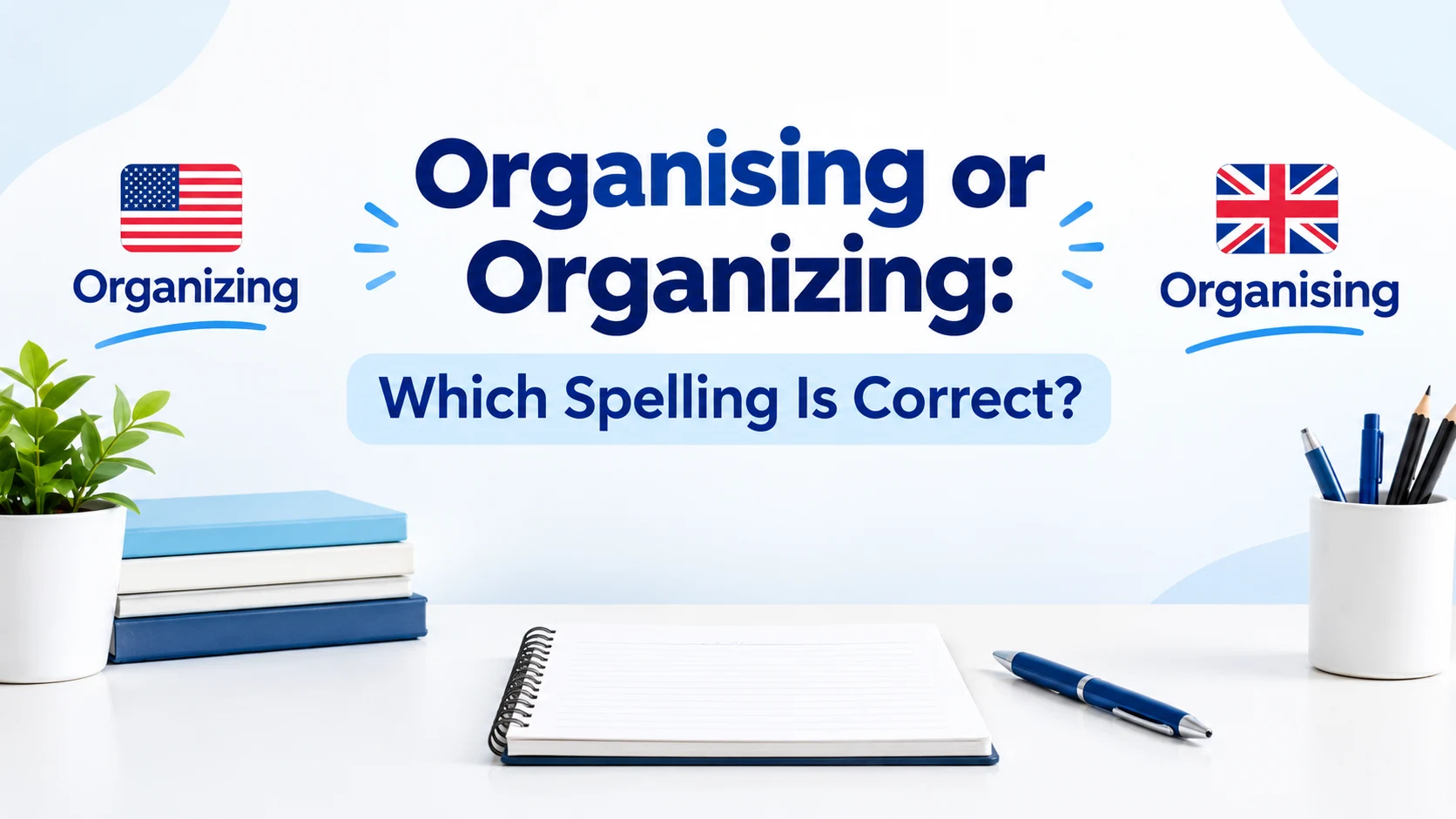
Should you write organising or organizing? Here is the short answer. Both are correct. Organizing is the American spelling, and organising is the British spelling. If you write for readers in the United States, use organizing.
You may have seen both spellings online, in emails, or on signs. That can be confusing. Many people stop and wonder if one of them is a mistake.
It is not. Small spelling choices can make your writing look careful and professional. This guide will explain the difference in plain words. You will learn what the word means, where each spelling is used, and how to avoid common mistakes. You will also see real examples, easy tips, and answers to common questions. By the end, you will know exactly which spelling to pick every time.
Quick Answer: Which One Should You Use?
In the United States, the right choice is organizing. It uses a z. In the United Kingdom, Australia, and New Zealand, people usually write organising with an s. Canada mostly uses the z spelling, like the United States, though Canadian writing mixes in some British habits.
Neither spelling is wrong. They are two versions of the same word. They mean the same thing, and they sound the same when you say them out loud. The only difference is where your reader lives and which style guide you follow.
Here is a simple rule. Pick one spelling and stick with it in the whole piece of writing. If your reader is American, choose organizing. If your reader is British, Australian, or from New Zealand, organising is the safer pick. Mixing both in one article looks careless, and readers notice it more than you might think.
What Does Organizing Mean?

Organizing means putting things in order so they are easy to find, use, or understand. When you organize your desk, you put pens in one spot, papers in another, and trash in the bin. When you organize your thoughts, you sort your ideas so they make sense.
The word is a verb, and it has a few common uses.
First, it can mean arranging things. You might organize books by color or by author. Second, it can mean planning an event or an activity. A teacher might organize a field trip. A neighbor might organize a yard sale. Third, it can mean bringing people together for a shared goal. Workers organize a union. Volunteers organize a food drive.
The idea behind all three uses is the same. Someone takes a messy or scattered set of things and gives them a clear shape. That is why the word is so popular. We use it at home, at school, at work, and in the community. It is a small word that does a big job.
Organising or Organizing: British vs. American English
Many spelling differences between American and British English follow patterns. This is one of the biggest. British English often uses the ending -ise. American English uses the ending -ize. That is why one word ends up with two forms.
Every form of the word changes the same way. Here is how the word family looks in each style.
| Word Form | American English | British English |
| Base verb | organize | organise |
| Third person (he, she, it) | organizes | organises |
| Past tense | organized | organised |
| -ing form | organizing | organising |
| Person or tool that organizes | organizer | organiser |
| Group or act of organizing | organization | organisation |
| Adjective | organizational | organisational |
Now let’s look at where each spelling is common around the world.
| Country or Region | Usual Spelling | Quick Note |
| United States | organize | The standard spelling in American writing |
| United Kingdom | organise | Common in news, schools, and government |
| Canada | organize | Usually follows the American z |
| Australia | organise | Follows British style |
| New Zealand | organise | Follows British style |
There is one more twist. Some British publishers, including Oxford University Press, use -ize endings even though they use British spelling for other words. This style is often called Oxford spelling. So you may find “organize” in a British book. That is a choice, not a mistake.
Where Did the Word Come From?

The word has a long history. It goes back to the Greek word organon, which meant a tool or an instrument. The Latin word organum grew from it. Later, French and Medieval Latin forms helped shape the English word we use today.
In early use, an “organ” was a tool. Something that was “organized” was made of working parts that fit together. This is also why your body has organs. Each organ has a job, and together they work as one system.
Many people think the z spelling is a new American change. That is a common myth. The -ize ending comes from a Greek ending that English borrowed through Latin and French. English writers used the z form for hundreds of years, and it stays closer to the Greek root. The -ise spelling grew in Britain, partly because French words often end in -ise. Later, American dictionary writers such as Noah Webster helped make the z spelling the standard in the United States.
Exact dates for when each spelling first appeared are hard to pin down, so this guide sticks to the broad story. The main point is simple. Neither spelling is a mistake, and each has deep roots.
How to Use the Word Correctly
Organize is a regular verb, so it is easy to use. You change its ending just like most other verbs.
Use organize for the base form. “I need to organize my closet.” Add an s when the subject is he, she, or it. “She organizes her week every Sunday.” Add a d for the past tense. “We organized the party in one day.” For an action that is happening now, drop the final e and add -ing. “They are organizing a bake sale.”
That last step trips people up. The word is not “organizeing.” You remove the e before adding -ing, just like you do with “make” and “making.”
The word also has helpful family members. An organizer is a person who plans things, or a tool like a desk organizer or a paper planner. An organization is a group, such as a club, a company, or a charity. It can also mean the act of putting things in order. “Good organization saves time.” The word organized can describe a person too. “My sister is very organized.”
You will also see it in a few common phrases. “Get organized” means to bring order to your life or space. “Well-organized” describes something that is neatly arranged. When it comes before a noun, it usually gets a hyphen, as in “a well-organized meeting.” “Organized crime” is a set phrase that means groups that carry out crimes in a planned way.
Common Mistakes to Avoid
Most mistakes with this word are small, but they can make writing look sloppy. Here are the ones that show up most often.
The biggest mistake is mixing spellings in the same piece. For example, someone might write “We organised the event, and the organizers were thrilled.” One word uses s and the other uses z. Pick one style and use it everywhere.
Another mistake is keeping the e before -ing. Some writers type “organizeing” or “organiseing.” The correct forms are “organizing” and “organising.”
A third mistake is a plain spelling slip. The middle of the word trips people up. You might see “orginize” or “organaze.” The safe way to remember it is that the word begins with “organ,” like the body part.
The fourth mistake is choosing a spelling that does not match your reader. An American company that uses “organisation” on its website may look a little out of place to local readers. A British school that uses “organization” may get the same reaction, unless it follows Oxford spelling on purpose.
The last mistake is going too far. Some people learn that British English uses -ise and then use it everywhere, or the opposite. Some words end in -ise in both styles because they are not built from the same ending. Look at the table below.
| Situation | Wrong | Right |
| Mixing styles in one article | organised and organizing | organized and organizing (or organised and organising) |
| Adding -ing to the wrong base | organizeing | organizing |
| Missing the “a” in “organ” | orginize | organize |
| Using the z in words that need s | advertize, exercize | advertise, exercise |
| Using American spelling for a British reader | organization (in a UK-only style guide) | organisation |
Words like “advertise,” “exercise,” “revise,” “surprise,” and “supervise” keep the s in both American and British English. So do not swap them just because you like the z spelling.
Real-Life Examples

Seeing the word in real sentences makes the difference easy to spot. Here are examples for daily life, first in American style and then in British style.
At home, an American might say, “I am organizing my kitchen this weekend.” A British speaker would write, “I am organising my kitchen this weekend.” The action is the same. Only the spelling changes.
At school, a teacher in the United States could write, “Ms. Lopez organized a reading night for families.” In the United Kingdom, the sentence would be, “Ms. Lopez organised a reading night for families.” A student might also say, “I keep my notes organized in one binder.”
At work, an American manager could say, “Our team is organizing a training day.” A manager in Australia would likely write, “Our team is organising a training day.” A company might also describe its new “organizational chart” or “organisational chart,” depending on the country.
In the community, a group of neighbors might say, “We are organizing a cleanup for the park.” A charity in New Zealand might write, “The organisers are asking for volunteers.”
Notice that the spelling changes in every form of the word. If you choose organizing, then you also use organized, organizer, and organization. If you choose organising, then you also use organised, organiser, and organisation. Stay with one set and your writing will feel smooth and steady.
Tips for Choosing the Right Spelling
You do not have to guess. A few simple steps can help you pick the right spelling every time.
Start with your reader. Ask yourself where most of them live. “Match your spelling to your reader: z for the US, s for the UK, Australia, and New Zealand. For a mixed audience, pick the majority and don’t switch.”
Next, check your style guide. Many schools, companies, and publishers have one. American writers often follow guides like the AP Stylebook or the Chicago Manual of Style, along with a dictionary such as Merriam-Webster. British writers often use Oxford or Cambridge dictionaries and guides. If your boss or teacher gives you a guide, follow it.
Then set your spellcheck tool to the right language. Word processors and writing apps let you choose English (US), English (UK), and other versions. This one step catches many mix-ups before anyone else sees them.
Finally, read your work once more just for spelling patterns. Look for words that end in -ize or -ise, and make sure they match. This takes less than a minute, and it can make your writing look far more polished.
If you write online, remember one more point. Search engines usually understand that both spellings mean the same thing. Still, using the spelling your readers expect makes your page feel more natural to them.
Current Usage and Trends
Exact numbers change all the time, so this guide will not quote any. But a few patterns are easy to see.
The z spelling is very common online. One reason is that the United States has a very large online audience. Another reason is that many apps and tools use American English as their default setting. The s spelling is still the standard in British news, schools, and government writing, and it is common in Australia and New Zealand.
The topic itself is also popular. Interest in decluttering, home storage, and tidy spaces has grown a lot in recent years. Many people now hire professional organizers, use planning apps, or follow home-organizing tips on video sites. Because of this, you will see the word in many places, from shopping guides to school newsletters.
Because both spellings are so common, many writers pick one and stay with it. That is a smart plan. Your readers care more about clear writing than about a single letter. Still, a steady spelling shows you paid attention.
Easy Ways to Remember the Difference

Memory tricks can help when you are in a hurry. Here is a fun one. In the United States, the letter Z is called “zee.” In Britain, it is called “zed.” Since Americans love the z sound in their alphabet, it can help you link the z spelling to American English.
Another trick is to connect the word to your audience. Before you write, ask, “Who is reading this?” Then choose the spelling that matches. After a few tries, it becomes a habit.
You can also make a tiny note near your desk that says “US = z, UK = s.” It may sound silly, but it works. Small reminders save you from small mistakes.
FAQs
Is it organising or organizing?
Both are correct. Organizing is the American spelling, and organising is the British spelling. Choose the one that fits your readers.
Is organising wrong in American English?
It is not wrong, but it looks British to most American readers. In writing for a United States audience, organizing is the better choice.
Can I use both spellings in one article?
It is best not to. Mixing them makes your writing look uneven. Pick one style and use it from the first word to the last.
Is it organization or organisation?
The same rule applies. American English uses organization with a z. British English uses organisation with an s. If you write “organizing,” match it with “organization.” If you write “organising,” match it with “organisation.”
What is Oxford spelling?
Oxford spelling is a style used by some British publishers. It uses British spelling for most words but keeps the -ize ending for words like organize. So a British book might use “organize” on purpose.
How can I set my spellcheck to the right version of English?
Open the language settings in your writing app and choose English (US) or English (UK). Once you set it, the tool will flag spellings that do not match your choice.
Conclusion
The choice between organising or organizing is much simpler than it looks. Both spellings are correct. Organizing is the standard in the United States and mostly in Canada. Organising is the usual choice in the United Kingdom, Australia, and New Zealand. The meaning stays the same in every place.
The key to good writing is to know your reader and pick the spelling that fits. Then stay steady. Use organize, organized, organizing, organizer, and organization together, or use their British partners together. Do not mix them.
Here is one last piece of practical advice. Set your spellcheck to the right English before you start, and give your work a quick final read. A few seconds of care can help your writing look clear, confident, and professional.

Hi, I’m Iqra, a passionate writer and grammar enthusiast dedicated to making English grammar simple, clear, and easy to understand. Through my work on grammar books and educational content, I help students, writers, and English learners improve their vocabulary, sentence structure, punctuation, and everyday communication skills. My goal is to turn confusing grammar rules into practical, easy-to-follow lessons that readers can confidently use in real life. I believe learning grammar doesn’t have to be difficult—it can be simple, useful, and even enjoyable. Through helpful guides, examples, and carefully explained grammar tips, Iqra aims to make learning English more accessible for everyone.