
Have you ever typed “dam” when you meant “damn,” or the other way around? You are not alone. These two words sound almost the same when you say them out loud, but they mean completely different things.
A dam is a wall built to hold back water, while damn is a word people use to show anger, surprise, or frustration. Mixing them up in an email or a school paper can make your writing look careless, even if you know exactly what you meant to say.
In this guide, you will learn the exact meaning of each word, how to use them correctly in a sentence, and the common mistakes people make. By the end, you will never confuse “dam” and “damn” again.
Quick Answer
Dam and damn are two different words that just happen to sound alike. A dam is a structure, usually made of concrete, earth, or rock, built across a river to stop or control the flow of water.
Damn, on the other hand, is used to express strong feelings like anger or surprise, and it can also mean to condemn someone or something. The words are spelled differently, and they are used in totally different situations.
Meaning or Definition
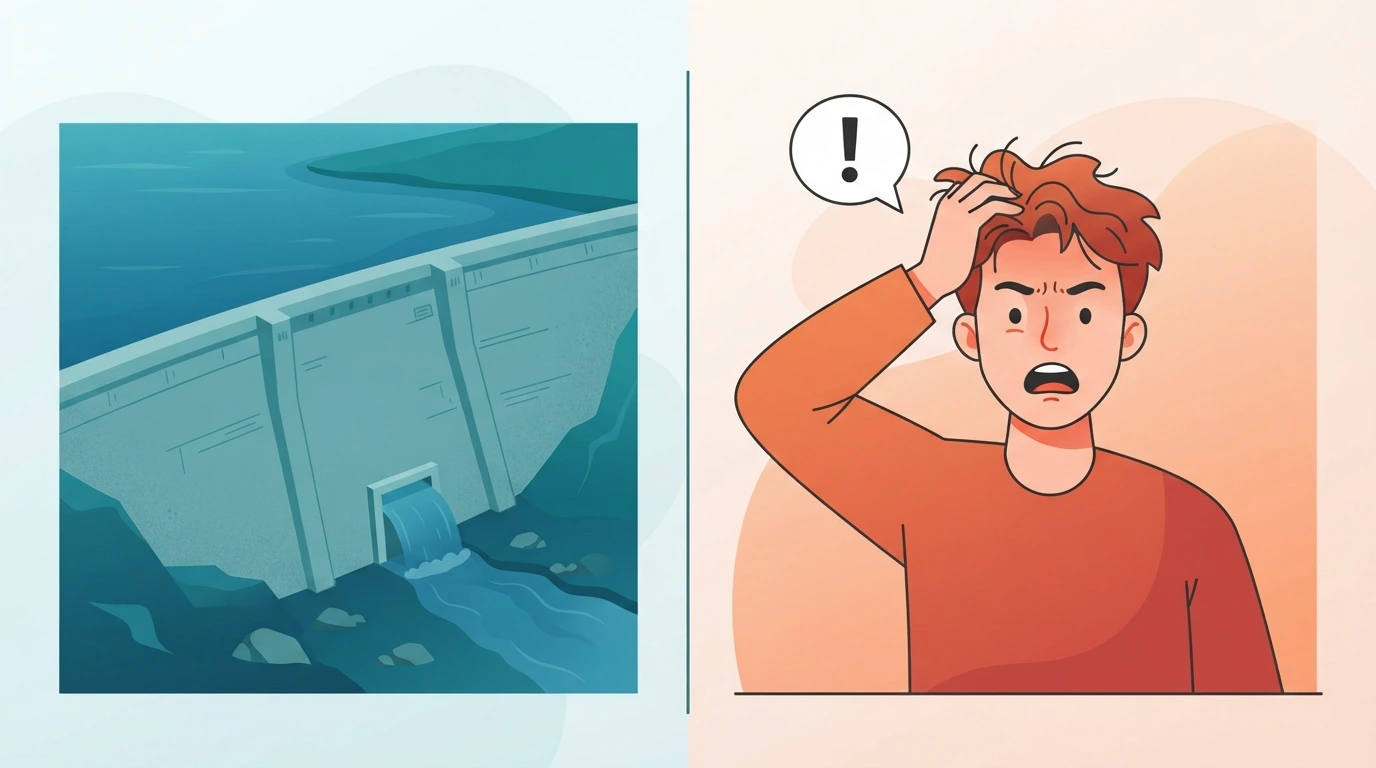
Let’s break down each word on its own, since that makes the difference much easier to remember.
A dam is a noun. It refers to a physical barrier built across a river, stream, or other body of water. People build dams to store water, control flooding, or generate electricity through hydropower. The Hoover Dam in the United States is one of the most famous examples in the world. You might also hear “dam” used as a verb, as in “to dam a river,” which means to block it with a structure.
Damn, in contrast, is mostly used as an interjection or exclamation. People say “damn” when they are surprised, annoyed, or impressed. For example, someone might say, “Damn, that was a great game!” The word can also function as a verb, meaning to criticize harshly or to condemn something, such as in the phrase “the critics damned the movie.” In more formal or religious contexts, “damn” can mean to condemn someone to a bad fate, like eternal punishment.
Here’s a simple table to show the core difference at a glance.
| Feature | Dam | Damn |
| Part of speech | Noun (mainly), sometimes verb | Interjection, verb, adjective |
| Basic meaning | A wall that blocks water | An expression of strong emotion or condemnation |
| Example sentence | The dam controls the river’s flow. | Damn, I forgot my keys again! |
| Common context | Engineering, geography, nature | Everyday speech, informal writing |
| Formality | Neutral, can be formal | Informal, sometimes considered mild swearing |
Grammar or Correct Usage
Since these two words look and sound so similar, grammar rules can help you keep them straight.
When you use dam, you are usually talking about something you can see or touch. It fits naturally after words like “the,” “a,” or “this,” just like any regular noun. For example: “The dam broke after the heavy rain.” You can also add an “s” to make it plural, as in “several dams were built along the river.”
When you use damn, you are usually adding emotion to a sentence. It often stands alone, like “Damn!” or it appears before a noun to add emphasis, such as “That’s a damn good idea.” In this second case, “damn” acts like an adjective, describing the noun that follows it. It is important to know that “damn” is considered a mild swear word by many people, so it is best avoided in formal writing, professional emails, or school assignments.
One helpful trick is to remember that “dam” has three letters and refers to something solid and real, like a wall. “Damn” has an extra letter, the silent “n,” which some people connect to the word “condemn,” since both words share that root meaning of judgment or punishment.
Common Mistakes
Even careful writers slip up sometimes. Here are the most common errors people make with these two words.
The first mistake is using “dam” when you actually mean “damn.” For example, someone might write “I dam near fell asleep in class,” when they meant to write “I damn near fell asleep in class.” This mix-up often happens because autocorrect or spell check does not always catch it, since both are real, correctly spelled words.
The second mistake is the opposite: using “damn” when talking about a water structure. For instance, writing “They built a damn across the river” is incorrect. The correct word here is “dam,” since you are describing a physical structure, not expressing emotion.
A third common error shows up in idioms. The phrase “I don’t give a damn” is often misspelled as “I don’t give a dam.” While this second version actually has an interesting history (explained in the next section), today the correct and standard spelling is “damn.”
Here is a table showing these common mix-ups side by side, so you can see the correct version at a glance.
| Incorrect Sentence | Correct Sentence | Why It’s Wrong |
| I dam near missed the bus. | I damn near missed the bus. | “Dam” cannot express emotion or emphasis. |
| They built a damn to stop flooding. | They built a dam to stop flooding. | “Damn” is not a physical structure. |
| I don’t give a dam about it. | I don’t give a damn about it. | Modern usage requires “damn” in this idiom. |
| The river dammn broke the banks. | The river dam broke, and water rushed in. | “Dammn” is not a word; only one “n” is used. |
Origin or History
Understanding where these words come from can also help you remember their meanings.
The word “dam” comes from Middle English and Middle Dutch, where it referred to a barrier built to hold back water. This meaning has stayed mostly the same for centuries, and you will find similar words in other Germanic languages, since they share a common root related to blocking or stopping flow.
“Damn” has a more colorful history. It comes from the Latin word “damnare,” which meant to condemn or inflict a penalty on someone. Over time, English speakers began using “damn” as a curse or an exclamation, especially in religious contexts where it referred to being condemned to a bad afterlife. Eventually, its use expanded into everyday speech as a general way to express strong feelings, separate from its original religious meaning.
Interestingly, there’s a popular idiom, “I don’t give a dam,” that some people trace back to an old British coin called a “dam,” which was worth very little money. Under this theory, saying you don’t give a dam meant something was nearly worthless. However, language experts generally agree this is likely a folk explanation, and the phrase almost certainly comes from “damn,” not the old coin. Today, “I don’t give a damn” is the standard and accepted spelling.
Real-Life Examples
Seeing these words used in real sentences can make the difference even clearer.
For “dam,” you might read a sentence like: “Engineers inspected the dam after the earthquake to check for cracks.” Or in a geography lesson: “The Three Gorges Dam in China is one of the largest dams in the world.” News articles often use “dam” when reporting on floods, droughts, or energy projects, since dams play a big role in managing water resources.
For “damn,” everyday conversation offers plenty of examples: “Damn, I can’t believe we won the game!” or “That was a damn good meal.” In movies and books, characters often use “damn” to show frustration, such as “Damn it, I left my phone at home again.” You will also see it in the classic phrase from the film Gone with the Wind: “Frankly, my dear, I don’t give a damn,” which remains one of the most quoted lines in film history.
Tips or Best Practices
Here are a few simple tips to help you choose the right word every time.
First, ask yourself if you are talking about something physical, like water, a river, or a structure. If yes, you need “dam.” Second, ask if you are expressing emotion, emphasis, or judgment. If yes, you need “damn.” This simple question-and-answer approach works almost every time.
Second, remember that “damn” is informal and can be seen as mildly inappropriate in professional or academic writing. If you are writing a school essay, a work email, or a formal report, it’s usually best to avoid “damn” altogether and use a more neutral word like “very,” “extremely,” or “surprisingly” instead.
Third, when in doubt, read your sentence out loud. If you are describing a wall or barrier that holds back water, “dam” almost always fits. If you are adding feeling or punch to your sentence, “damn” is the word you want.
Finally, use spell check as a helper, not a guarantee. Since both “dam” and “damn” are correctly spelled words, your spell checker will not catch this kind of mistake. Proofreading with your own eyes is the best way to catch it.
FAQs
1. What is the main difference between “dam” and “damn”?
“Dam” is a structure that blocks water, while “damn” is a word used to express strong emotion, emphasis, or condemnation. They are spelled and used completely differently, despite sounding alike.
2. Is “damn” considered a swear word?
Yes, many people consider “damn” a mild swear word. It is generally acceptable in casual conversation but is often avoided in formal writing, school assignments, and professional settings.
3. How do you use “dam” in a sentence?
You use “dam” when talking about a physical barrier that controls water, such as “The dam supplies electricity to the entire city.” It can also be used as a verb, as in “They plan to dam the river next year.”
4. Why do people confuse “dam” and “damn”?
The two words sound almost identical when spoken, and both are real English words, so spell checkers often miss the error. This makes it easy to type the wrong one without noticing.
5. Is it “I don’t give a dam” or “I don’t give a damn”?
The correct modern spelling is “I don’t give a damn.” Although some people connect it to an old low-value coin, most language experts agree the phrase comes from the word “damn.”
6. Can “damn” be used as an adjective?
Yes, “damn” can act as an adjective to add emphasis before a noun, such as “That’s a damn shame” or “What a damn mess.” In this form, it strengthens the feeling behind the sentence.
Conclusion
Now that you know the difference, you can use “dam” and “damn” with confidence. Remember, a dam is something real and solid, a structure built to control water.
Damn, on the other hand, is all about emotion, If it’s surprise, frustration, or emphasis. The easiest way to remember which one to use is to ask yourself: am I talking about water, or am I expressing a feeling Keep this simple question in mind, and you’ll never mix up these two words again.
Practice spotting them in books, articles, and everyday conversation, and soon choosing the right one will feel completely natural.

Hi, I’m Iqra, a passionate writer and grammar enthusiast dedicated to making English grammar simple, clear, and easy to understand. Through my work on grammar books and educational content, I help students, writers, and English learners improve their vocabulary, sentence structure, punctuation, and everyday communication skills. My goal is to turn confusing grammar rules into practical, easy-to-follow lessons that readers can confidently use in real life. I believe learning grammar doesn’t have to be difficult—it can be simple, useful, and even enjoyable. Through helpful guides, examples, and carefully explained grammar tips, Iqra aims to make learning English more accessible for everyone.