If you see tiny white or yellowish flakes in your hair, you may wonder, “Are these nits or dandruff?” The easiest clue is that dandruff usually flakes off the scalp and hair easily, while nits are lice eggs that stick firmly to individual hair shafts.
Both can cause an itchy scalp and can look similar at first glance. However, they are very different problems. Dandruff is a common scalp condition that causes flakes of dead skin. Nits are eggs laid by head lice and are usually attached close to the scalp.
Knowing the difference matters because dandruff does not require lice treatment, while an active head-lice infestation needs appropriate treatment. In this guide, you will learn what nits and dandruff look like, how they differ, how to check your hair, what symptoms to watch for, and when to ask a healthcare professional for help.
Quick Answer: Are These Nits or Dandruff?
The main difference between nits or dandruff is how they attach to the hair. Dandruff consists of loose flakes of scalp skin that usually brush, shake, or fall away easily. Nits are lice eggs that are firmly attached to individual strands of hair and can be difficult to remove.
Nits are often found close to the scalp, especially behind the ears and around the back of the neck. They can look like tiny yellow, brown, tan, or whitish seeds. Dandruff is usually more irregular and flaky.
It is also important to remember that an itchy scalp does not automatically mean you have lice. Dandruff, eczema, dry skin, and other scalp problems can also cause itching.
If you find a suspected nit, gently try to move it along the hair shaft. A flake of dandruff usually comes away easily. A true nit tends to remain firmly attached.
| Feature | Nits | Dandruff |
| What it is | Lice eggs | Loose scalp skin flakes |
| Attached to hair? | Yes, firmly | Usually no |
| Appearance | Small, oval, seed-like | Flaky or irregular |
| Usually near scalp? | Yes | Can occur anywhere flakes fall |
| Easily brushed away? | Usually no | Usually yes |
| Contagious? | Associated with head lice | No |
| Main concern | Possible head-lice infestation | Scalp flaking |
What Are Nits?
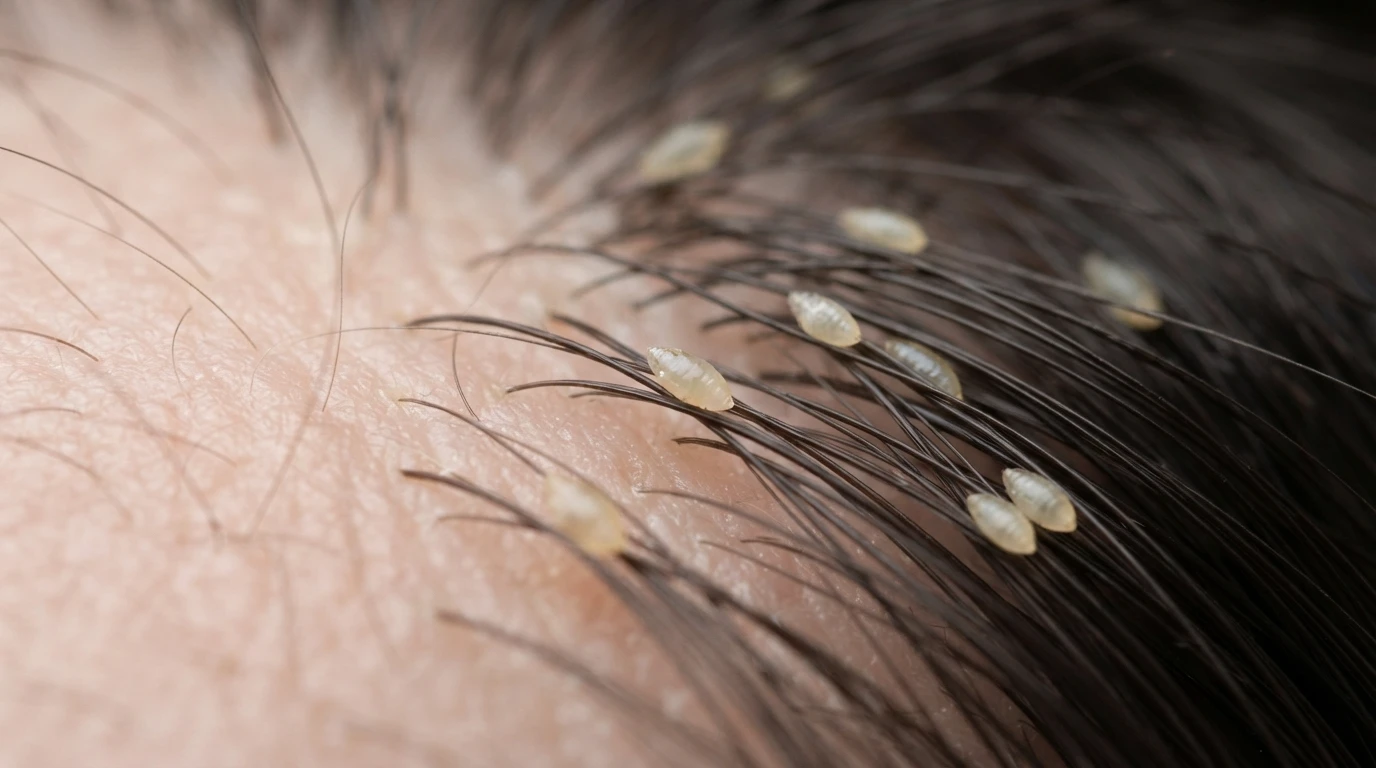
Nits are the eggs of head lice. Adult female head lice attach their eggs to individual hair shafts with a sticky substance. The eggs are usually placed close to the scalp because they need the warmth of the scalp to develop.
Nits are extremely small, so they can be difficult to identify without good lighting. They may appear yellow, brown, tan, or whitish. After an egg hatches, the remaining shell can look clearer or lighter.
Nits are most commonly noticed around the ears and near the hairline at the back of the neck. These are useful areas to inspect if you suspect head lice.
Finding a nit does not always mean there are active lice right now. Some nits may be empty shells, and nits located farther away from the scalp may be old or already hatched. The CDC notes that nits more than about one-quarter inch from the scalp are often hatched or dead.
For that reason, finding a live crawling louse is the strongest sign of an active head-lice infestation.
What Does Dandruff Look Like?
Dandruff is a common scalp condition that causes small pieces of skin to flake from the scalp. The flakes can appear white, grayish, or sometimes slightly yellow, depending on the scalp and its oils.
Unlike nits, dandruff is not an insect or an egg. It is related to the way the scalp sheds skin. Dandruff can also be linked with oily or irritated skin, dry skin, sensitivity to hair products, and a skin condition called seborrheic dermatitis.
Dandruff may appear on your shoulders, clothing, hair, eyebrows, or around the scalp. It may become more noticeable during cold, dry weather or periods of stress.
One of the most useful clues is movement. If the white material falls away when you brush, scratch, or gently shake the hair, it is more likely to be dandruff than a nit.
Nits or Dandruff: What Is the Difference?
The biggest difference between nits or dandruff is attachment.
A nit is attached directly to a hair shaft. It tends to stay in place even when you move the hair. Dandruff, on the other hand, is loose skin that can usually be brushed or washed away.
Nits also tend to have a small, oval, seed-like appearance. Dandruff usually looks more like irregular flakes.
Here is a simple comparison:
| What You Notice | More Likely Nits | More Likely Dandruff |
| Firmly stuck to one hair | ✓ | |
| Falls onto shoulders | ✓ | |
| Looks like a tiny oval seed | ✓ | |
| Looks like an irregular flake | ✓ | |
| Difficult to remove with fingers | ✓ | |
| Comes away during brushing | ✓ | |
| Live crawling insects nearby | ✓ | |
| General scalp flaking | ✓ |
Still, appearance alone is not always enough. Nits can easily be confused with dandruff, dirt, hair-product residue, or other small particles in the hair.
How to Tell Nits From Dandruff at Home
You can often get a better idea by carefully examining the scalp and hair under bright light.
Start by separating the hair into small sections. Look closely around the scalp, behind the ears, and near the back of the neck. These are common places to find head lice and nits.
If possible, use a fine-toothed lice comb. A wet-hair examination can also make moving lice easier to spot. Slowly comb through small sections from the scalp outward.
Then look at anything you find.
If it is loose and falls away easily, it may be dandruff or another harmless particle. If it looks like a tiny seed and seems cemented to the hair shaft, it may be a nit.
The CDC recommends looking for crawling lice or nits attached close to the scalp. It also points out that misidentifying dandruff as nits is common.
Do not rely only on itching. Some people with head lice do not have symptoms at first, while dandruff can cause significant itching without any lice being present.
Where Are Nits Usually Found?
Nits can be found throughout the hair, but they are commonly seen close to the scalp. The areas behind the ears and around the back of the neck deserve special attention.
Female lice attach their eggs to hair shafts near the scalp. The eggs usually hatch in about a week, although the exact timing can vary.
If you see suspected nits far down the hair shaft, they may be old, empty, or dead. This is why simply finding something that looks like a nit does not always prove that an active infestation is present.
A live louse is much more useful when determining whether head lice are currently present.
Does Dandruff Cause Head Lice?
No. Dandruff does not cause head lice.
Dandruff is a scalp condition involving skin flaking. Head lice are tiny parasitic insects that live on the human scalp and feed on blood. They are completely different conditions.
Having dandruff does not mean someone is more likely to get head lice.
Head lice are also not caused by poor hygiene. The CDC and Mayo Clinic explain that head lice can affect people regardless of how clean their hair or home is.
This is an important point because people sometimes feel embarrassed when they discover lice. There is no reason to feel ashamed.
Can Nits Look Like Dandruff?
Yes. Nits can look very similar to small pieces of dandruff, especially when you are seeing them for the first time.
Both may appear as tiny white, yellowish, or pale objects in the hair. They can also be difficult to see clearly without strong lighting.
The key difference is how firmly they are attached. Dandruff usually comes away easily. Nits are attached to the hair shaft and are much harder to remove.
Other things can also look like nits. Hair-product residue, dirt, scabs, and other particles may become trapped in the hair. Mayo Clinic notes that these can sometimes be mistaken for lice eggs.
That is why it is better to examine the entire scalp rather than deciding based on one tiny white spot.
Does Itching Mean You Have Nits?
Not necessarily.
Itching is one of the most common symptoms of head lice, but it can have many other causes. Dandruff, eczema, dry skin, irritation from hair products, and other scalp conditions can also make your scalp itch.
With a first head-lice infestation, itching may not happen right away. The CDC says it can take four to six weeks for itching to appear after the first infestation.
This means you should not use itching alone to decide whether you have lice.
Instead, check the hair carefully for crawling lice and firmly attached nits.
A crawling insect is especially important because finding a live nymph or adult louse is the best way to confirm an active head-lice infestation.
How Head Lice Spread
Head lice mainly spread through direct hair-to-hair or head-to-head contact with someone who has an infestation. They crawl from one person’s hair to another person’s hair. They cannot jump or fly.
Close contact among children is a common way lice can spread. Sharing certain personal items, such as combs, brushes, hats, scarves, or hair accessories, may also allow transmission, although direct head-to-head contact is the main route.
Head lice do not come from dandruff.
They also do not live on household pets. Dogs and cats do not spread human head lice.
Understanding how lice spread can help families avoid unnecessary worry and focus on the steps that actually matter.
What Should You Do If You Find Possible Nits?
If you find something that looks like a nit, first stay calm. Do not immediately assume that you have head lice.
Use bright light and examine the hair carefully. Pay special attention to the areas behind the ears and near the back of the neck.
A fine-toothed lice comb can help you search through the hair. The American Academy of Dermatology recommends wetting the hair, using bright light, separating the hair into sections, and slowly combing from the scalp outward.
If you find a crawling adult louse or nymph, you should follow appropriate head-lice treatment guidance. Over-the-counter and prescription treatments are available, but they should be used exactly according to their instructions.
If you are unsure whether what you see is a nit, dandruff, or something else, a healthcare professional can help confirm the diagnosis.
Avoid repeatedly applying lice treatments simply because you see flakes. Treating the wrong problem can irritate the scalp and will not solve dandruff.
How Dandruff Is Usually Managed
Mild dandruff can often be managed with regular, gentle hair washing. If that does not help, a medicated dandruff shampoo may be useful.
Some dandruff shampoos contain active ingredients designed to reduce the causes of scalp flaking. Different products work in different ways, so it is important to follow the directions on the product you choose.
If a shampoo causes significant burning, itching, or irritation, stop using it. Mayo Clinic also recommends seeking medical attention for signs of a serious allergic reaction.
Dandruff can return even after it improves. That does not necessarily mean you are doing something wrong. For many people, managing dandruff is an ongoing process.
Common Mistakes When Comparing Nits and Dandruff
One common mistake is assuming that every white speck is a nit. Hair can collect dandruff, lint, dirt, product residue, and other particles.
Another mistake is focusing only on itching. Itching is common with lice, but it is also common with dandruff and several other scalp conditions.
A third mistake is trying to diagnose an infestation from one photograph or one small particle. Proper examination of the scalp and hair is much more useful.
People also sometimes believe that lice mean someone has poor hygiene. That is not true. Head lice can affect clean hair and people from many different backgrounds.
Finally, do not assume that finding old-looking nits automatically means there are active lice. Nits farther from the scalp may be old or already hatched.
When Should You See a Healthcare Professional?
Most cases of dandruff can be managed without medical care. However, you may want to see a healthcare professional if your scalp problem does not improve, becomes severe, or is difficult to identify.
If you suspect head lice but cannot tell whether the objects in your hair are actually nits, professional advice can prevent unnecessary treatment.
You should also seek help if scratching causes sores or if the scalp becomes very irritated. Scratching from head lice can create sores that may become infected.
For children, parents or caregivers can ask a healthcare professional or pharmacist for advice about appropriate lice treatment, especially for young children.
The goal is simple: identify the problem correctly before treating it.
FAQs About Nits or Dandruff
How can I tell if I have nits or dandruff?
Look at how the material attaches to your hair. Dandruff usually comes away easily, while nits are firmly attached to individual hair shafts. Also check for crawling lice, especially around the ears and back of the neck.
Can dandruff be mistaken for nits?
Yes. Dandruff is commonly mistaken for nits because both can appear as small pale particles in the hair. However, dandruff usually brushes away easily, while nits are difficult to remove because they are attached to the hair shaft.
Are nits white or yellow?
Nits can appear yellow, brown, tan, or whitish. Their appearance can also change after they hatch. Because they are extremely small, lighting and close examination can make a big difference.
Does an itchy scalp always mean lice?
No. An itchy scalp can be caused by lice, dandruff, eczema, dry skin, or irritation from hair products. Some people with a first lice infestation may not itch for several weeks.
Can nits fall off like dandruff?
Nits are firmly attached to hair and generally do not fall away as easily as dandruff. If a particle easily brushes or falls from the hair, it is more likely to be dandruff or another loose substance.
Should I treat my hair for lice if I only see flakes?
Not automatically. First determine whether the flakes are actually nits or simply dandruff. If you cannot tell, use a fine-toothed comb and bright light or ask a healthcare professional for help. Unnecessary lice treatment can irritate the scalp.
Conclusion
When comparing nits or dandruff, remember the most useful clue: nits stick firmly to hair, while dandruff usually flakes away easily. Nits are lice eggs, while dandruff is loose scalp skin.
If you suspect lice, carefully check the scalp and hair, especially behind the ears and around the back of the neck. Look for crawling lice as well as firmly attached eggs.
If you mainly see loose flakes and no crawling insects or firmly attached eggs, dandruff may be a more likely explanation. Mild dandruff can often be managed with regular washing or an appropriate dandruff shampoo.
Most importantly, do not feel embarrassed or assume that lice are caused by poor hygiene. They can affect anyone. When you are unsure, getting the right diagnosis before starting treatment is the safest approach.

Hi, I’m Iqra, a passionate writer and grammar enthusiast dedicated to making English grammar simple, clear, and easy to understand. Through my work on grammar books and educational content, I help students, writers, and English learners improve their vocabulary, sentence structure, punctuation, and everyday communication skills. My goal is to turn confusing grammar rules into practical, easy-to-follow lessons that readers can confidently use in real life. I believe learning grammar doesn’t have to be difficult—it can be simple, useful, and even enjoyable. Through helpful guides, examples, and carefully explained grammar tips, Iqra aims to make learning English more accessible for everyone.