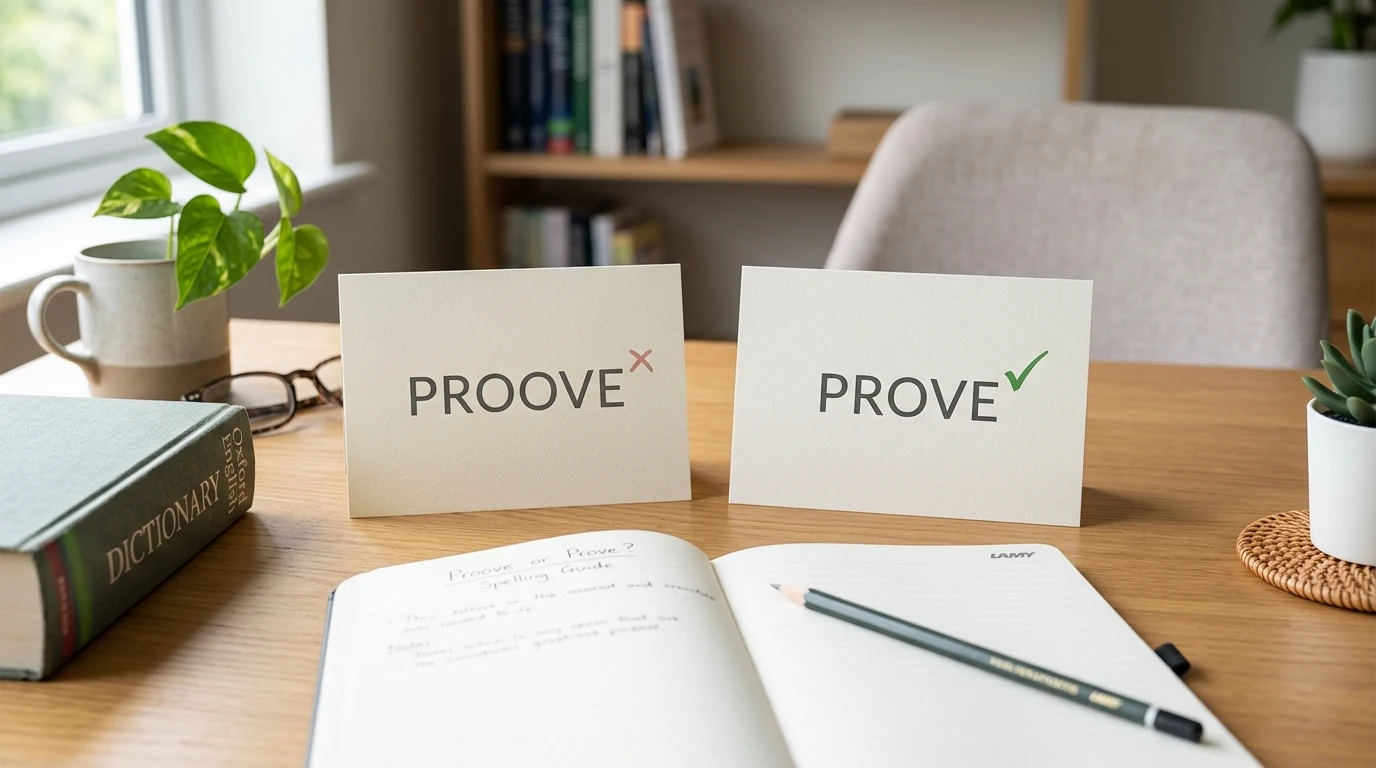
The correct spelling is prove. “Proove” is a common spelling mistake, but it is not the standard spelling of the English verb. Prove means to show that something is true by using facts, evidence, or clear reasons. For example, “She used the test results to prove her answer was correct.”
If you are unsure If to write “proove or prove,” you are not alone. English has many words that sound similar to how they are spelled, which can make spelling difficult. In this guide, you will learn the meaning of prove, how to use it in sentences, common spelling mistakes, and the difference between prove and related words. You will also find simple examples and answers to common questions to help you use the correct spelling confidently in everyday writing.
Quick Answer: Proove or Prove?
Prove is the correct spelling in standard English. Proove is a misspelling and should not be used in formal writing, schoolwork, professional emails, or website content.
The word prove is a verb. It describes the act of showing that something is true, real, or correct. You can prove a point with facts, prove a claim with evidence, or prove that you can do something through your actions.
Here is a quick comparison.
| Word | Correct? | Meaning |
| Prove | Yes | To show that something is true |
| Proove | No | A common misspelling of prove |
| Proved | Yes | Past tense of prove |
| Proven | Yes | A form of prove used in certain verb constructions and as an adjective |
| Proving | Yes | The -ing form of prove |
Remember this simple rule: Always write prove with one “o” before the “v.” This spelling is correct in both American and British English.
What Does Prove Mean?
The word prove means to show that something is true, correct, or real. You can do this by presenting facts, evidence, results, or examples. The word is common in everyday conversations, schools, workplaces, science, law, and many other areas.
For example, imagine that a student says an answer to a math problem is correct. The teacher may ask the student to prove the answer by showing the steps used to solve the problem.
Similarly, if someone claims that a product works well, they might prove the claim by sharing reliable test results.
Prove can also describe showing a quality through actions. For example, a person can prove that they are trustworthy by keeping promises and telling the truth.
The exact meaning depends on the sentence, but the central idea stays the same: prove means to provide a reason or basis for believing that something is true.
Here are some simple examples:
- The scientist worked to prove the theory.
- She wants to prove that her answer is correct.
- His actions prove that he cares.
- The test results prove the machine works.
- I will prove my point with facts.
These examples show how prove can be used in different situations without changing its spelling.
How to Use Prove Correctly in a Sentence

The word prove is used when you want to show that something is true, demonstrate a fact, or establish that a person or thing has a certain quality. It often appears with the word “that,” but this is not always necessary.
For example, you can say, “The evidence proves that the report is accurate.” You can also say, “The evidence proves the report is accurate.” Both sentences are correct.
The word prove can also be followed by an object, such as a point, a claim, or a theory.
Consider these examples:
- I can prove my answer.
- The teacher asked us to prove the result.
- We need more facts to prove the claim.
- She hopes to prove that the plan will work.
- His hard work will prove his ability.
When writing a sentence, choose the form of prove that matches the time and structure of your sentence. Use prove for the base form, proves with a singular third-person subject in the present tense, proved for the past tense, and proving for continuous actions.
For example, “I prove my point with facts” uses the base form. “She proves her point with facts” uses proves. “She proved her point yesterday” uses the past-tense form.
These small grammar choices help your writing sound clear and natural.
Why Is Prove the Correct Spelling?
The spelling prove is the accepted form in standard English dictionaries. Although some people write “proove” by mistake, adding an extra “o” does not make the word correct.
One reason this mistake happens is that English spelling does not always follow a simple sound pattern. People may hear a long vowel sound and assume that two vowels are needed to represent it. However, English words use different spelling patterns, and the number of vowel letters cannot always be predicted from pronunciation alone.
For example, consider these words:
| Correct word | Common misspelling |
| Prove | Proove |
| Improve | Improove |
| Move | Moove |
| Remove | Remoove |
In each case, the standard spelling uses one “o” before the “v.” These examples can help you remember the spelling of prove.
Notice that improve and remove also contain the same letter pattern. Learning these related words can make it easier to recognize the correct spelling when writing.
The best approach is to remember prove as a complete word instead of trying to guess its spelling from the way it sounds.
Prove vs. Prooved: What Is the Difference?
Prove is the correct base form of the verb, while prooved is a misspelling of the past-tense form proved.
When describing something that happened in the past, use proved rather than prooved.
For example, the sentence “She proved her point during the meeting” is correct. The sentence “She prooved her point during the meeting” contains a spelling error.
English verbs do not all form their past tense in the same way. Many regular verbs add “-ed,” such as walked, played, and helped. Prove follows this pattern by changing to proved.
Here are examples of the correct forms:
- Present: I prove my answer with evidence.
- Present: She proves her answer with evidence.
- Past: She proved her answer yesterday.
- Future: She will prove her answer tomorrow.
- Continuous: She is proving her answer now.
These forms make it easier to use prove correctly when writing about different times.
You should also avoid writing “prooved” when using the word in school assignments, business documents, blog posts, or other formal content. The correct spelling is always proved.
Prove vs. Proven: Which Word Should You Use?
Prove and proven come from the same verb, but they are used in different grammatical situations.
Prove is the base form of the verb. Proven is commonly used as a past participle and as an adjective describing something that has been shown to work or be true.
For example, “We need to prove our claim” is correct because the sentence uses the base form. In contrast, “The method has proven effective” is also correct because proven appears after has.
You may also see proved used as a past participle. Both proved and proven are accepted forms in standard English, although the most natural choice can depend on the sentence and regional usage.
| Sentence | Correct form | Why it works |
| I will prove my point. | Prove | Base form after “will” |
| She proved her claim. | Proved | Simple past tense |
| They have proven the theory. | Proven | Past participle after “have” |
| The method is proven effective. | Proven | Adjective describing the method |
| He has proved his ability. | Proved | Past participle after “has” |
A simple way to remember the difference is to look at the words around the verb.
Use prove after words such as will, can, and must. Use proved for a completed past action. Use proven when it fits a perfect-tense construction or when describing something established as true or effective.
For example, “This is a proven method” describes a method that has been shown to work. The word proven is not a spelling mistake; it is a valid form of the verb prove.
Prove vs. Proof: Understanding the Difference
Prove and proof are closely related, but they do not have the same grammatical role.
Prove is a verb. It describes the action of showing that something is true. Proof is usually a noun that refers to evidence or information supporting a claim.
Consider this example: “I can prove my claim because I have proof.”
In this sentence, prove describes an action, while proof describes the supporting evidence.
Here are more examples:
- The scientist wants to prove the result.
- The scientist found proof of the result.
- Please prove that your answer is correct.
- Please provide proof that your answer is correct.
- Her actions prove that she is honest.
- Her actions are proof of her honesty.
Both words are useful, but you should not replace one with the other without checking the sentence.
For example, “I have prove” is incorrect in standard English when you mean evidence. You should write “I have proof.”
Likewise, if you mean to describe the action of showing something is true, “I will proof my claim” is generally incorrect. Write “I will prove my claim.”
There are specialized uses of proof as a verb, such as proofreading a document, but these do not change the usual distinction between prove and proof.
Prove vs. Improve: Are They Related?
Prove and improve look similar because both end in “ove,” but their meanings are different.
Prove means to show that something is true. Improve means to make something better or become better.
For example, a student might prove that an answer is correct by showing the calculation. The same student might improve their writing by practicing grammar and spelling.
Compare these sentences:
- I want to prove that my answer is correct.
- I want to improve my writing skills.
- The evidence helped prove the claim.
- Daily practice helped improve her spelling.
- He will prove his point with facts.
- He will improve his performance through practice.
The spelling patterns are useful to compare because both words have one “o” before the “v.” However, their meanings and uses are different.
When deciding which word to use, focus on the message you want to communicate. If you mean to demonstrate the truth of a statement, choose prove. If you mean to make something better, choose improve.
This distinction is especially useful for English learners who may recognize the words but confuse their meanings in a sentence.
Common Spelling Mistakes With Prove
Spelling mistakes can happen when people write quickly, rely on sound, or confuse similar-looking words. Knowing the most common errors can help you avoid them.
The most frequent mistake is writing “proove” instead of prove. Another error is writing “prooved” instead of proved. Both forms contain an extra “o.”
Some writers also confuse prove with proof, particularly when they are unsure If the sentence needs a verb or a noun.
Here are several incorrect and correct examples:
| Incorrect sentence | Correct sentence |
| I will proove my point. | I will prove my point. |
| She prooved her answer. | She proved her answer. |
| They can proove the result. | They can prove the result. |
| He has prooved his claim. | He has proved his claim. |
| I need to proof my idea is true. | I need to prove my idea is true. |
The final example uses proof incorrectly as a verb in the intended meaning. Although proof has specialized verb uses, prove is the standard choice for demonstrating that an idea is true.
To avoid these mistakes, read your writing carefully before publishing or submitting it. A spelling checker can also help, but it is still important to understand why a word is correct.
For website owners and bloggers, correct spelling matters because it helps readers understand the content and makes articles look professional. A single spelling error does not automatically determine search rankings, but clear and accurate writing supports a better reading experience.
How to Remember the Correct Spelling of Prove
The easiest way to remember prove is to learn it alongside a few related words.
Start with the basic pattern: prove, move, and improve. Each word contains one “o” before the “v.” Repeating this pattern can help you recognize the correct spelling when you write.
You can also use a short memory sentence:
“I prove my point with facts.”
Write this sentence a few times, paying attention to the spelling of prove. Then try creating your own sentences using the word.
Another helpful method is to learn the different forms together: prove, proves, proved, proving, and proven. This helps you recognize the word even when its ending changes.
You should also pay attention to spelling while reading books, articles, and reliable online resources. Seeing a word used correctly in context can make it easier to remember.
Finally, do not rely only on the way a word sounds. English spelling contains many patterns and exceptions, so checking a trusted dictionary is a useful habit whenever you feel unsure.
With a little practice, you can learn to write prove correctly without needing to stop and think about it every time.
Real-Life Examples of Prove
One of the best ways to understand a word is to see how people use it in everyday situations. Prove is useful in conversations, education, work, science, and personal relationships.
In school, a teacher may ask a student to prove an answer by explaining the steps. At work, an employee may prove that a report is accurate by checking the information. In daily life, a person may prove their reliability by keeping promises.
Here are more examples showing how the word works in different settings.
At school: “The student used the correct formula to prove the answer.”
At work: “The team collected data to prove that the new process was effective.”
In science: “Researchers conducted experiments to test and support their claim.”
In daily life: “She proved she was a good friend by helping when I needed her.”
In a discussion: “He used clear facts to prove his point.”
In sports: “The player proved his skills during the final match.”
In technology: “The test results helped prove that the software worked as expected.”
In personal growth: “She proved to herself that she could learn a new skill.”
These examples show that prove is not limited to one subject or situation. It can describe using evidence to support a statement or demonstrating a quality through actions.
However, the strength of the proof depends on the situation. In casual conversation, a clear example may be enough to support a point. In science, research, or legal settings, stronger evidence and careful standards may be required.
Is Prove Different in American and British English?
No. Prove is spelled the same way in standard American and British English.
Unlike words such as color and colour or organize and organise, prove does not have a separate standard American spelling and British spelling.
Writers in both varieties use prove, proved, proving, and proven, depending on the sentence. There may be differences in preferred wording or grammatical style in certain contexts, but “proove” is not the standard spelling in either variety.
For example, these sentences are correct in both American and British English:
- I can prove that the statement is true.
- She proved her point with evidence.
- The method has proven effective.
- They are proving the claim through careful testing.
If you are writing for an American audience, use prove. If you are writing for a British audience, also use prove.
This makes the word easy to handle in international writing. You do not need to change its spelling based on the country of your readers.
When Should You Use Prove?
Use prove whenever you need to describe the action of showing that something is true, correct, or supported by evidence.
The word is useful when explaining an answer, supporting an argument, testing an idea, or demonstrating a person’s ability.
For example, you might write, “I need to prove that the information is accurate.” You could also say, “She wants to prove that she can complete the task.”
However, be careful not to suggest that every claim has been fully established just because someone presents evidence. The word prove can express a strong conclusion, so choose it when the evidence supports that meaning.
In scientific writing, for instance, researchers often test hypotheses and gather evidence rather than claiming that one experiment proves a theory beyond all doubt. In everyday writing, the word may be used more casually.
For professional or educational content, make your meaning clear and support important claims with reliable sources.
A useful rule is to ask yourself: “Am I describing the act of showing something to be true?” If the answer is yes, prove is likely the right word.
If you mean evidence itself, use proof instead. If you are describing something that has already been established, proven or proved may be more suitable.
Frequently Asked Questions About Proove or Prove
1. Is proove or prove correct?
Prove is correct. Proove is a common misspelling and is not accepted as the standard spelling of the English verb. Write “I can prove my point,” not “I can proove my point.”
2. What does prove mean in simple English?
Prove means to show that something is true or correct by giving evidence, facts, reasons, or examples. For instance, a student can prove an answer by showing the steps used to solve a problem.
3. Is prooved a real word?
Prooved is not the standard spelling. The correct past-tense form is proved. For example, write “She proved her answer was correct,” not “She prooved her answer was correct.”
4. Should I use proved or proven?
Both are correct forms of prove. Proved is commonly used as the simple past tense, as in “He proved his point.” Proven is often used after has, have, or had, and as an adjective, as in “The method has proven effective.”
5. What is the difference between prove and proof?
Prove is a verb that describes showing something is true. Proof is usually a noun meaning evidence that supports a statement. For example, “I can prove my claim because I have proof.”
6. Is prove spelled the same in American and British English?
Yes. Prove is the standard spelling in both American and British English. Neither variety uses proove as the standard spelling of this word.
Conclusion: Proove or Prove?
When choosing between proove or prove, remember that prove is the only correct standard spelling. The word means to show that something is true by using evidence, facts, or clear reasons. Proove is a common spelling mistake that you should avoid in schoolwork, professional writing, and online articles.
It is also important to understand the related forms. Use proved for the simple past tense, proven in appropriate past-participle constructions and as an adjective, and proof when you mean evidence itself.
Fortunately, remembering the correct spelling is simple. Think of related words such as move and improve, which also use one “o” before the “v.” Practice writing short sentences, check your spelling when necessary, and read your work before publishing it.The next time you are unsure, choose prove. With regular practice, you will become more confident in using this word correctly in everyday English.

Fazal Abbas
Fazal Abbas is a passionate English grammar writer with over 2 years of experience creating clear, helpful, and easy-to-understand grammar content. He specializes in confusing words, common grammar mistakes, word usage, sentence structure, and practical English tips.
With a simple teaching style, Fazal explains difficult grammar topics in easy English that students, writers, and everyday learners can understand. His goal is to make English grammar less confusing and more useful in real-life communication.
Through GrammarBook, Fazal shares practical examples, clear explanations, and useful tips to help readers improve their English with confidence. He believes that learning grammar should be simple, friendly, and enjoyable.