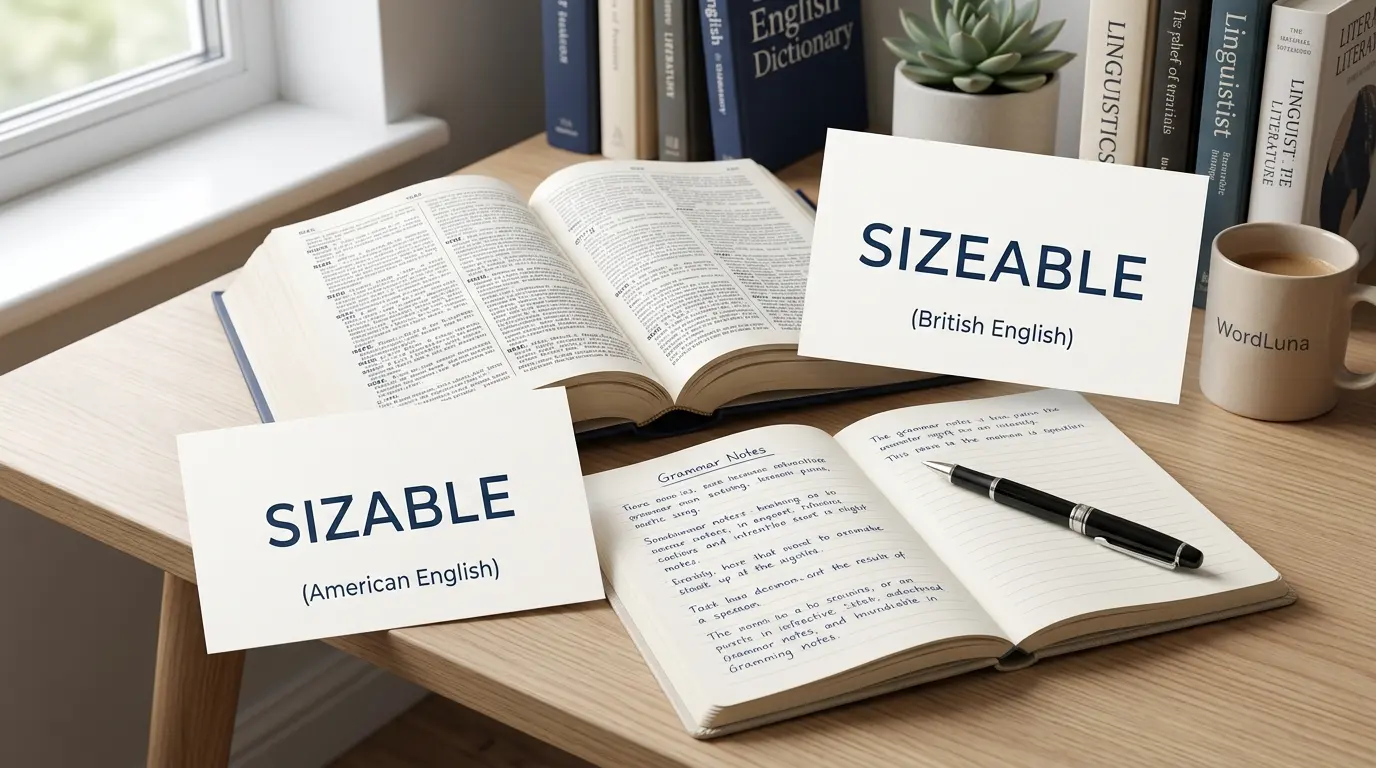
Have you ever wondered If to write sizeable or sizable You may have seen both spellings in books, websites, news articles, or everyday writing. At first, they may look like a spelling mistake, but neither form is wrong.
The difference comes down to spelling preferences in different forms of English. American English usually favors sizable, while British English often uses sizeable. Both words have the same meaning and work in the same way in a sentence.
Knowing which spelling to choose can help you write more clearly and keep your work consistent. This is especially useful when writing blog posts, school assignments, business emails, or website content.
In this guide, you will learn the meaning of both words, the difference between American and British usage, common mistakes to avoid, and practical examples that make the choice easy.
Quick Answer: Sizeable or Sizable?
The correct spelling depends on the type of English you are using. If you write for an American audience, choose sizable. If you follow British English, sizeable is also a common choice.
Here is a quick comparison:
| Word | Correct? | Common usage |
| Sizable | Yes | American English |
| Sizeable | Yes | British English and other varieties |
| Sizeble | No | Incorrect spelling |
| Siseable | No | Incorrect spelling |
Both correct forms are adjectives. They describe something that is fairly large or important in size, amount, or number.
For example:
- The company made a sizable profit last year.
- The company made a sizeable profit last year.
Both sentences are correct and express the same idea.
Easy rule: Use sizable for American English and sizeable when following a British English style guide. Most importantly, choose one spelling and use it consistently throughout your writing.
What Does Sizable or Sizeable Mean?
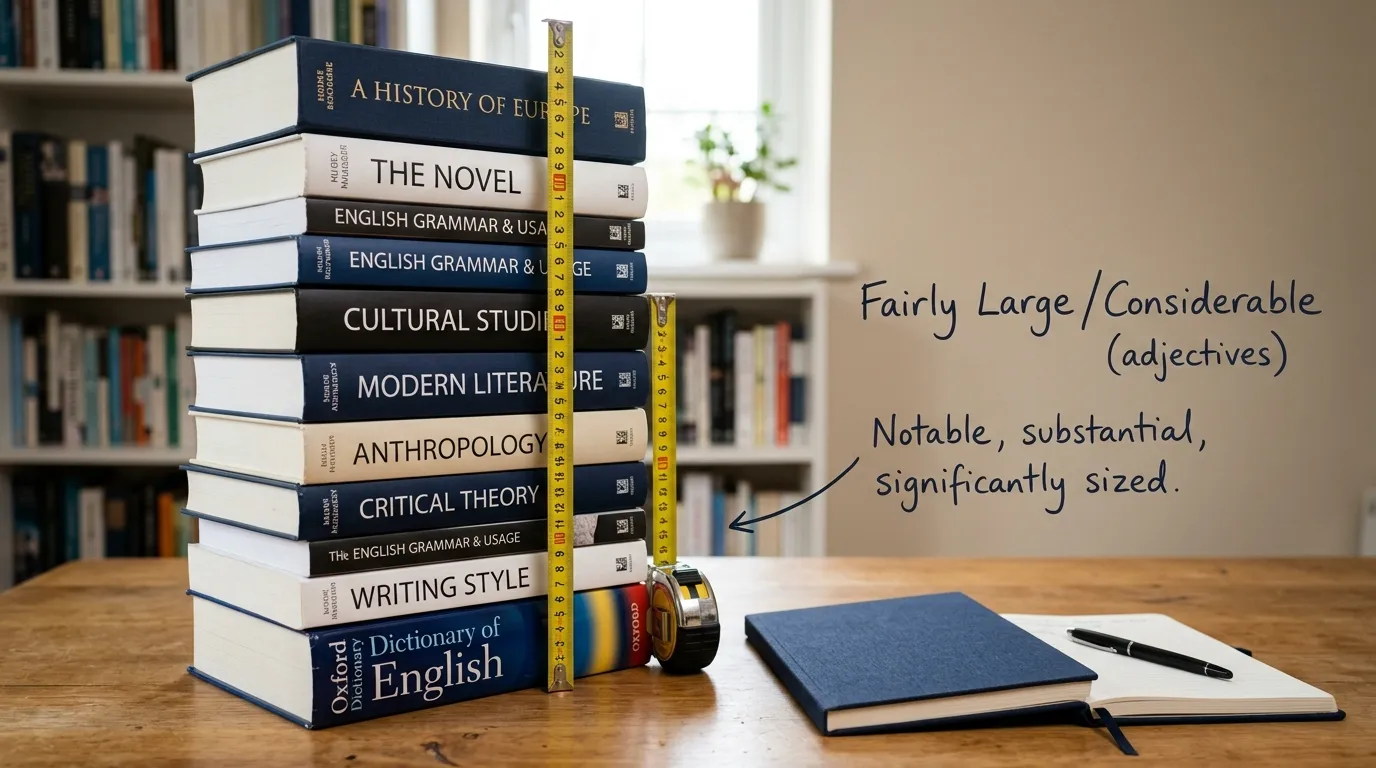
The word sizable or sizeable means fairly large or large enough to be noticed. It often describes something that has a considerable size, amount, number, or effect.
The word does not always mean extremely large. Instead, it suggests that something is big enough to matter.
For example, imagine a small business that earns $500 in profit one month and $5,000 the next month. The owner might describe the increase as a sizable improvement. The word helps show that the change is important.
Here are some common uses:
- A sizable amount: A fairly large quantity of something.
- A sizable group: A group with many people.
- A sizable profit: A considerable amount of money earned.
- A sizable house: A house with plenty of space.
- A sizable difference: A difference large enough to notice.
- A sizable opportunity: An opportunity with meaningful potential.
Consider these examples:
- We saved a sizable amount of money for our vacation.
- A sizable crowd gathered outside the stadium.
- The new store has a sizable parking area.
- She received a sizable bonus at work.
- The two plans have a sizable difference in cost.
In each sentence, the word describes something that is relatively large or significant.
The meaning stays the same If you spell it sizable or sizeable. The extra letter e does not change the definition, pronunciation, or grammatical role.
Why Are Both Sizable and Sizeable Correct?
English has several words with different accepted spellings in different regions. These differences often developed through changes in spelling habits, dictionaries, and publishing traditions.
The words sizable and sizeable are an example of this pattern.
The spelling sizable follows a common American English preference for dropping the final e from certain words before adding the suffix -able. The spelling sizeable keeps the final e.
Both forms are established in modern English. Therefore, you do not need to treat one as a spelling error.
Think about the word recognizable, which is common in American English, and recognisable, which is common in British English. The same general kind of spelling difference appears in many words, although English spelling rules have exceptions.
Here is the key point: English does not have just one spelling style used everywhere. American and British English share most words but differ in some spelling choices.
If you are writing for a particular country, following that country’s usual spelling conventions can make your work feel more natural to readers.
For example, an American business report would normally use sizable investment. A British report might use sizeable investment. Both are understandable and correct.
Sizable vs. Sizeable in American and British English
The main difference between these spellings is regional preference.
American English generally favors sizable. British English commonly accepts and uses sizeable. However, neither spelling belongs exclusively to one country, and readers can understand both forms.
The table below explains the difference.
| Feature | Sizable | Sizeable |
| Spelling | One final form without the extra e | Includes an extra e before the suffix |
| American English | Generally preferred | Also recognized |
| British English | Understood and sometimes used | Commonly used |
| Meaning | Fairly large or considerable | Fairly large or considerable |
| Pronunciation | The same | The same |
| Part of speech | Adjective | Adjective |
| Formal writing | Correct | Correct |
Which Spelling Should American Writers Use?
If your audience is mainly in the United States, sizable is the safer choice.
American newspapers, business writers, bloggers, and students generally favor this spelling. It also fits the spelling style used in many American dictionaries and editorial guides.
For example:
- The city approved a sizable budget for road repairs.
- Our website received a sizable increase in visitors.
- The project requires a sizable investment.
- The team made a sizable improvement this season.
If you are creating content for an American audience, use sizable in your title, introduction, headings, and body text whenever the word appears.
Which Spelling Should British Writers Use?
If you are following British English, sizeable is a natural choice.
British spelling often keeps the extra e in words of this kind. However, sizable is not meaningless or automatically incorrect in British writing.
For example:
- The council faces a sizeable challenge.
- The family owns a sizeable piece of land.
- The company reported a sizeable increase in sales.
- A sizeable number of visitors attended the event.
If your school, employer, or publisher has a style guide, follow its instructions. Consistency is more important than switching between the two forms without a reason.
How to Use Sizable or Sizeable in a Sentence
Both spellings are adjectives. An adjective describes a noun, such as a person, place, object, amount, or situation.
You can use sizable or sizeable before a noun or after a linking verb when the sentence calls for an adjective.
For example:
Before a noun:
- The business earned a sizable profit.
- We purchased a sizeable table for the dining room.
- The school has a sizable library.
- They faced a sizeable problem.
In these sentences, the adjective comes before the noun it describes.
After a linking verb:
- The profit was sizable.
- The new office is sizeable.
- Their collection seems sizable.
- The difference became sizeable over time.
Here, the adjective follows a linking verb such as was, is, seems, or became.
You can also use these words to describe abstract ideas rather than physical objects.
For example:
- The decision had a sizable impact on the business.
- She made a sizeable contribution to the project.
- The team gained a sizable advantage.
- The new policy caused a sizeable change in costs.
These examples show that the word is not limited to physical size. It can describe amounts, effects, gains, and other things that can be considered considerable.
A helpful writing tip is to ask yourself If fairly large or considerable would make sense in the sentence. If it would, sizable or sizeable may be a suitable choice.
Real-Life Examples of Sizable and Sizeable

Examples make spelling differences easier to understand. The following sentences show how both forms work in everyday situations.
Business and Money
Businesses often use the word to describe money, costs, profits, investments, or losses.
- The company received a sizable investment from a new partner.
- We made a sizeable profit during the holiday season.
- The repair work required a sizable amount of money.
- The store offered a sizeable discount on selected products.
- The business suffered a sizeable loss after sales declined.
These examples show that the word can describe positive or negative amounts. A sizable loss is a considerable loss, just as a sizable profit is a considerable profit.
Education and School
Students and teachers can use either spelling when discussing groups, resources, or changes in school performance.
- A sizable group of students joined the science club.
- The school received a sizeable donation for new books.
- She made a sizable improvement in her reading skills.
- The library contains a sizeable collection of reference books.
- The teacher gave the class a sizable assignment.
For American schoolwork, sizable is usually the better choice. For British schoolwork, sizeable may be preferred.
Home and Daily Life
The word can also describe common things around the house or in daily activities.
- We bought a sizable sofa for the living room.
- Their garden has a sizeable area for growing vegetables.
- She packed a sizable bag for the trip.
- The family needs a sizeable dining table.
- He saved a sizable amount for his new computer.
These sentences describe things that are large enough to be noticeable or useful.
News and Public Events
News reports may use these words to describe crowds, changes, effects, and public spending.
- A sizable crowd gathered at the town square.
- The new road project requires a sizeable budget.
- The storm caused a sizable amount of damage.
- The charity received a sizeable number of donations.
- The proposal sparked a sizable public debate.
The best spelling depends on the publication’s editorial style, not on the subject of the news story.
Sizable or Sizeable: Common Mistakes to Avoid
Although both spellings are correct, writers can still make mistakes when using them. Most problems involve regional spelling, inconsistent writing, or choosing a word that does not fit the sentence.
Here are the most common mistakes and how to avoid them.
Mistake 1: Thinking Sizeable Is Always Wrong
Some writers believe that sizable is the only correct spelling. This is not true.
Sizeable is an accepted spelling, especially in British English. It is not an error simply because it contains an extra letter.
Incorrect claim: “Sizeable is always a spelling mistake.”
Correct understanding: Both sizable and sizeable are correct. The preferred form depends on the style of English you are following.
Mistake 2: Thinking Sizable Is Always Wrong in British English
The opposite mistake happens when writers assume that sizable cannot be used in British English.
Although sizeable is common in British writing, sizable is also a recognized spelling. A writer may encounter it in publications that follow American spelling or use a different editorial style.
The best approach is to follow the spelling guide required by your school, company, or publisher.
Mistake 3: Mixing Both Spellings in the Same Article
Imagine reading a blog post that says:
“The company made a sizable profit. Later, it announced a sizeable investment.”
Both sentences are grammatically correct. However, using both spellings in the same article may look inconsistent if there is no clear reason for the change.
Choose one form and use it throughout the article.
For American-focused content, use sizable. For British-focused content, sizeable is a reasonable choice.
Mistake 4: Using the Word When You Mean Something Else
The word sizable means fairly large or considerable. It does not automatically mean enormous, unlimited, or the largest possible.
For example:
- Correct: The company made a sizable profit.
- Potentially misleading: The company made the biggest profit in the world.
The first sentence says the profit was considerable. The second makes a much stronger claim.
Always choose a word that matches the facts you want to communicate.
Mistake 5: Misspelling Both Forms
Common incorrect spellings include sizeble and siseable.
The correct forms are:
- Sizable
- Sizeable
A simple way to check your spelling is to remember that both words begin with size. The difference is If you keep the final e before -able.
Mistake 6: Assuming the Extra E Changes the Meaning
The extra e in sizeable does not create a different meaning. It is a spelling variation, not a separate word with a different definition.
For example, a sizable room and a sizeable room describe the same kind of room.
If you remember these points, you can avoid the most common errors and use the word with confidence.
Sizable vs. Sizeable vs. Considerable: What Is the Difference?
The words sizable, sizeable, and considerable have similar meanings, but they are not always interchangeable in every sentence.
Sizable and sizeable are spelling variants of the same adjective. Considerable is a separate word that often means large in amount, degree, or importance.
Compare the words below.
| Word | Basic meaning | Example |
| Sizable | Fairly large or considerable | The store made a sizable profit. |
| Sizeable | Fairly large or considerable | The store made a sizeable profit. |
| Considerable | Large enough to matter | The store made a considerable profit. |
| Substantial | Large or important in amount or effect | The store made a substantial profit. |
| Significant | Important or noticeable | The store saw a significant increase in sales. |
| Huge | Very large | The store received a huge order. |
In many situations, you can replace sizable with considerable or substantial without changing the basic idea.
For example:
“The company made a sizable investment.”
“The company made a considerable investment.”
Both sentences suggest that the investment was large enough to matter.
However, significant can focus more on importance than physical size, while huge often suggests something very large. The best choice depends on the meaning you want to express.
For everyday writing, sizable is clear and useful. It works well when you want to describe an amount, group, change, or object without making an exaggerated claim.
What Is the Origin of the Word Sizable?

The word sizable comes from the word size, which refers to how large or small something is. The suffix -able is commonly used to form adjectives.
In general, adding -able can express that something has a particular quality or can be described in a particular way. In sizable, the word has developed the meaning of being fairly large or considerable.
The spelling sizeable preserves the final e in size, while sizable drops it. English has many spelling patterns like this, and the exact form can vary by word and regional convention.
It is important not to assume that every word ending in e must follow one universal rule when adding -able. English spelling includes exceptions and established variations.
For the everyday question of sizeable or sizable, you do not need to memorize a complicated historical explanation. The practical point is that both forms are accepted, and American and British writing often favor different versions.
If you need a detailed historical account for academic research, consult a reputable dictionary that provides dated examples and etymological information rather than relying on guesses about when a spelling first appeared.
Which Spelling Is Better for SEO Content?
If you write online articles, choosing the right spelling can help keep your content consistent and suitable for your intended readers.
For an American audience, sizable is generally the best default. For a British audience, sizeable is a natural option.
Search engines can often understand related spelling variants, but that does not mean you should repeat both forms unnecessarily. Clear, useful writing matters more than trying to include every possible spelling.
Here are some practical SEO tips:
- Know your audience. Decide If your article is aimed mainly at American, British, or international readers.
- Use one main spelling. Choose the preferred form for your audience and apply it consistently.
- Write a natural title. For American readers, a title such as “Sizable or Sizeable: Which Spelling Is Correct?” is clear and relevant.
- Avoid keyword stuffing. You do not need to repeat the phrase sizable or sizeable in every paragraph.
- Use examples that answer the question. Readers want to know which spelling is correct, what it means, and when to use each form.
- Check your article before publishing. A spelling checker or editorial review can help identify accidental changes between American and British spelling.
For example, if your website follows American English, you might write:
“Both spellings are correct, but sizable is the preferred form in American English.”
That sentence directly answers the reader’s question and naturally includes the main keyword.
You should also avoid making unsupported claims about which spelling receives more searches. Search demand can change over time, and reliable keyword data is needed to compare the two terms.
The goal is to satisfy the reader’s intent first. A clear answer, useful examples, and consistent spelling provide more value than repeating keywords simply to make an article longer.
Tips for Remembering Sizable or Sizeable
If you often forget which spelling to use, a few simple reminders can help.
Remember the American Spelling: American English usually prefers sizable, without the extra “e.” For example, “The company made a sizable profit.”
Remember the British Spelling: British English commonly uses sizeable, with the extra “e.” For example, “The company made a sizeable profit.”
Remember the Meaning: Both sizable and sizeable mean fairly large or considerable. The spelling changes, but the meaning and pronunciation stay the same.
Choose One Spelling: Use sizable for American English content and sizeable when following British English conventions. Keep your spelling consistent throughout the article.
Use the Right Spelling for Your Readers: Before publishing, consider your target audience and follow the spelling style that best suits them.
Follow one style guide: If you write for a company, school, or website, use the spelling its style guide recommends.
Check similar words carefully: English spelling rules are not always uniform. Do not assume that the spelling of sizable determines how every other word ending in -able must be written.
Here is a quick memory trick:
- Sizable: Common American preference.
- Sizeable: Common British preference.
You can also remember these two example sentences:
- American English: “The project requires a sizable budget.”
- British English: “The project requires a sizeable budget.”
Both sentences are correct. Once you connect each spelling with its common regional preference, choosing the right form becomes much easier.
FAQs About Sizable or Sizeable
1. Is Sizable or Sizeable Correct?
Both sizable and sizeable are correct English spellings. They have the same meaning and pronunciation. American English generally prefers sizable, while British English commonly uses sizeable. Choose the spelling that matches your audience or writing style guide.
2. Is Sizable American or British English?
Sizable is the preferred spelling in American English. It is also understood in British English. If you are writing for readers in the United States, sizable is usually the best choice.
3. Is Sizeable British or American English?
Sizeable is commonly used in British English. However, it is also an accepted spelling outside Britain. It means the same thing as sizable, so the extra letter does not change the word’s meaning.
4. Do Sizable and Sizeable Mean the Same Thing?
Yes. Both words mean fairly large or considerable in size, amount, number, or importance. For example, “a sizable profit” and “a sizeable profit” describe the same thing. The only difference is the spelling preference.
5. How Do You Spell Sizable in the USA?
In American English, the usual spelling is sizable, without an extra e before the ending. For example, “The company received a sizable order.” This is the form most American writers should use unless their style guide says otherwise.
6. Can I Use Both Sizable and Sizeable in Formal Writing?
Yes, both spellings are accepted in formal writing. However, it is best to choose one spelling and use it consistently throughout a document. If you are writing for an American organization, use sizable. If you follow a British English style guide, sizeable may be preferred.
Conclusion
The choice between sizeable and sizable is simple once you understand the regional spelling difference. Both words are correct, and both mean fairly large or considerable in size, amount, number, or importance.
The main difference is that American English generally prefers sizable, while British English commonly uses sizeable. Neither form is automatically wrong, and the extra letter e does not change the meaning or pronunciation.If you write blog posts, school assignments, business reports, or emails, choose the spelling that suits your audience. Then use it consistently throughout your writing.
For most content aimed at American readers, sizable is the recommended choice. If you are following British English, sizeable is a suitable option.Remember this simple rule: both spellings are correct, but your audience helps determine which one to use. With that in mind, you can write confidently and avoid unnecessary spelling mistakes.

Fazal Abbas
Fazal Abbas is a passionate English grammar writer with over 2 years of experience creating clear, helpful, and easy-to-understand grammar content. He specializes in confusing words, common grammar mistakes, word usage, sentence structure, and practical English tips.
With a simple teaching style, Fazal explains difficult grammar topics in easy English that students, writers, and everyday learners can understand. His goal is to make English grammar less confusing and more useful in real-life communication.
Through GrammarBook, Fazal shares practical examples, clear explanations, and useful tips to help readers improve their English with confidence. He believes that learning grammar should be simple, friendly, and enjoyable.