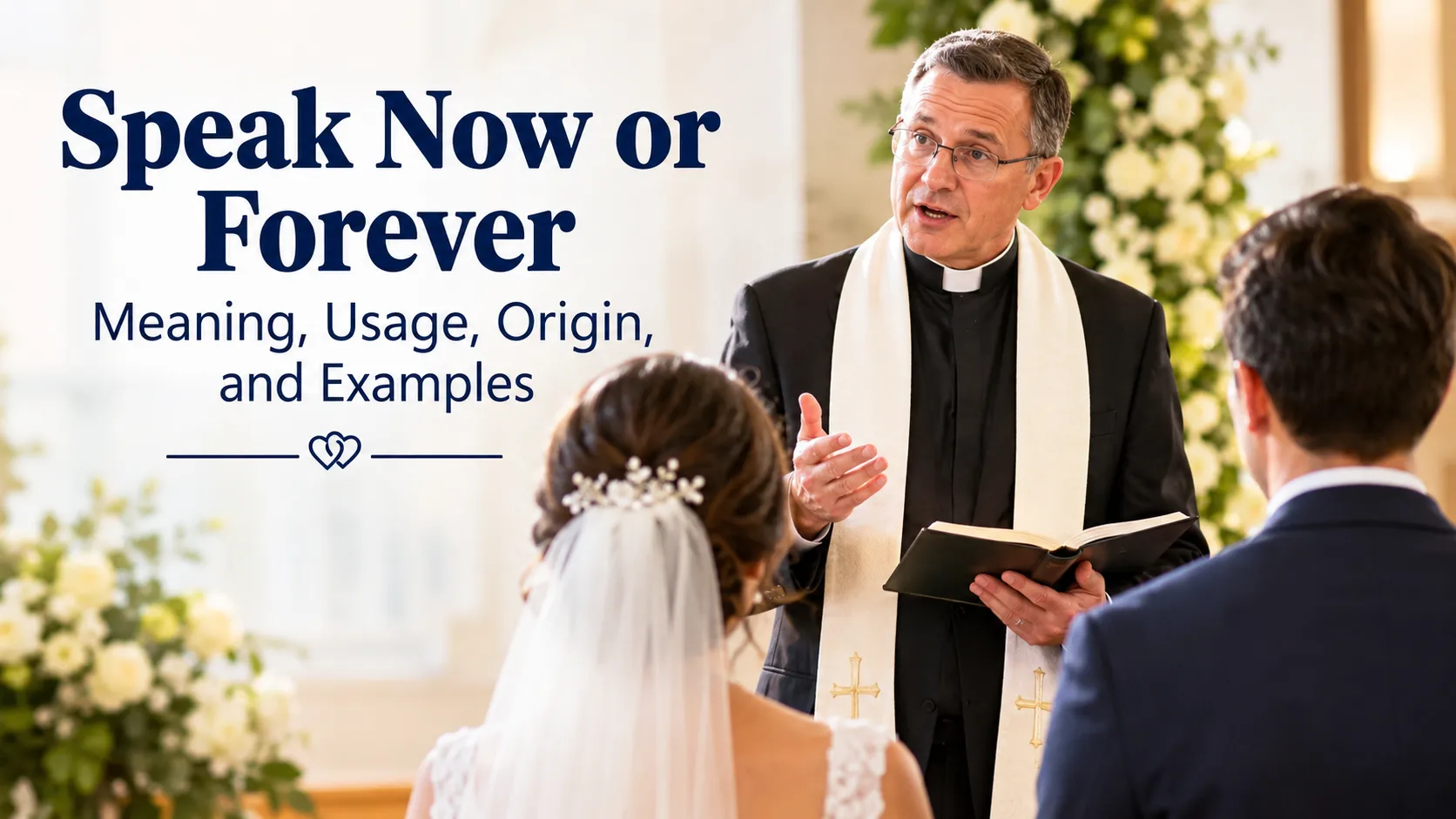
If you hear “speak now or forever hold your peace,” it means this is the final chance to raise an important objection.
The phrase is most strongly linked to traditional wedding ceremonies, where people were once given an opportunity to speak up about a serious reason a marriage should not happen.
Today, it is also used more generally to mean, “Say what you need to say now, or stay silent later.”
Quick Answer: What Does “Speak Now or Forever” Mean?
“Speak now or forever hold your peace” is a traditional expression that gives someone a final opportunity to object, share important information, or express disagreement.
The full phrase is usually:
“Speak now or forever hold your peace.”
The wording “speak now or forever” is often used as a shortened reference to the longer expression. By itself, it does not contain the complete meaning.
In a wedding, the phrase traditionally asks whether anyone knows a valid reason why the couple should not be married. If someone has such information, they are expected to speak at that moment.
In everyday English, however, the phrase can have a wider meaning. Someone may use it when they want to give people one final chance to share an opinion or objection.
For example:
“If anyone has a better idea, speak now or forever hold your peace.”
Here, the speaker is not talking about marriage. They simply mean that this is the last chance to say something.
What Is the Meaning of “Speak Now or Forever Hold Your Peace”?
The expression has two simple parts.
“Speak now” means to say something at the present moment. It suggests that the opportunity to speak is available right now.
“Forever hold your peace” means to remain silent about the matter from that point forward.
So, the basic idea is:
If you have something important to say, say it now because you may not get another chance later.
The word “peace” is important here. It does not mean peacefulness in the modern sense. In this expression, “hold your peace” means to remain silent or refrain from speaking.
This is why peace, not piece, is the correct word.
| Expression | Meaning |
| Speak now | Say what you need to say now |
| Hold your peace | Remain silent |
| Speak now or forever hold your peace | Speak up now or stay silent afterward |
| Speak your mind | Express your honest opinion |
| Raise an objection | State a reason for disagreement |
The phrase can sound dramatic because of its traditional wedding use. However, its basic idea is quite simple: do not wait until the opportunity has passed to say something important.
Why Is “Speak Now or Forever Hold Your Peace” Used at Weddings?
The expression is best known as part of a traditional marriage ceremony.
Historically, a wedding was not simply a private event between two people. A marriage could have important legal and social consequences. Communities therefore had ways to announce upcoming marriages and give people an opportunity to raise serious objections.
The familiar wording became associated with the Christian marriage liturgy and the Book of Common Prayer. Historical versions of the marriage service contain wording that asks whether anyone knows a reason the couple should not legally be joined.
The original purpose was much more practical than the dramatic scenes often shown in movies.
For example, an objection might concern an existing marriage or another recognized impediment to the proposed marriage. The opportunity allowed such information to be brought forward before the ceremony continued.
Today, many couples choose ceremonies that do not include this traditional question. Modern weddings are often personalized, and some couples prefer a ceremony focused on support and celebration rather than objections.
So, if you have only heard the expression in movies, its historical purpose may be quite different from the dramatic image you have seen on screen.
Where Did the Phrase Come From?
The phrase is associated with the Book of Common Prayer, a major English-language Christian liturgical work. The first Book of Common Prayer was published in 1549, and later editions contained marriage-service wording that became closely connected with the familiar expression.
An especially recognizable historical version appears in the 1662 marriage service. It asks whether anyone knows a just cause why the couple should not be lawfully joined and tells that person to speak or otherwise remain silent.
The phrase therefore has a long connection with English Christian wedding tradition.
It is worth noting that the expression is not simply a quotation from the Bible. Its familiar wedding wording comes through the marriage liturgy of the Book of Common Prayer.
The history also explains why the expression sounds formal. Modern everyday English usually says things more directly. Instead of saying “forever hold your peace,” someone might simply say:
“If you have an objection, say it now.”
The older wording survived because it became strongly connected with weddings, tradition, and formal ceremonies.
Is It “Speak Now or Forever” or “Speak Now or Forever Hold Your Peace”?

The complete and traditional expression is:
“Speak now or forever hold your peace.”
“Speak now or forever” is not the full phrase.
People sometimes shorten the expression when referring to it in conversation. For example:
“This is your speak-now-or-forever moment.”
Even then, the listener usually understands the missing words because the original phrase is so familiar.
For an article, school assignment, grammar explanation, or formal writing, it is better to use the complete expression:
Speak now or forever hold your peace.
| Version | Correct? | Explanation |
| Speak now or forever hold your peace | Yes | Complete traditional expression |
| Speak now or forever | Incomplete | Common shortened reference |
| Speak now or forever hold your piece | No | “Piece” has a different meaning |
| Speak now or hold your peace forever | Grammatically possible | Same basic idea, but not the traditional wording |
| Speak now or remain silent forever | Yes, as a paraphrase | Explains the meaning in modern English |
Why Is It “Peace” and Not “Piece”?
One of the most common mistakes is writing “speak now or forever hold your piece.”
That is incorrect.
The correct word is peace.
Peace can relate to quiet, calm, or an absence of conflict. In the expression “hold your peace,” it means to remain silent.
Piece, on the other hand, means a part or portion of something.
For example:
“I ate a piece of cake.”
Here, piece means a portion.
But:
“Please hold your peace.”
Here, peace relates to silence.
This is an easy mistake because peace and piece sound alike in standard English. They are homophones, which means they have the same pronunciation but different meanings and spellings.
A simple way to remember it is:
Hold your peace = stay quiet.
A piece of something = a part of something.
How Do You Use “Speak Now or Forever Hold Your Peace” Correctly?

The expression is usually used when someone wants to give another person a final opportunity to object or speak.
It can be serious, humorous, or dramatic depending on the situation.
At a wedding, the meaning is traditional and formal:
“If anyone knows a reason why these two should not be married, speak now or forever hold your peace.”
In everyday conversation, the meaning is usually less serious:
“We are choosing the restaurant tonight, so speak now or forever hold your peace.”
Here, nobody is literally being told to remain silent forever. The speaker is making a playful statement that the decision is about to be made.
The expression can also be used when a group is making a decision.
“If anyone disagrees with the plan, speak now or forever hold your peace.”
This means:
“Tell us your concerns now because we are going ahead with the plan.”
The expression works best when there really is a final opportunity to speak. Using it repeatedly for ordinary questions can make it sound forced.
Real-Life Examples of “Speak Now or Forever Hold Your Peace”
Understanding examples is one of the easiest ways to learn an idiom.
Wedding example:
“Before we continue with the ceremony, the minister asked whether anyone had an objection.”
Someone might describe this moment by saying:
“The minister gave everyone a chance to speak now or forever hold their peace.”
Workplace example:
“I’m sending the final schedule to everyone at noon. If you see a problem, speak now or forever hold your peace.”
Here, the phrase means that employees should report problems before the schedule becomes final.
Family example:
“We’re ordering pizza in five minutes. If you want a different topping, speak now or forever hold your peace.”
This is a playful use. Nobody expects the person to remain silent forever.
Travel example:
“We’re booking the hotel tonight, so speak now or forever hold your peace.”
The speaker means that this is the last chance for someone to object.
Decision-making example:
“If anyone has another suggestion, speak now or forever hold your peace.”
This means that the group is about to make a final decision.
| Situation | Example | Meaning |
| Wedding | “Speak now or forever hold your peace.” | Raise a valid objection now |
| Work | “If you see a problem, speak now or forever hold your peace.” | Report the problem before the decision is final |
| Family | “Want a different restaurant? Speak now or forever hold your peace.” | Give your opinion before the choice is made |
| Friends | “We’re leaving at six, so speak now or forever hold your peace.” | Object or suggest a change now |
| Humor | “Anyone against pizza tonight? Speak now or forever hold your peace.” | A playful final call for opinions |
What Does “Hold Your Peace” Mean?
“Hold your peace” means to remain silent.
The phrase is old-fashioned, so you will not hear “hold your peace” as often as simpler expressions such as “stay quiet” or “keep silent.”
For example:
Traditional:
“Hold your peace.”
Modern:
“Stay quiet.”
However, the older expression remains familiar because of the famous wedding phrase.
This is similar to other traditional expressions that have survived in modern English because people continue to hear them in ceremonies, books, movies, television, and popular culture.
The important point is that “hold your peace” does not mean holding something called peace in your hands. It is an idiomatic expression about remaining silent.
What Is the Difference Between “Speak Now or Forever” and “Speak Your Mind”?
These expressions are related, but they are not exactly the same.
Speak your mind means to express your honest thoughts or opinions.
Speak now or forever hold your peace means that you have a limited opportunity to speak before the matter is considered settled.
For example:
“She always speaks her mind.”
This means she openly expresses her opinions.
But:
“If you disagree with the plan, speak now or forever hold your peace.”
This means there is a final opportunity to object.
| Phrase | Main idea | Typical use |
| Speak your mind | Express your honest opinion | Everyday conversation |
| Speak up | Say something instead of staying quiet | Everyday conversation |
| Raise an objection | State a reason for disagreement | Formal situations |
| Speak now or forever hold your peace | Give a final chance to object | Weddings and humorous situations |
| Keep silent | Do not speak | General situations |
Knowing these differences helps you choose the expression that sounds natural for your situation.
Common Mistakes With “Speak Now or Forever Hold Your Peace”
The first common mistake is using piece instead of peace.
Incorrect:
“Speak now or forever hold your piece.”
Correct:
“Speak now or forever hold your peace.”
Another mistake is assuming that the phrase always refers to a wedding. Weddings are its most famous setting, but English speakers also use it humorously or figuratively when discussing decisions.
A third mistake is treating the phrase as a command to literally stay silent for the rest of your life. In everyday conversation, it is usually an exaggeration. The speaker means that the opportunity to object is ending.
Another issue is using the phrase in situations where there is no real final decision. Because the expression has a dramatic tone, it can sound unnatural if used for something very small.
For example, saying:
“Speak now or forever hold your peace”
when asking someone whether they want tea or coffee may sound overly dramatic unless you are intentionally being funny.
Is “Speak Now or Forever Hold Your Peace” Still Used Today?
Yes, but its use depends heavily on the setting.
The phrase remains widely recognized because of its long history and its appearance in wedding traditions and popular culture. However, many modern wedding ceremonies do not include a formal public objection section. Couples often choose personalized ceremonies instead.
The phrase also continues to appear in ordinary English as an idiom.
Someone might use it before:
- Making a group decision
- Finalizing a plan
- Choosing a restaurant
- Sending a schedule
- Starting a trip
- Making a purchase
- Ending a discussion
In these situations, the expression is usually playful.
For example:
“We’re leaving in ten minutes. Speak now or forever hold your peace!”
The speaker is not making a serious legal statement. They are simply saying, “If you have a problem with the plan, tell me now.”
“Speak Now or Forever Hold Your Peace” in Movies and Popular Culture
Movies and television have helped make the phrase familiar to people who have never attended a traditional wedding.
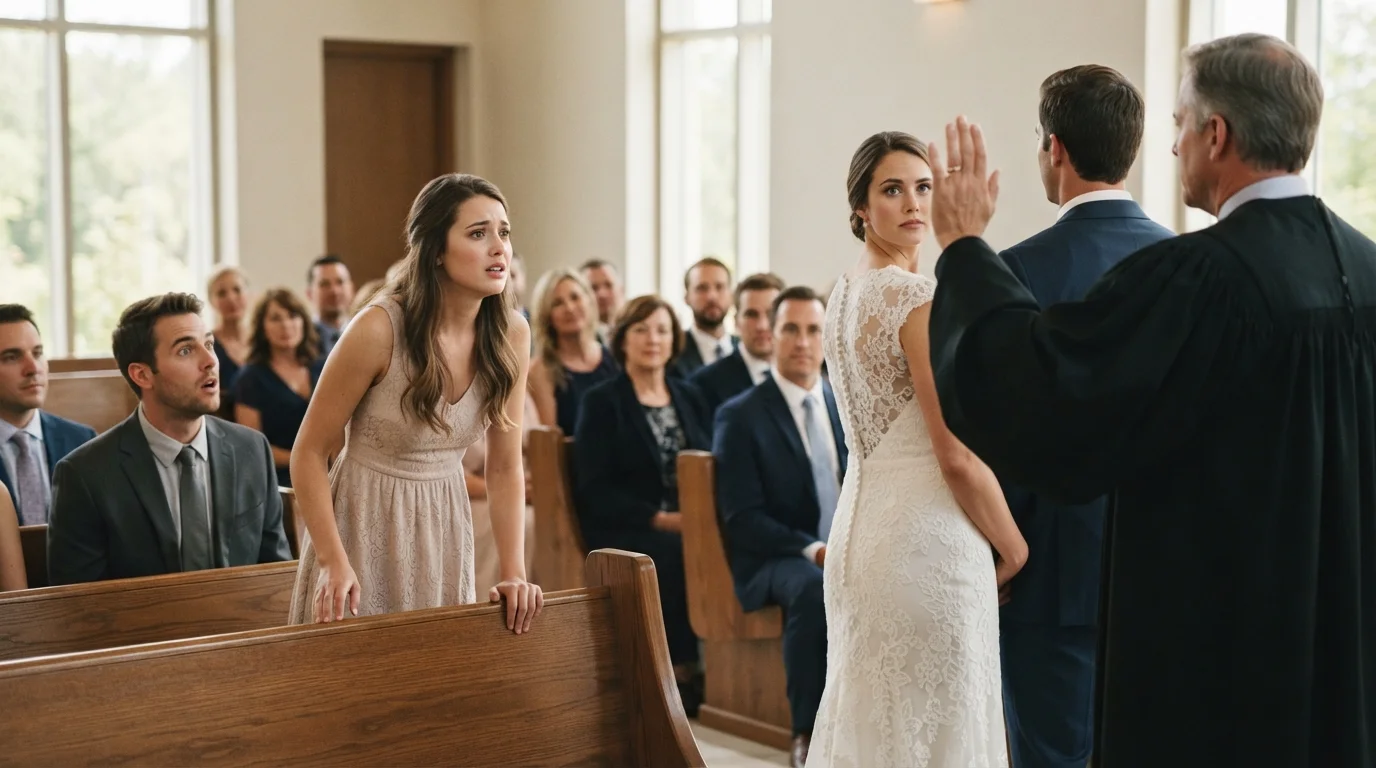
A common movie scene shows an officiant asking for objections. Suddenly, someone stands up and announces that the wedding should not happen.
This creates drama because the phrase naturally sounds like a final warning.
However, the historical purpose was not mainly to create a romantic confrontation. The traditional wedding objection was connected to concerns about whether a marriage could lawfully take place.
That difference is useful to remember.
Movie meaning:
Someone dramatically confesses love or reveals a secret.
Historical meaning:
Someone raises a serious objection to the proposed marriage.
Modern casual meaning:
Someone is given one last chance to disagree or speak up.
All three meanings may appear in English, but they belong to different contexts.
How Can You Say “Speak Now or Forever Hold Your Peace” in Simple English?
If the traditional wording feels difficult, you can explain it with simpler English.
Here are several natural alternatives:
“Say something now if you disagree.”
“Tell us your concern before we continue.”
“This is your last chance to object.”
“If you have something to say, say it now.”
“Tell me now, or don’t complain later.”
These alternatives are easier for beginners to understand.
The exact alternative depends on the situation. A wedding ceremony may require respectful and formal language, while a conversation with friends may use a more casual version.
For example:
Formal:
“If anyone has a valid objection, please speak now.”
Casual:
“If you don’t like the plan, say so now.”
Funny:
“Anyone want to complain? Now’s your chance!”
When Should You Avoid Using the Phrase?
Although the phrase is well known, it has a strong dramatic and old-fashioned tone.
You may want to avoid it when you need very clear, direct language.
For example, in a professional email, saying:
“Speak now or forever hold your peace.”
could sound aggressive or theatrical.
A better option would be:
“Please share any concerns before we finalize the plan.”
That sentence is clearer and more professional.
The traditional phrase works better in informal conversations, jokes, storytelling, wedding-related writing, or situations where you intentionally want a dramatic effect.
This is an important part of good English usage: a phrase can be grammatically correct but still not fit every situation.
Frequently Asked Questions About “Speak Now or Forever”
Is “speak now or forever hold your peace” correct?
Yes. “Speak now or forever hold your peace” is the traditional and correct form of the expression. The word peace is correct, not piece.
What does “speak now or forever hold your peace” mean?
It means that someone should express an important objection or concern now because they may not have another opportunity later. It is traditionally associated with weddings.
Is “speak now or forever hold your peace” from the Bible?
No. The familiar wording comes from Christian marriage liturgy associated with the Book of Common Prayer, rather than being a direct Bible quotation.
Why do people say “speak now or forever hold your peace” at weddings?
Historically, it gave people an opportunity to raise a serious objection to a proposed marriage before the ceremony proceeded. Such objections could relate to whether the marriage could lawfully take place.
Is it “hold your peace” or “hold your piece”?
It is “hold your peace.” In this expression, peace refers to remaining silent. Piece means a part or portion of something.
Can I use “speak now or forever hold your peace” outside a wedding?
Yes. It is often used humorously or figuratively when someone is given a final chance to express an opinion or objection. For example, “We’re ordering now, so speak now or forever hold your peace.”
Conclusion
“Speak now or forever hold your peace” is a traditional English expression that means you should speak up when you have an important objection or concern, especially when you may not get another chance later.
The phrase is strongly connected with traditional wedding ceremonies and has roots in Christian marriage liturgy associated with the Book of Common Prayer. Its historical purpose was more practical than the dramatic wedding scenes often shown in movies.
Remember that peace is the correct spelling, not piece. Also, “speak now or forever” is only a shortened reference; the traditional expression is “speak now or forever hold your peace.”In modern English, you can use it outside weddings as a playful way to say, “This is your last chance to speak up.” Use it when you want a little drama or humor, and choose simpler wording when clarity matters most.

Fazal Abbas
Fazal Abbas is a passionate English grammar writer with over 2 years of experience creating clear, helpful, and easy-to-understand grammar content. He specializes in confusing words, common grammar mistakes, word usage, sentence structure, and practical English tips.
With a simple teaching style, Fazal explains difficult grammar topics in easy English that students, writers, and everyday learners can understand. His goal is to make English grammar less confusing and more useful in real-life communication.
Through GrammarBook, Fazal shares practical examples, clear explanations, and useful tips to help readers improve their English with confidence. He believes that learning grammar should be simple, friendly, and enjoyable.