Swept is the correct past tense and past participle of the verb sweep. Sweeped is incorrect in standard English. For example, say “I swept the floor yesterday,” not “I sweeped the floor yesterday.” Although sweeped may appear in learner writing or informal mistakes, you should use swept in schoolwork, professional writing, and everyday American English.
English has many irregular verbs, and sweep is one of them. Its past form does not follow the usual pattern of adding -ed to the end of a verb. If you have ever wondered If to write “sweeped the room” or “swept the room,” this guide will help you understand the difference.
You will learn the meaning of sweep, its correct verb forms, the grammar rules behind it, and how to use swept in real-life sentences. You will also discover common mistakes, practical examples, and easy tips to remember the correct form.
Quick Answer: Sweeped or Swept?
The correct word is swept. It is the simple past tense and past participle of sweep. The word sweeped is not accepted as the standard past form in modern English.
Use swept when talking about cleaning a floor, moving something with a sweeping motion, or describing a strong movement of air or water.
For example, “She swept the kitchen floor before dinner” is correct. “She sweeped the kitchen floor before dinner” is incorrect.
Here is a quick comparison to help you remember the difference.
| Word | Correct or incorrect? | Example |
| Sweep | Correct | I sweep the floor every day. |
| Sweeps | Correct | He sweeps the porch each morning. |
| Sweeping | Correct | She is sweeping the room. |
| Swept | Correct | We swept the floor yesterday. |
| Sweeped | Incorrect in standard English | We sweeped the floor yesterday. |
The easiest rule is simple: sweep, swept, swept. Learn these three forms together, and you will be less likely to make this common grammar mistake.
What Does Sweep Mean?
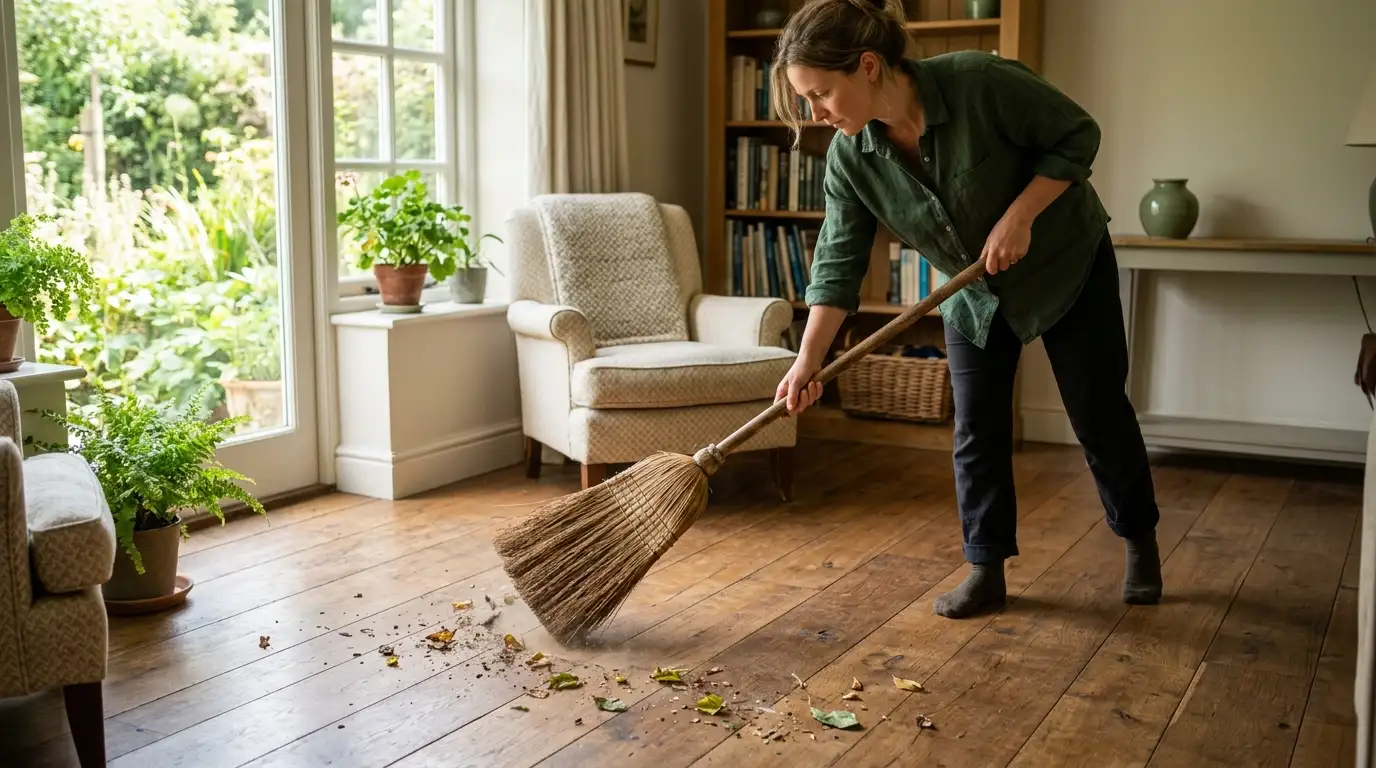
The verb sweep usually means to clean a surface by moving dirt, dust, or other small pieces away with a broom or similar tool.
For example, when you use a broom to remove dust from your kitchen floor, you sweep the floor. The action may take a few minutes, but the word can describe many other kinds of movement, too.
The word sweep also has meanings beyond cleaning. It can describe a wide, smooth movement across an area, a sudden movement of air or water, or a complete victory in a series of games.
Consider these examples:
“I sweep my bedroom every Saturday.” This means that you clean the bedroom regularly.
“The wind swept through the open window.” This means that the wind moved quickly through the room.
“Our team swept the series.” This means that the team won every game in that series.
Although these sentences describe different actions, the verb follows the same irregular pattern. Its simple past form is swept, not sweeped.
Understanding the meaning of sweep makes it easier to recognize why the word appears in different situations. It also helps you use the correct form when writing about cleaning, movement, sports, or other events.
Why Is Swept Correct Instead of Sweeped?
The main reason is that sweep is an irregular verb. Most regular English verbs form their simple past tense by adding -ed. For example, walk becomes walked, and clean becomes cleaned.
However, irregular verbs do not always follow that rule. Their past forms may change in a different way, so you need to learn them individually.
The verb sweep changes to swept in both the simple past tense and the past participle.
Compare these verbs:
| Base form | Simple past | Past participle |
| Sweep | Swept | Swept |
| Sleep | Slept | Slept |
| Keep | Kept | Kept |
| Weep | Wept | Wept |
| Creep | Crept | Crept |
| Leap | Leapt or leaped | Leapt or leaped |
These examples show that English has several verbs with similar past forms. However, not every verb follows exactly the same pattern. For instance, leaped is also accepted alongside leapt.
You should not assume that every verb ending in -eep changes in the same way. Instead, learn the correct forms of each verb.
For sweep, remember this pattern: the base form is sweep, and both the simple past and past participle are swept.
That is why “I swept the floor” is correct, while “I sweeped the floor” is not correct in standard English.
The Three Forms of Sweep: Sweep, Swept, Swept
To use sweep correctly, you need to understand its three main verb forms. Each form has a different job in a sentence, even though the past tense and past participle look the same.
The three forms are:
| Verb form | Word | Example |
| Base form | Sweep | I sweep the kitchen every morning. |
| Simple past | Swept | I swept the kitchen yesterday. |
| Past participle | Swept | I have swept the kitchen already. |
The base form, sweep, is used for present actions, instructions, and after certain helping verbs. The simple past form, swept, describes an action that happened in the past. The past participle, also swept, is used with helping verbs such as have, has, and had.
For example, you can say, “I sweep my room every weekend.” This describes a regular habit.
If you cleaned your room last weekend, you can say, “I swept my room last weekend.”
If you want to explain that the cleaning is complete, you can say, “I have swept my room.”
Notice that the word changes according to the sentence’s grammar, but you never need to use sweeped in standard English.
Learning these three forms together is one of the easiest ways to improve your grammar. It also helps you write more confidently when describing daily routines, past events, and completed actions.
When Should You Use Swept in a Sentence?

Use swept when you describe an action that happened in the past or when you need the past participle after a helping verb.
The exact sentence structure depends on the tense you want to express.
For example, if you are talking about something that happened yesterday, the simple past tense is usually the right choice. If you are talking about an action that has already been completed, the present perfect tense may be more suitable.
Here are some common situations in which you should use swept.
For an action completed in the past
Use swept when the action happened at a finished time in the past.
Examples:
- I swept the living room before my guests arrived.
- She swept the leaves off the front steps yesterday.
- We swept the classroom after the lesson.
- My father swept the garage on Saturday.
With have, has, or had
Use swept after these helping verbs when forming perfect tenses.
Examples:
- I have swept the kitchen already.
- She has swept the floor twice today.
- They had swept the hall before the visitors came.
- We have swept all the leaves into a pile.
In passive sentences
Use swept with a suitable form of be when the focus is on the surface or place being cleaned rather than the person doing the action.
Examples:
- The floor was swept before the shop opened.
- The hallway has been swept.
- The classroom had been swept before the students arrived.
In each case, swept is the correct form. You do not need to add -ed to sweep because the verb already has its own irregular past form.
Sweeped or Swept in American English
If you are writing for an American audience, choose swept. It is the standard past tense and past participle used in American English.
This rule does not change between formal and informal writing. If you are writing a school assignment, a blog post, a work email, or a text message, swept is the appropriate choice.
American English uses many irregular verbs that do not follow the usual -ed pattern. For example, Americans generally write went instead of goed, bought instead of buyed, and swept instead of sweeped.
Here are examples of natural American English sentences:
- I swept the kitchen floor this morning.
- He swept the porch before leaving for work.
- The janitor swept the hallway after school.
- The strong wind swept leaves across the driveway.
- Our basketball team swept the playoff series.
You may see sweeped in online comments, learner writing, or other places where someone has applied the regular past-tense rule by mistake. Seeing a word used does not automatically make it standard English.
For your American English grammar articles, educational content, and everyday writing, use swept consistently.
Swept vs. Sweep: What Is the Difference?
The difference between swept and sweep is mainly about time and sentence structure.
Sweep is the base form. You use it for actions in the present, regular habits, commands, and after certain helping verbs.
Swept is the simple past form and past participle. You use it for completed past actions and in verb structures that require a past participle.
Compare these sentences:
| Sentence | Why it is correct |
| I sweep the floor every day. | The simple present describes a habit. |
| She sweeps the floor every day. | The verb takes -s with he, she, or it. |
| Please sweep the floor. | The base form is used for a command. |
| I swept the floor yesterday. | The simple past describes a finished action. |
| I have swept the floor. | The past participle follows have. |
| She had swept the floor before lunch. | The past participle follows had. |
One important detail is that you should not use swept after every helping verb.
For example, say “I will sweep the floor tomorrow,” not “I will swept the floor tomorrow.” After will, use the base form of the verb.
Likewise, say “I am going to sweep the floor,” not “I am going to swept the floor.”
The correct form depends on the words that come before the verb and the meaning of the sentence. Once you understand these patterns, choosing between sweep and swept becomes much easier.
How to Use Swept Correctly in a Sentence
One common grammar mistake is treating sweep like a regular verb. Since many English verbs form the past tense by adding -ed, it may seem natural to write sweeped. However, sweep is irregular, so its past form is different.
Here are some mistakes to watch for.
Mistake 1: Using sweeped for a past action
Incorrect: I sweeped the kitchen yesterday.
Correct: I swept the kitchen yesterday.
The action happened in the past, so you need the simple past form swept.
Mistake 2: Using sweeped after have
Incorrect: She has sweeped the floor.
Correct: She has swept the floor.
The present perfect tense requires the past participle. For sweep, that form is swept.
Mistake 3: Using swept after will
Incorrect: We will swept the porch tomorrow.
Correct: We will sweep the porch tomorrow.
After will, use the base form of the verb. The action is in the future, so sweep is the correct choice.
Mistake 4: Using sweep instead of swept for a completed past action
Incorrect: He sweep the room last night.
Correct: He swept the room last night.
The phrase last night tells the reader that the action happened in the past. Use swept instead of sweep.
Mistake 5: Changing the verb twice
Incorrect: I have sweeped the floor.
Correct: I have swept the floor.
You do not need to add -ed to a verb that already has an irregular past participle.
A helpful habit is to read your sentence and look for time words such as yesterday, last week, and two days ago. These words often signal the simple past tense. Also, check for helping verbs such as have, has, and had, which can signal the need for a past participle.
Remember, the goal is not to add -ed to every verb. The goal is to choose the correct form for the sentence.
Real-Life Examples of Swept in Everyday English
Seeing a word in different situations helps you understand how people use it. The verb swept can describe cleaning, movement, emotions, sports, and other events.
Here are examples from everyday life.
At home
“I swept the bedroom before making the bed.”
This sentence describes a completed cleaning action.
At school
“The students swept the classroom after art class.”
The students finished cleaning the room after their activity.
At work
“The store manager swept the entrance before opening the shop.”
The sentence explains what the manager did before the business opened.
Outside
“The wind swept dry leaves across the road.”
Here, swept describes the movement of leaves caused by the wind.
In sports
“Our team swept the championship series.”
This means the team won every game in the series.
In a story
“A wave swept the small boat toward the shore.”
The verb describes a strong movement caused by water.
When describing emotions
“A feeling of relief swept over her.”
Here, swept describes a feeling that seemed to spread over someone suddenly.
These examples show why the verb is useful beyond household cleaning. Although the meaning changes with the context, the past form remains swept.
When you write your own sentences, think about the action you want to describe. If you are talking about a past event involving sweep, use swept.
What Is the Difference Between Swept and Sweeping?
Both swept and sweeping come from the verb sweep, but they serve different purposes.
Swept is the simple past form and past participle. Sweeping is the -ing form, which can be used in continuous tenses or as a noun or adjective.
Compare the following examples.
“I swept the floor this morning.” This sentence describes a completed action in the past.
“I am sweeping the floor right now.” This sentence describes an action happening at the moment of speaking.
“She was sweeping the porch when it started raining.” This sentence describes an ongoing past action that was interrupted by another event.
“The sweeping motion was smooth.” In this sentence, sweeping describes the type of motion.
The correct form depends on the tense and meaning you want to express. You should not use sweeping as a replacement for swept when you need the simple past tense.
For example, “I sweeping the floor yesterday” is incorrect. You could write “I swept the floor yesterday” or “I was sweeping the floor yesterday afternoon,” depending on what you want to say.
The first sentence focuses on the completed action. The second focuses on the action as it was happening at a particular time.
Easy Tips to Remember the Correct Past Tense of Sweep
If you often forget If to write sweeped or swept, a few simple tricks can help you remember the correct form.
Tip 1: Memorize the three forms together.
Repeat this pattern aloud: “Sweep, swept, swept.” Say it a few times while thinking of a broom cleaning a floor. Linking the words to a familiar action can make them easier to remember.
Tip 2: Learn similar irregular verbs.
Some verbs have past forms that sound similar to swept. For example, sleep becomes slept, and keep becomes kept. Learning these words together can help you recognize common irregular patterns.
Tip 3: Look for past-time words.
Words such as yesterday, last night, and last weekend often tell you that a sentence needs the simple past tense.
For example, “I swept the porch last weekend” is correct.
Tip 4: Practice with short sentences.
Write three sentences using sweep, swept, and sweeping. For example:
Present Tense: I sweep my room every Sunday.
Past Tense: I swept my room yesterday.
Present Continuous Tense: I am sweeping my room now.
This small exercise helps you understand how each form works.
Tip 5: Read your sentence aloud.
If you are unsure about a sentence, read it aloud and check its structure. For example, “She has swept the floor” follows the correct pattern because has is followed by the past participle.
The most important tip is to remember that irregular verbs must be learned individually. Do not assume that adding -ed will always create the correct past tense.
Frequently Asked Questions About Sweeped or Swept
1. Is sweeped a real word?
Sweeped may appear in writing, but it is not the standard past tense or past participle of sweep. In standard English, use swept instead. For example, write “I swept the floor,” not “I sweeped the floor.”
2. Is swept the past tense of sweep?
Yes. Swept is the simple past tense of sweep. For example, “She swept the kitchen yesterday.” It is also the past participle, as in “She has swept the kitchen.”
3. Should I write I sweeped or I swept?
Write “I swept.” The verb sweep is irregular, so it does not form its past tense by adding -ed. For example, “I swept the porch before dinner” is correct.
4. Is it have swept or have sweeped?
The correct phrase is have swept. The past participle of sweep is swept. For example, “I have swept the floor already” is correct, while “I have sweeped the floor already” is incorrect in standard English.
5. Is swept correct in American and British English?
Yes. Swept is the standard past tense and past participle in both American and British English. You do not need to change the spelling based on which variety of English you are using.
6. What are the three forms of sweep?
The three main forms are sweep, swept, and swept. Use sweep for the base form, swept for the simple past, and swept as the past participle. For example, “I sweep daily,” “I swept yesterday,” and “I have swept today.”
Conclusion: Sweeped or Swept?
When deciding between sweeped or swept, remember that swept is the correct form in standard English. The verb sweep is irregular, so you cannot form its past tense by simply adding -ed.
Use sweep for the base form, swept for completed past actions, and swept as the past participle after helping verbs such as have, has, and had. For example, “I sweep the floor every day,” “I swept it yesterday,” and “I have swept it already” are all correct.Also, remember that swept can describe more than cleaning. It can refer to wind, water, emotions, and even winning every game in a series.
If you want to improve your English, practice the three verb forms together and use them in short, everyday sentences. Most importantly, avoid writing sweeped when you mean swept. With a little practice, you will remember the correct form and use it confidently in your writing

Fazal Abbas
Fazal Abbas is a passionate English grammar writer with over 2 years of experience creating clear, helpful, and easy-to-understand grammar content. He specializes in confusing words, common grammar mistakes, word usage, sentence structure, and practical English tips.
With a simple teaching style, Fazal explains difficult grammar topics in easy English that students, writers, and everyday learners can understand. His goal is to make English grammar less confusing and more useful in real-life communication.
Through GrammarBook, Fazal shares practical examples, clear explanations, and useful tips to help readers improve their English with confidence. He believes that learning grammar should be simple, friendly, and enjoyable.