If you are wondering to write visual aid or aide, the correct choice depends on what you mean. Visual aid is correct when you mean a picture, chart, diagram, slide, or other visual tool that helps explain something. Aide means a person who helps someone. Although these words sound alike, they have very different meanings and uses.
This mix-up is common because aid and aide are pronounced the same in most situations. The word visual makes the answer easier, though. When something helps you understand information by letting you see it, you need the word aid, not aide.
In this guide, you will learn the difference between visual aid and aide, see simple examples, understand common mistakes, and learn an easy way to remember which spelling to use.
Quick Answer: Visual Aid or Aide?
The correct phrase is visual aid when you are talking about something visual that helps explain or present information.
A visual aid can be a chart, photograph, map, graph, diagram, video, slide, or illustration. It helps people understand an idea by giving them something to look at.
The word aide, on the other hand, means a person whose job is to help someone.
For example:
| Word | Meaning | Example |
| Aid | Something that helps | The chart was a useful visual aid. |
| Aide | A person who helps | The teacher’s aide helped the students. |
| Visual aid | A visual tool that helps explain something | She used a visual aid during her presentation. |
| Visual aide | Usually incorrect for this meaning | She used a visual aide during her presentation. |
So, if you are preparing a presentation and need a picture, chart, or diagram, write visual aid.
What Does Visual Aid Mean?

A visual aid is something you can see that helps communicate information.
Teachers use visual aids in classrooms. Speakers use them during presentations. Businesses use them in meetings. Doctors may use pictures or diagrams to explain information to patients.
The main purpose is simple: make information easier to understand by showing it visually.
For example, imagine a teacher is explaining how the water cycle works. The teacher could simply talk about evaporation, condensation, and precipitation. However, a diagram showing the movement of water can make the idea much easier to understand.
That diagram is a visual aid.
Visual aids can take many forms. A photograph can help people understand what something looks like. A graph can show changes in numbers. A map can explain location. A diagram can show how something works.
The word aid means something that helps. Therefore, a visual aid is literally a visual thing that helps.
What Does Aide Mean?
The noun aide means a person who helps another person.
It is commonly used for someone who assists another person as part of a job or role. For example, a teacher’s aide helps a teacher and students. A medical aide may help with certain tasks in a health care setting.
Here are some examples:
- The teacher’s aide helped organize the classroom.
- The senator’s aide prepared the meeting schedule.
- The nurse’s aide helped with routine tasks.
- The classroom aide worked with small groups of students.
Notice that each example refers to a person.
This is the easiest way to separate aid and aide:
Aid = something that helps.
Aide = a person who helps.
That small difference can prevent many spelling mistakes.
Visual Aid vs. Visual Aide
The phrases visual aid and visual aide sound almost identical, but they do not mean the same thing.
A visual aid is a visual object or tool used to help explain information.
A visual aide would literally suggest a person who provides visual assistance. That is not the normal meaning of the common phrase.
For example:
Correct: The speaker used a visual aid during the presentation.
Usually incorrect: The speaker used a visual aide during the presentation.
The first sentence tells us that the speaker used something such as a chart, image, or slide.
The second sentence makes aide look like the name of a person. That does not fit the intended meaning.
| Phrase | Meaning | Correct for presentations? |
| Visual aid | A visual tool that helps explain information | Yes |
| Visual aide | A person who helps with something visual | Usually no |
| Presentation aid | Something that helps a presentation | Yes |
| Teaching aid | Something used to help teaching | Yes |
For normal writing, schoolwork, presentations, and educational content, visual aid is the phrase you want.
Aid vs. Aide: What Is the Difference?
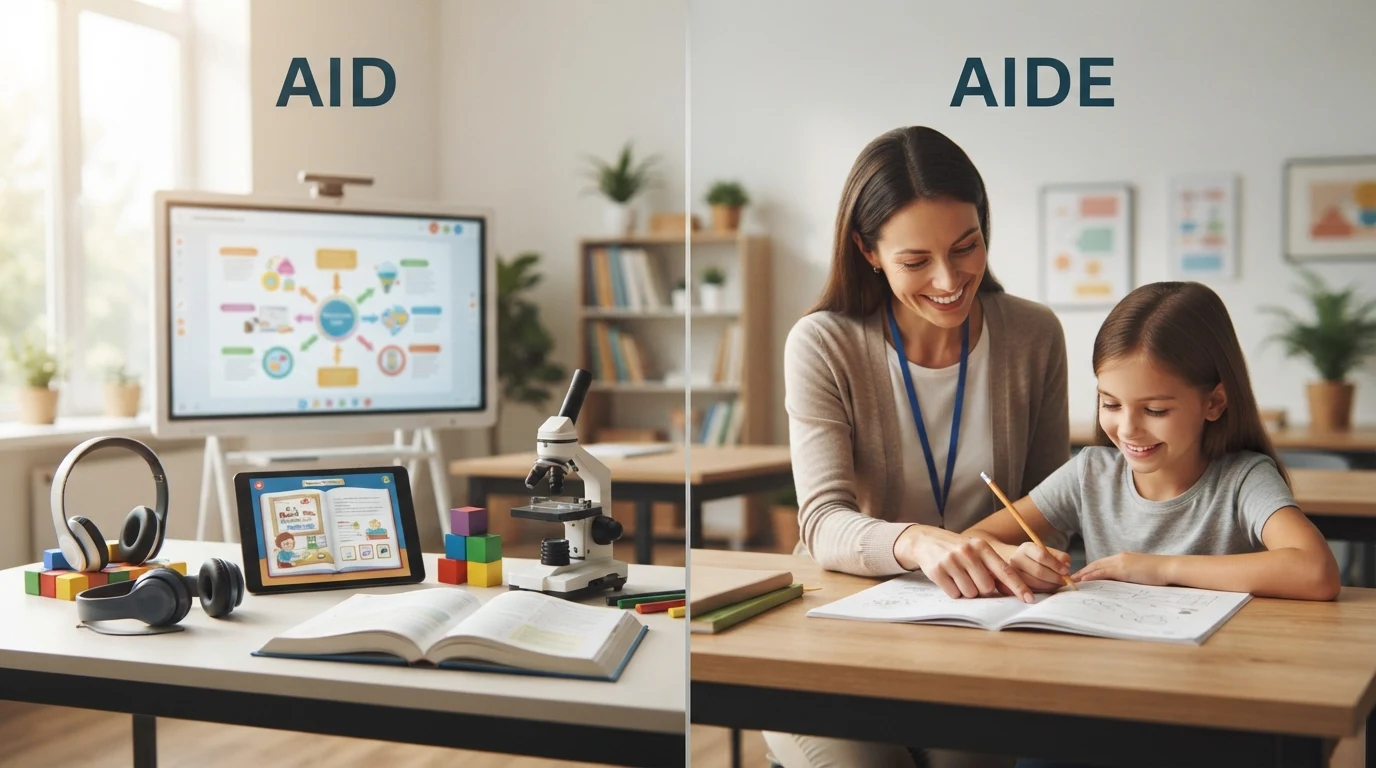
The words aid and aide are homophones. Homophones are words that sound the same but have different meanings and spellings.
This is why the mistake is so easy to make.
Aid can be a noun or a verb.
As a noun, it means something that helps:
The map was an important aid for travelers.
As a verb, aid means to help:
The new program will aid students.
Aide is a noun that refers to a person who helps:
The teacher’s aide helped the children.
The extra e in aide can help you remember that it refers to a person. However, this is only a memory trick, not a rule about the letter itself.
When you see visual aid, think about an object that helps you see and understand information.
When Should You Use Visual Aid?
Use visual aid when a visual object supports communication or learning.
For example, a teacher may use a visual aid to explain a difficult science lesson. A student may use a visual aid during a class presentation. A business employee may use charts and graphs as visual aids during a meeting.
Here are some common situations:
Classroom:
A teacher uses a diagram as a visual aid to explain the parts of a plant.
Presentation:
A speaker uses photographs as visual aids to support a presentation.
Business meeting:
A manager uses graphs as visual aids to explain sales numbers.
Training:
A trainer uses videos as visual aids to demonstrate a process.
Public speaking:
A speaker uses slides as visual aids to make important points easier to follow.
In all these cases, the visual item is helping the audience understand something.
Therefore, visual aid is the correct phrase.
Types of Visual Aids
A visual aid does not have to be a traditional poster or picture. Almost anything that helps people understand information through sight can serve as a visual aid.
Here are some common examples:
| Type of Visual Aid | How It Helps |
| Photograph | Shows what something looks like |
| Chart | Organizes information visually |
| Graph | Shows numbers, patterns, or changes |
| Diagram | Explains parts or processes |
| Map | Shows places and locations |
| Infographic | Combines images and information |
| Slide | Organizes presentation content |
| Video | Shows movement or a process |
| Illustration | Explains an idea through artwork |
| Model | Represents a real object or system |
For example, if you are explaining population growth, a line graph may work better than a long paragraph of numbers.
If you are explaining where a city is located, a map may be more useful.
The best visual aid is usually the one that makes the main idea easier to understand.
Why Are Visual Aids Important?
People often understand information more easily when words are supported by useful visuals.
A visual aid can break a complicated idea into smaller pieces. It can also help an audience notice relationships, differences, patterns, or important details.
Imagine someone explaining the human heart only with words. The explanation may be correct, but a labeled diagram can give the listener a much clearer picture.
Visual aids can also make presentations easier to follow. Instead of listening to a long explanation with no visual support, an audience can look at a chart, photograph, or diagram while the speaker explains it.
However, a visual aid should support the message rather than distract from it.
A slide filled with tiny words, too many pictures, and confusing colors may make a presentation harder to understand.
Good visual aids are usually clear, relevant, and easy to read.
Real-Life Examples of Visual Aid

Seeing the phrase in complete sentences makes its meaning easier to understand.
Here are several natural examples:
Example 1:
The teacher used a diagram as a visual aid.
Example 2:
Please include a visual aid with your presentation.
Example 3:
The chart was an effective visual aid for explaining the results.
Example 4:
The speaker used photographs as visual aids.
Example 5:
A map can be a useful visual aid during a geography lesson.
Example 6:
The student created a visual aid for her science project.
Example 7:
The instructor used a short video as a visual aid.
Example 8:
The graph served as a visual aid during the meeting.
In every example, aid refers to a thing that helps.
Real-Life Examples of Aide
Now compare those examples with aide.
Example 1:
The teacher’s aide helped the students with their work.
Example 2:
The classroom aide prepared the materials.
Example 3:
The senator’s aide arranged the meeting.
Example 4:
The medical aide assisted with routine duties.
Example 5:
In each sentence, aide refers to a person.
This gives you a very simple test.
If you can replace the word with helper, use aide.
If you are talking about something that provides help, use aid.
Common Mistakes With Visual Aid or Aide
One of the most common mistakes is writing visual aide when you mean a visual tool.
For example:
Incorrect:
The teacher prepared a visual aide for the lesson.
Correct:
The teacher prepared a visual aid for the lesson.
Another common mistake is assuming that aide is simply a more formal spelling of aid. It is not. The two words have related meanings, but they are used differently.
Some writers also confuse aid with aids.
For example:
Correct:
The presentation included several visual aids.
Here, aids is simply the plural of aid.
You can say:
- one visual aid
- two visual aids
- several visual aids
- useful visual aids
You would not normally write visual aides when talking about charts, pictures, or slides.
A Simple Trick to Remember Aid and Aide
Here is an easy memory trick:
AID = an object or action that helps.
AIDE = a person who helps.
Think about a classroom.
A visual aid could be a chart on the wall.
A teacher’s aide could be a person standing beside the teacher.
You can also remember the phrase:
A visual aid helps you see.
The word aid belongs in visual aid because the chart, picture, slide, or diagram is the thing doing the helping.
If you are talking about a person, aide may be the correct word.
This simple distinction works in many everyday sentences.
Aid, Aide, and Help: How They Compare
The word help is more general than aid or aide.
For example, you can say:
This chart helps explain the process.
You can also say:
This chart is a visual aid.
Both sentences communicate a similar idea.
But if you say:
The teacher’s aide explained the chart.
you are talking about a person.
| Word | Part of Speech | Basic Meaning | Example |
| Aid | Noun/Verb | Something that helps / to help | The chart is an aid. |
| Aide | Noun | A person who helps | The teacher’s aide helped. |
| Help | Noun/Verb | Assistance or to assist | The chart helps students. |
This comparison shows why replacing aide with aid is not always possible.
The surrounding words matter.
Is Visual Aid Singular or Plural?
Visual aid is singular.
If you are talking about more than one, use visual aids.
For example:
The teacher used one visual aid.
But:
The teacher used several visual aids.
The plural form is made by adding s to aid.
Do not change it to aides simply because there is more than one visual tool.
Visual aids means multiple visual tools.
Aides means multiple people who help.
For example:
The presentation included three visual aids.
This means there were three visual tools.
But:
Three classroom aides attended the meeting.
This means three people attended.
The spelling changes the meaning.
Visual Aid in American English
Visual aid is standard and natural in American English.
It is widely used in education, business, public speaking, training, presentations, and other settings where information is supported by visual material.
The same basic distinction between aid and aide applies in American English:
Aid refers to help or something that helps.
Aide refers to a person who helps.
You may see aide in job titles and professional descriptions, such as teacher’s aide, classroom aide, or administrative aide.
The phrase visual aid, however, uses aid because it refers to a helpful visual tool.
When Visual Aide Could Make Sense
Although visual aid is the normal phrase, the words visual aide could technically be used in a very different context if aide truly refers to a person.
For example, imagine a person whose job is to provide visual assistance. In a specially defined job title, an organization might call that worker a “visual aide.”
But this is not the ordinary meaning of the phrase.
If your sentence is about a presentation, classroom chart, photograph, graph, diagram, or slide, visual aid is the correct choice.
This distinction is important because a word can be grammatically possible but still be unusual or inappropriate in normal usage.
Tips for Using Visual Aid Correctly
When writing visual aid, first ask yourself what you are describing.
If it is a picture, chart, graph, map, diagram, slide, or video, use visual aid.
If it is a person who helps, consider aide is the correct noun.
It also helps to look at the sentence around the word.
For example:
I created a visual for my presentation.
The blank refers to a thing. Therefore, aid is correct.
Now consider:
The teacher’s helped me with my assignment.
The blank refers to a person. Therefore, aide is correct.
Another useful habit is to learn common phrases as complete units. Instead of memorizing only the word aid, remember visual aid as a standard phrase.
This makes the correct spelling much easier to recall when you are writing quickly.
FAQs About Visual Aid or Aide
Is it visual aid or visual aide?
The correct phrase is visual aid when you mean a chart, picture, graph, diagram, slide, or other visual tool that helps explain information.
What is the difference between aid and aide?
Aid means help or something that helps. Aide means a person who helps. They sound alike but have different meanings.
Is visual aid one word or two words?
Visual aid is two words. “Visual” describes the type of aid being used.
What is an example of a visual aid?
A chart, photograph, map, graph, diagram, slide, infographic, or video can be used as a visual aid.
Is “visual aides” correct?
Usually not when you mean visual tools. The correct plural is visual aids. “Aides” refers to people who help.
How can I remember visual aid vs. visual aide?
Remember that a visual aid is a thing that helps you see or understand information. An aide is a person who helps.
Conclusion: Visual Aid or Aide?
The difference between visual aid or aide becomes simple once you focus on meaning. Use visual aid when you mean a picture, chart, graph, map, diagram, slide, or another visual tool that helps explain information. Use aide when you mean a person who provides assistance.
The easiest rule is aid = something that helps, while aide = a person who helps. This distinction can help you avoid one of the most common spelling mistakes in presentations, school assignments, and professional writing.
So, if you are preparing a presentation and need a chart or picture, write visual aid. If you are talking about a person who assists a teacher or another professional, aide may be the right word.
Once you remember this simple difference, choosing the correct spelling becomes much easier.

Fazal Abbas
Fazal Abbas is a passionate English grammar writer with over 2 years of experience creating clear, helpful, and easy-to-understand grammar content. He specializes in confusing words, common grammar mistakes, word usage, sentence structure, and practical English tips.
With a simple teaching style, Fazal explains difficult grammar topics in easy English that students, writers, and everyday learners can understand. His goal is to make English grammar less confusing and more useful in real-life communication.
Through GrammarBook, Fazal shares practical examples, clear explanations, and useful tips to help readers improve their English with confidence. He believes that learning grammar should be simple, friendly, and enjoyable.