When comparing clockwise or counterclockwise, the main difference is the direction of movement around a circle. Clockwise means moving in the same direction as the hands of a traditional clock, while counterclockwise means moving in the opposite direction. These terms help us explain how objects turn, how we follow directions, and how we understand movement in everyday life.
You may see these words in math class, on a map, while tightening a screw, or when following exercise instructions. Although they sound similar, they describe two different directions. Learning the difference can help you follow instructions correctly and avoid common mistakes.
In this guide, you will learn what clockwise and counterclockwise mean, how to recognize each direction, when to use them in sentences, and how they apply to real-life situations. You will also find simple examples, helpful comparisons, and answers to common questions.
Quick Answer: Clockwise or Counterclockwise
Clockwise means moving in the same direction as the hands of a traditional clock. Counterclockwise means moving in the opposite direction.
Imagine looking directly at a clock. The hands move from the top toward the right, then down, across the bottom, and back up the left side. This is clockwise movement.
If you move around the same circle in the reverse direction, you are moving counterclockwise.
Here is a simple comparison:
| Clockwise | Counterclockwise |
| Follows the direction of clock hands | Moves opposite to clock hands |
| Moves from 12 toward 3 | Moves from 12 toward 9 |
| Often shortened to CW | Often shortened to CCW |
| Also called anticlockwise in many contexts | Also called anticlockwise in British English |
| Example: Turn a dial to the right along its circular path | Example: Turn a dial in the reverse direction |
Remember that these directions depend on the viewpoint. When you look directly at a clock face, its hands move clockwise. Looking at a circular object from the opposite side can change how its rotation appears.
What Does Clockwise Mean?
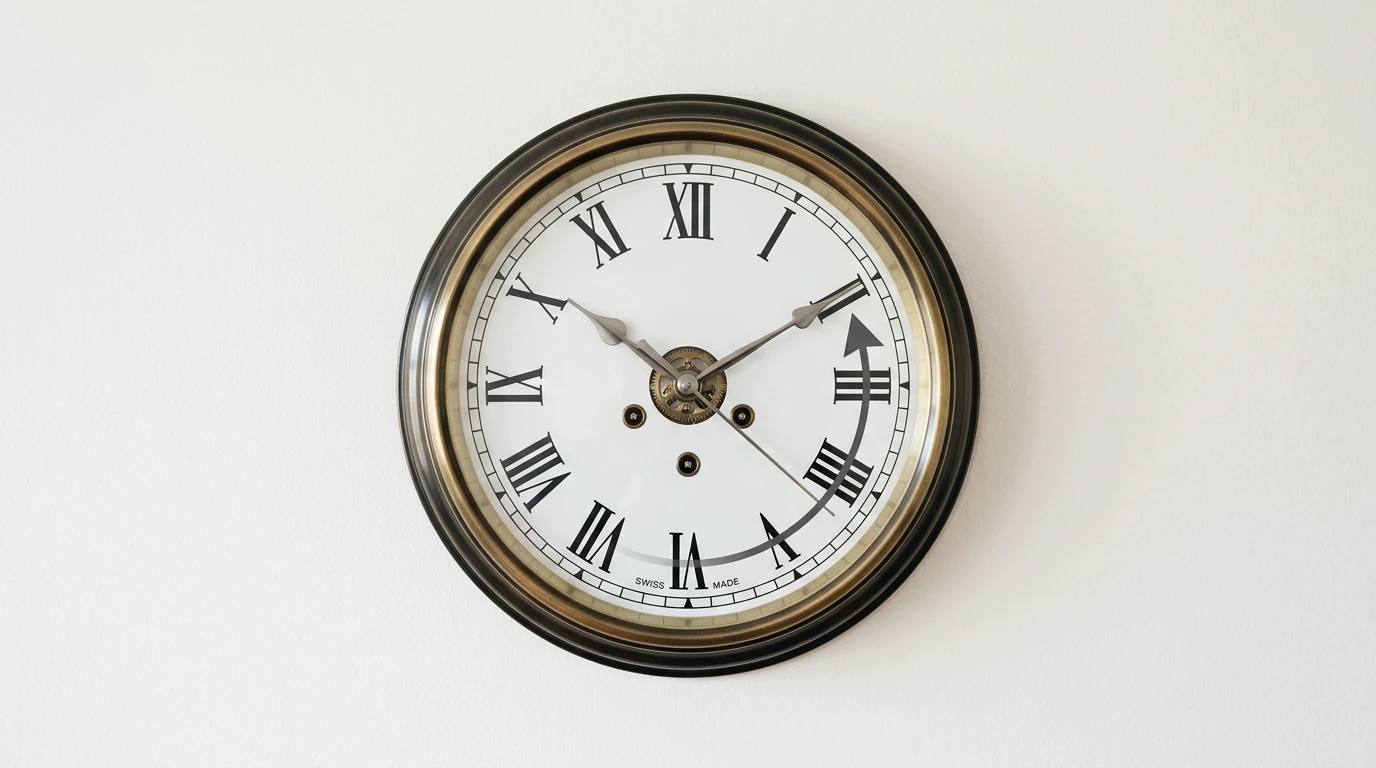
Clockwise describes movement in the same direction as the hands of a traditional clock.
To understand this word, picture a clock on a wall. Start at the 12 at the top. Move toward the 3 on the right, continue to the 6 at the bottom, move toward the 9 on the left, and return to the 12. This path is clockwise.
The word is formed from “clock” and “wise,” where “wise” relates to a manner or direction. In everyday English, clockwise is used as an adjective or adverb to describe the direction in which something turns or moves.
For example, you might turn a round knob clockwise, move your hand clockwise in a circle, or follow a clockwise path around a track.
Here are a few simple sentences:
- Turn the knob clockwise to close the valve.
- The dancer moved clockwise around the room.
- The clock hands rotate clockwise.
- Draw a clockwise circle with your finger.
- The wheel turned clockwise as the machine started.
The exact direction of a turn can depend on which side of the object you are viewing. Therefore, it is important to consider your viewpoint when describing rotation.
What Does Counterclockwise Mean?
Counterclockwise means moving in the opposite direction from the hands of a traditional clock.
Imagine tracing the edge of a clock face backward. Start at the 12, move toward the 9, continue to the 6, then move toward the 3 before returning to the top. This is counterclockwise movement.
The word contains “counter,” which means against or opposite in this context, and “clockwise,” which identifies the reference direction.
Counterclockwise is common in American English, especially in instructions, mathematics, science, and everyday conversation.
For example, a person might turn a dial counterclockwise to loosen a part. A student might draw a counterclockwise arrow around a circle. A gymnast might perform a turn in a counterclockwise direction.
Here are some examples:
- Turn the handle counterclockwise to open the door.
- The arrow points counterclockwise around the circle.
- The wheel began rotating counterclockwise.
- Move your arm counterclockwise during the warm-up.
- The object spins counterclockwise when viewed from above.
Counterclockwise does not always mean turning left in every possible situation. The direction of rotation depends on the viewing angle and the object’s position. For this reason, circular movement is often easier to describe using clockwise and counterclockwise than using only left and right.
Clockwise vs. Counterclockwise: Main Differences
Clockwise and counterclockwise describe opposite directions around a circle. Both words are useful when giving instructions, explaining movement, or describing rotation.
The key is to imagine a clock face as your reference point.
| Feature | Clockwise | Counterclockwise |
| Direction | Same as clock hands | Opposite to clock hands |
| Starting at 12 | Moves toward 3 | Moves toward 9 |
| Common abbreviation | CW | CCW |
| American English | Clockwise | Counterclockwise |
| Another common term | No special alternative needed | Anticlockwise |
| Example instruction | Rotate the dial clockwise | Rotate the dial counterclockwise |
These words do not describe how fast an object moves. They only explain its direction.
A wheel can rotate clockwise slowly or quickly. It can also rotate counterclockwise slowly or quickly. Speed and direction are separate features of movement.
The terms can also describe a complete turn or only part of a turn. For example, moving from 12 to 3 along the shorter path in the clockwise direction is a quarter-turn clockwise. Moving from 12 to 9 along the shorter path in the counterclockwise direction is a quarter-turn counterclockwise.
How to Remember Clockwise and Counterclockwise
The easiest way to remember these terms is to use the hands of a clock.
Look at a clock or imagine one in your mind. Its hands move from 12 to 3, then to 6, then to 9, and back to 12. That is clockwise.
Now reverse the path. Start at 12 and move to 9, then 6, then 3, and back to 12. That is counterclockwise.
You can also use these simple memory tips.
Think of the clock face. Clockwise follows the familiar movement of clock hands. Counterclockwise goes the other way.
Use your finger. Draw a circle in the air. Move your finger in the same direction as a clock’s hands, then reverse it. You will feel the difference.
Remember the starting point. If you start at the top of a circle, clockwise movement initially heads to the right. Counterclockwise movement initially heads to the left.
Practice with a round object. Place a cup or a round lid on a table. Trace a path around its edge in each direction.
These small exercises can make the terms easier to understand, especially for young students who are learning about shapes and movement.
How to Use Clockwise and Counterclockwise in a Sentence

Clockwise and counterclockwise are used to describe the direction of a turn, rotation, or circular path.
Both words can appear in different parts of a sentence. Clockwise is often used as an adverb, as in “Turn the handle clockwise.” It can also act as an adjective, as in “Follow the clockwise path.”
Counterclockwise works in the same way.
Here are examples of correct usage:
| Sentence | How the word is used |
| Turn the knob clockwise. | Describes how to turn the knob |
| The wheel rotates counterclockwise. | Describes the direction of rotation |
| We walked in a clockwise circle. | Describes the direction of the path |
| Draw a counterclockwise arrow. | Describes the arrow’s direction |
| The machine makes a clockwise turn. | Describes the turn |
| Move the dial counterclockwise. | Gives an instruction |
You can use these words in everyday conversation, written instructions, school assignments, and technical explanations.
For example, a teacher might say, “Draw a circle and add a clockwise arrow.” A repair guide might say, “Rotate the adjustment screw counterclockwise.” A fitness instructor might say, “Make five clockwise circles with each arm.”
In each sentence, the word makes the direction clear without requiring a long explanation.
Is Counterclockwise the Same as Anticlockwise?
Yes. Counterclockwise and anticlockwise generally mean the same thing: moving in the direction opposite to the hands of a traditional clock.
The main difference is regional preference.
Counterclockwise is the more common form in American English. Anticlockwise is widely used in British English and other varieties of English.
For example, an American instruction might say, “Turn the cap counterclockwise.” A British instruction might say, “Turn the cap anticlockwise.”
Both sentences describe the same action.
| Word | Common usage | Meaning |
| Clockwise | American and British English | Same direction as clock hands |
| Counterclockwise | Especially American English | Opposite direction to clock hands |
| Anticlockwise | Especially British English | Opposite direction to clock hands |
If you are writing for an American audience, counterclockwise is usually the best choice. If you are writing for a British audience, anticlockwise may sound more familiar.
However, both terms are understood in many English-speaking countries. The best choice depends on your audience and the style of English you are using.
Clockwise or Counterclockwise in Mathematics
Clockwise and counterclockwise are important in mathematics because they describe the direction of rotation around a point.
Students may use these terms when working with circles, angles, shapes, coordinate planes, and geometric transformations.
For example, imagine a square placed on a table. If you rotate it clockwise by 90 degrees, it turns one quarter of a full circle in the direction of clock hands. If you rotate it counterclockwise by 90 degrees, it turns one quarter of a circle in the opposite direction.
A full rotation is 360 degrees. A half-turn is 180 degrees, and a quarter-turn is 90 degrees.
| Amount of rotation | Clockwise example | Counterclockwise example |
| Quarter-turn | 90 degrees clockwise | 90 degrees counterclockwise |
| Half-turn | 180 degrees clockwise | 180 degrees counterclockwise |
| Three-quarter turn | 270 degrees clockwise | 270 degrees counterclockwise |
| Full turn | 360 degrees clockwise | 360 degrees counterclockwise |
There is one detail worth remembering: a 180-degree turn ends in the same orientation whether you rotate clockwise or counterclockwise by 180 degrees. However, the direction taken during the turn is different.
In coordinate geometry, a positive or negative angle may indicate a direction of rotation, depending on the convention being used. In the usual Cartesian coordinate plane, positive angles are measured counterclockwise from the positive horizontal axis, while negative angles are measured clockwise.
These conventions are useful in algebra, geometry, physics, and engineering.
Clockwise or Counterclockwise in Everyday Life
You can find clockwise and counterclockwise movement in many everyday activities. These terms help people give clear directions without pointing or showing the movement physically.
For example, you may use them when turning a key, adjusting a dial, opening a lid, or following a circular exercise routine.
Here are some common situations.
Turning a knob: Instructions may tell you to turn a knob clockwise or counterclockwise. The correct direction depends on how the knob or mechanism is designed.
Opening a jar: Many common screw-top jars loosen when turned counterclockwise and tighten when turned clockwise, assuming you are viewing the lid from above. However, some specialized closures use different mechanisms.
Using a screwdriver: Many standard right-hand threaded screws tighten clockwise and loosen counterclockwise when viewed from the screw head. Some screws use left-hand threads, so there are exceptions.
Following a track: A running group may travel clockwise or counterclockwise around a circular track. The direction depends on the rules or instructions for that activity.
Drawing circles: Art teachers may ask students to draw clockwise or counterclockwise circles to practice control and movement.
In all these situations, using the correct term can make instructions clearer. It is especially useful when the direction matters for safety or for operating equipment properly.
Clockwise or Counterclockwise in Machines and Tools
Machines often contain rotating parts, including wheels, gears, fans, and motors. Describing their direction accurately helps people understand how a machine operates.
A motor may rotate clockwise when viewed from one end and appear to rotate counterclockwise when viewed from the other end. This does not mean the motor has changed its physical direction. The difference comes from the viewing angle.
For this reason, technical instructions may specify the viewing position, such as “clockwise when viewed from the drive end.”
Tools also use directional instructions. A common screw may tighten clockwise and loosen counterclockwise when viewed directly at its head. But this rule is not universal. Left-hand threads and specialized equipment can work differently.
Before turning a valve, adjusting a machine, or changing a part, read the instructions carefully. Do not assume every control works in the same direction.
The words clockwise and counterclockwise tell you which way to turn something, but they do not tell you whether that movement will open, close, tighten, or loosen it. That depends on the design of the object.
Common Mistakes When Using Clockwise or Counterclockwise
Although these words are simple, people sometimes confuse their meanings or use them without enough context.
One common mistake is thinking that clockwise always means right and counterclockwise always means left. This shortcut works for the initial movement from the top of a clock face when viewed directly, but it does not describe every point along a circular path.
Another mistake is confusing direction with speed. Clockwise does not mean fast, and counterclockwise does not mean slow. Either direction can happen at any speed.
Some people also assume counterclockwise and anticlockwise have different meanings. In normal use, they describe the same direction.
Here are common mistakes to avoid:
| Common mistake | Correct understanding |
| Clockwise always means moving right | It means following the direction of clock hands around a circle |
| Counterclockwise means moving slowly | It means moving opposite to clock hands |
| Counterclockwise and anticlockwise have different meanings | They generally mean the same thing |
| Every screw loosens counterclockwise | Most standard right-hand threaded screws do, but exceptions exist |
| Rotation looks the same from every viewpoint | The apparent direction can change with the viewing angle |
| Clockwise describes speed | It describes direction, not speed |
To avoid these mistakes, picture a clock face before giving directions. If you are explaining a machine or a technical object, state the viewing position when necessary.
Real-Life Examples of Clockwise and Counterclockwise
Examples can make these words easier to understand and remember. The following sentences show how they work in different settings.
At home:
“Turn the kitchen timer clockwise to set the time.”
“Rotate the lid counterclockwise to open the jar.”
At school:
“Draw a clockwise arrow around the circle.”
“Rotate the triangle 90 degrees counterclockwise.”
During exercise:
“Move both arms clockwise in small circles.”
“Repeat the movement counterclockwise.”
In a workshop:
“Turn the adjustment dial clockwise according to the manual.”
“The wheel rotates counterclockwise when viewed from this side.”
When giving directions:
“Walk clockwise around the garden.”
“Move counterclockwise around the marked circle.”
Notice that each example explains a direction of movement. The words do not tell us the exact distance traveled, how quickly the movement occurs, or how much force is required.
If you want to give complete instructions, include those details separately. For example, “Turn the dial clockwise by one quarter-turn” is more specific than “Turn the dial clockwise.”
Tips for Choosing the Correct Direction
If you are unsure whether to use clockwise or counterclockwise, take a moment to picture the movement.
First, imagine a traditional clock viewed from the front. Its hands move from the top toward the right. That direction is clockwise.
Next, imagine reversing the hands. Moving from the top toward the left is counterclockwise.
If you are describing an actual object, think about where the viewer is standing. This matters when describing a spinning wheel, a motor shaft, or another object that can be viewed from different sides.
You can also use an arrow to show the direction. A circular arrow moving in the same direction as clock hands represents clockwise movement. A circular arrow moving the opposite way represents counterclockwise movement.
For written instructions, be as specific as necessary. Instead of saying “Turn the wheel,” you could say “Turn the wheel clockwise by half a turn.”
Finally, follow the manufacturer’s directions when operating tools or machinery. The meaning of the direction words stays the same, but the result of turning a control depends on its design.
Frequently Asked Questions About Clockwise or Counterclockwise
1. What is the main difference between clockwise and counterclockwise?
Clockwise follows the direction of a traditional clock’s hands. Counterclockwise moves in the opposite direction. Both terms describe circular movement or rotation.
2. Is counterclockwise one word or two words?
Counterclockwise is written as one word in standard American English. It is not normally hyphenated. Anticlockwise is also written as one word.
3. Is anticlockwise the same as counterclockwise?
Yes. Both words describe movement opposite to the hands of a traditional clock. Counterclockwise is more common in American English, while anticlockwise is common in British English.
4. Does clockwise always mean turning right?
No. Clockwise means following the direction of clock hands around a circle. The initial movement from the top heads right when viewed directly, but the apparent direction can change depending on your viewpoint.
5. Which direction tightens a standard screw?
Most standard right-hand threaded screws tighten when turned clockwise and loosen when turned counterclockwise, viewed directly at the screw head. Some screws use left-hand threads, so always check the instructions when needed.
6. How can I remember counterclockwise?
Imagine a clock face. Clockwise follows the hands, while counterclockwise goes backward around the face. Starting at the top, clockwise initially moves right and counterclockwise initially moves left.
Conclusion: Clockwise or Counterclockwise
Understanding clockwise or counterclockwise is easier when you use a traditional clock as your guide. Clockwise follows the direction of the clock’s hands, while counterclockwise moves in the opposite direction. Both terms help explain circular movement in everyday life, mathematics, exercise, and technical instructions.
Remember that these words describe direction, not speed. Also, the way a rotating object appears can change depending on where you view it from. This is why technical instructions sometimes specify a viewing position.
If you are learning these terms for school or using them in everyday conversation, practice by tracing a circle with your finger in both directions. You can also use a simple drawing or clock face to check your understanding.The next time you need to describe a turn, picture the clock first. That small habit will help you choose the correct word and give clearer directions.

Hi, I’m Iqra, a passionate writer and grammar enthusiast dedicated to making English grammar simple, clear, and easy to understand. Through my work on grammar books and educational content, I help students, writers, and English learners improve their vocabulary, sentence structure, punctuation, and everyday communication skills. My goal is to turn confusing grammar rules into practical, easy-to-follow lessons that readers can confidently use in real life. I believe learning grammar doesn’t have to be difficult—it can be simple, useful, and even enjoyable. Through helpful guides, examples, and carefully explained grammar tips, Iqra aims to make learning English more accessible for everyone.