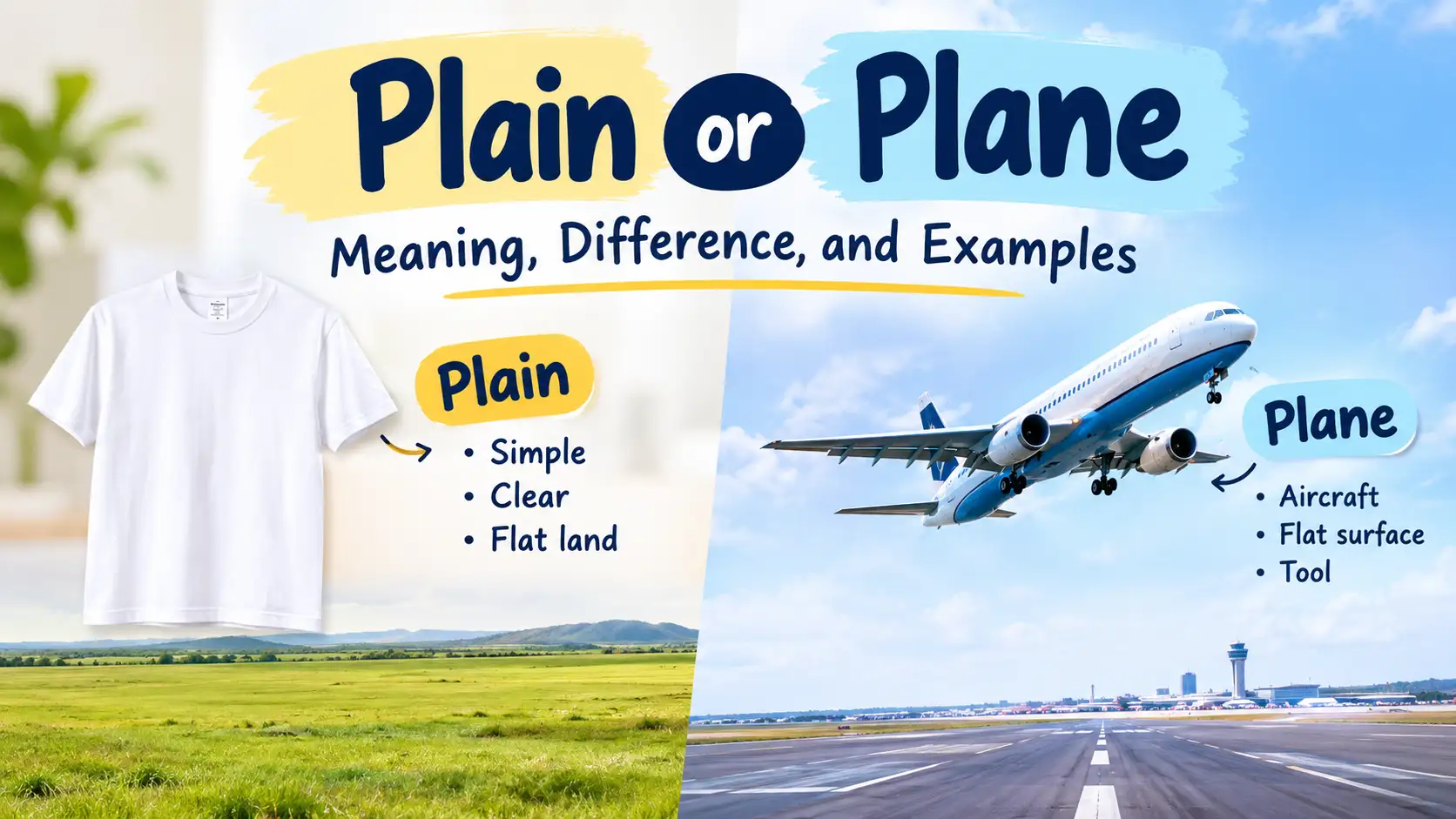
The words plain and plane sound alike, but they have different meanings and uses. Plain can mean simple, clear, or a large area of flat land. Plane usually means an aircraft, a flat surface, or a level in geometry. Knowing when to use plain or plane will help you write clearly and avoid common spelling mistakes.
Both words are pronounced the same way, which makes them easy to mix up. However, their meanings and spelling are different. The good news is that you can learn the difference with a few simple rules and examples.
In this guide, you will discover the meaning of each word, how to use it in a sentence, and how to remember which spelling is correct. You will also learn common mistakes, practical examples, and answers to frequently asked questions.
Quick Answer: Plain vs. Plane
Plain and plane are homophones. This means they sound alike but have different meanings and spellings.
Use plain when you mean something simple, easy to understand, or a large area of flat land. Use plane when you mean an aircraft or a flat surface, especially in geometry.
| Word | Main meaning | Example |
| Plain | Simple or not decorated | She wore a plain white shirt. |
| Plain | Easy to understand | His message was plain and clear. |
| Plain | A large, flat area of land | The horses ran across the plain. |
| Plane | An aircraft | Our plane landed safely. |
| Plane | A flat surface in geometry | The points lie on the same plane. |
| Plane | A tool used to smooth wood | The carpenter used a plane on the door. |
The easiest way to remember the difference is to connect plane with an airplane and plain with something simple.
What Does Plain Mean?
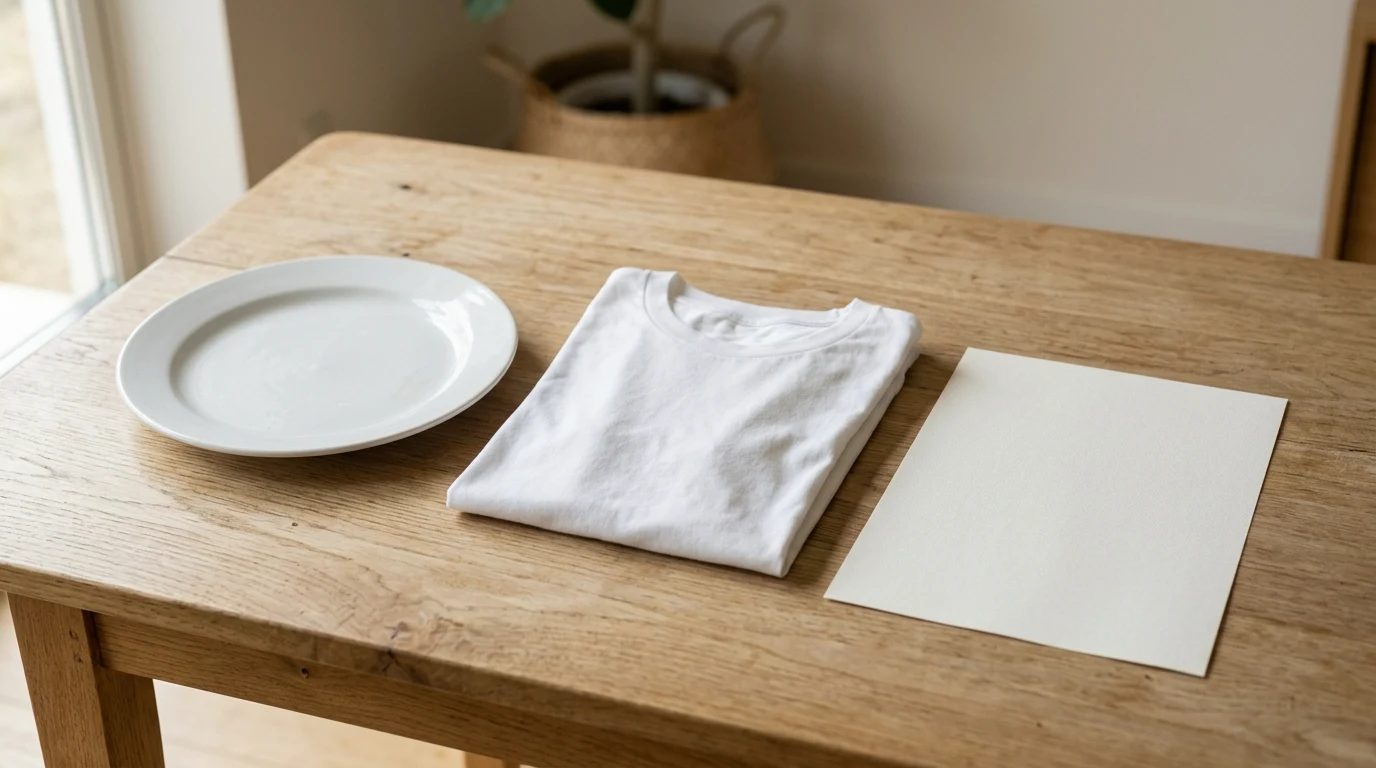
The word plain has several meanings in English. It is commonly used as an adjective, but it can also be a noun or an adverb in certain expressions.
As an adjective, plain often describes something that is simple, has no extra decoration, or is easy to understand. As a noun, it can describe a wide area of flat land.
Understanding these meanings will help you choose plain correctly in everyday writing.
Plain means simple or not decorated.
For example, if someone wears a plain black shirt, the shirt does not have a special design, pattern, or decoration.
Here are more examples:
- She chose a plain dress for the event.
- I prefer plain coffee without sugar.
- The room had plain white walls.
- He wrote the answer in plain English.
- We saw green fields across the open plain.
The meaning changes with the context, but the spelling remains the same.
What Does Plane Mean?
The word plane also has several meanings. It is often used as a noun, although it can also be a verb.
The most familiar meaning of plane is an aircraft that carries people or goods through the air. However, plane has important meanings in mathematics, construction, and woodworking.
Plane means an aircraft or a flat surface, depending on the context.
For example, when someone says, “My plane leaves at noon,” they are talking about an aircraft. When a math teacher talks about a geometric plane, the word refers to a flat surface that extends in two dimensions.
Consider these examples:
- The plane took off on time.
- We traveled to another country by plane.
- The triangle lies on a flat plane.
- The carpenter used a plane to smooth the wooden board.
- The two lines meet in the same plane.
Notice that the word plane does not always refer to flying. The sentence tells you which meaning the writer intends.
This is why learning the meaning of each word is more helpful than memorizing its spelling alone.
Plain or Plane: Key Differences
Although plain and plane sound the same, they have different meanings, grammatical uses, and common word combinations.
The following table shows the main differences.
| Feature | Plain | Plane |
| Pronunciation | Same as plane | Same as plain |
| Common word type | Adjective and noun | Noun and verb |
| Describes something simple | Yes | No |
| Refers to an aircraft | No | Yes |
| Refers to flat land | Yes | No |
| Used in geometry | Not usually | Yes |
| Example | Plain paper | A passenger plane |
The most important difference is meaning. You cannot use these words interchangeably just because they sound alike.
For example, “I booked a plain to London” is incorrect if you mean an aircraft. The correct sentence is “I booked a plane to London.”
Similarly, “She wore a plane dress” is incorrect if you mean a simple dress. You should write, “She wore a plain dress.”
When to Use Plain in a Sentence
Use plain when you want to describe something simple, clear, ordinary, or without decoration. You can also use it when talking about a large area of flat land.
Here are the most common situations in which plain is correct.
1. To describe something simple
Plain often describes objects, clothing, food, or designs without extra features.
Examples:
- He bought a plain notebook.
- She likes plain yogurt.
- I wore a plain blue shirt.
- The gift came in a plain box.
- They painted the wall a plain color.
2. To describe clear language
Plain can describe words or explanations that are easy to understand.
Examples:
- Please explain the rules in plain English.
- The teacher gave us a plain explanation.
- The instructions were written in plain language.
- Her meaning was plain to everyone.
3. To describe a flat area of land
A plain is a large area of land that is generally flat or gently rolling.
Examples:
- The farmers planted crops on the plain.
- A herd of deer crossed the plain.
- The village stood near a wide plain.
- The river flowed through the plain.
4. To describe something obvious
The expression “plain to see” means that something is easy to notice or understand.
Examples:
- It was plain to see that she was happy.
- The mistake was plain to everyone.
- His excitement was plain on his face.
These examples show that plain is useful in many everyday situations. Think about whether you mean simple, clear, obvious, or flat land before choosing this spelling.
When to Use Plane in a Sentence
Use plane when you are talking about an aircraft, a flat geometric surface, or a woodworking tool. It can also be used as a verb when describing the act of smoothing or shaping a surface with a plane.
1. To describe an aircraft
This is the most common everyday meaning of plane.
Examples:
- The plane arrived early.
- My family traveled by plane.
- The pilot checked the plane before takeoff.
- We watched the plane fly over the city.
- Her plane was delayed because of bad weather.
2. To describe a geometric surface
In geometry, a plane is a flat, two-dimensional surface that extends indefinitely in every direction.
Examples:
- The points lie on one plane.
- The teacher drew a triangle on the plane.
- Two lines can intersect on a plane.
- The diagram shows a point on a plane.
3. To describe a woodworking tool
A plane is a hand tool used to remove thin layers of wood and create a smooth or even surface.
Examples:
- The carpenter picked up his plane.
- He used a plane to smooth the wooden edge.
- The old plane needed a sharper blade.
4. To describe smoothing wood as an action
Plane can also be a verb.
Examples:
- He will plane the rough board.
- The worker planed the wooden door.
- She carefully planed the edge until it was smooth.
In these sentences, plane refers to an action rather than an aircraft or a surface.
Plain vs. Plane: Real-Life Examples
The best way to understand plain or plane is to see how each word works in everyday situations.
| Situation | Correct sentence | Why it is correct |
| Clothing | I bought a plain T-shirt. | The shirt has a simple design. |
| Air travel | We boarded the plane. | Plane means an aircraft. |
| Writing | Use plain English. | Plain means easy to understand. |
| Geography | Cattle grazed on the plain. | Plain means flat land. |
| Mathematics | Draw the shape on a plane. | Plane means a flat geometric surface. |
| Woodworking | He used a plane on the board. | Plane is a tool for smoothing wood. |
| Obvious information | The answer was plain to see. | Plain means clear or obvious. |
| Travel plans | Their plane landed safely. | Plane means an aircraft. |
These examples show why context matters. You can usually identify the correct spelling by asking what the sentence is trying to say.
If the sentence describes a shirt, a clear explanation, or a stretch of land, plain may be correct. If it describes an aircraft, a geometric surface, or a woodworking tool, plane may be correct.
Plain or Plane: Common Mistakes to Avoid
Because these words have the same pronunciation, spelling mistakes are common. Even experienced English writers may confuse them when typing quickly.
Here are some errors to watch for.
Mistake 1: Using plane for something simple
Incorrect: She wore a plane white dress.
Correct: She wore a plain white dress.
Why? Plain describes a dress without extra decoration.
Mistake 2: Using plain when talking about an aircraft
Incorrect: The plain landed at the airport.
Correct: The plane landed at the airport.
Why? Plane is the word for an aircraft.
Mistake 3: Confusing a plain with a plane in geography
Incorrect: The farmers worked on the plane.
Correct: The farmers worked on the plain.
Why? A plain is a large, generally flat area of land.
Mistake 4: Confusing the two words in travel writing
Incorrect: We booked a plain to New York.
Correct: We booked a plane to New York.
Why? An aircraft is a plane.
Mistake 5: Using plane instead of plain in clear communication
Incorrect: The teacher explained the rule in plane English.
Correct: The teacher explained the rule in plain English.
Why? Plain English means language that is easy to understand.
To avoid these mistakes, do not rely on pronunciation. Think about the meaning of the sentence before choosing the spelling.
Easy Tricks to Remember Plain vs. Plane
You do not need to memorize a long grammar rule to remember the difference. A few simple associations can make the words easier to use.
Trick 1: Remember the airplane
The word plane is part of the familiar word airplane. Both refer to an aircraft.
Example: “The plane flew above the clouds.”
When you think about flying, choose plane.
Trick 2: Connect plain with simple
Think of plain paper, plain clothes, or plain food. These things are simple or have few decorations.
Example: “He wrote his notes on plain paper.”
When you think about something simple or clear, choose plain.
Trick 3: Remember the flat land
A plain is a large, generally flat area of land.
Example: “The horses ran across the plain.”
When you think about a landscape with wide, open land, choose plain.
Trick 4: Read the entire sentence
Sometimes a word has more than one meaning. Reading the full sentence helps you understand the intended message.
For example:
- “The plane is ready for takeoff.” Plane means an aircraft.
- “The design is plain.” Plain means simple.
- “The grassland plain stretched for miles.” Plain means flat land.
These small habits can help you choose the right word in schoolwork, emails, blog posts, and everyday conversations.
Are Plain and Plane Homophones?
Yes, plain and plane are homophones in standard American English. Homophones are words that sound alike but have different meanings and spellings.
Other common examples of homophones include:
| Homophones | Meaning |
| There / Their | A place / belonging to them |
| Two / Too | The number 2 / also or excessively |
| Right / Write | Correct or a direction / to form words |
| Sea / See | A large body of salt water / to look |
| Plain / Plane | Simple or flat land / aircraft or flat surface |
Homophones can be confusing because pronunciation does not tell you which spelling to use. Instead, you need to understand the meaning of the sentence.
For example, if you hear someone say, “The plane is ready,” the surrounding conversation may tell you whether they mean an aircraft or a different kind of plane.
In writing, choosing the correct word makes your meaning clear.
Is Plain or Plane More Common in American English?
Both plain and plane are common words in American English, but they are used in different contexts. There is no single spelling that replaces the other.
Plane is frequently used in conversations about travel, airports, aircraft, and geometry. Plain appears in descriptions of simple objects, clear language, and open landscapes.
The frequency of each word depends on the topic.
For example, a travel blog may use plane many times when discussing flights. A cooking blog may use plain when describing plain yogurt or plain flour. A geography textbook may use plain when explaining landforms.
Here are some examples from different settings:
- Travel: Our plane departs at six in the morning.
- Cooking: Add plain yogurt to the mixture.
- Education: Write your answer in plain English.
- Geography: The river passes through a broad plain.
- Mathematics: The shape lies on a flat plane.
Both words are correct when used with their intended meanings. The key is to select the word that fits the context rather than choosing one spelling because it seems more familiar.
Frequently Asked Questions About Plain or Plane
What is the main difference between plain and plane?
Plain means simple, clear, or a large area of flat land. Plane usually means an aircraft, a flat geometric surface, or a woodworking tool. The words sound alike but have different meanings.
Is it a plain or a plane that flies?
A plane flies. It is a common short form of airplane and refers to an aircraft that carries passengers or cargo.
Example: “The plane took off at noon.”
Does plain mean simple?
Yes. Plain often means simple, ordinary, or without decoration. It can also mean easy to understand.
Example: “She wore a plain black dress.”
Can plane mean a flat surface?
Yes. In geometry, a plane is a flat, two-dimensional surface that extends indefinitely. The word can also refer to a tool used to smooth wood.
Are plain and plane pronounced the same?
Yes. In standard American English, plain and plane are homophones. They have the same pronunciation but different spellings and meanings.
How can I remember when to use plain or plane?
Remember that a plane can fly, while plain can describe something simple. Also, a plain can be a wide area of flat land. Check the meaning of your sentence before choosing the word.
Conclusion: Plain or Plane Which Word Should You Use?
Choosing between plain or plane becomes easy once you understand what each word means. Plain describes something simple, clear, or without decoration. It can also refer to a large area of flat land. Plane, on the other hand, commonly refers to an aircraft, a flat surface in geometry, or a tool used to smooth wood.
Although these words sound the same, you should never use them interchangeably. The correct spelling depends on the meaning you want to express.
When writing, ask yourself one simple question: Am I talking about something simple or a flat area of land, or do I mean an aircraft or another kind of plane? This quick check can help you avoid spelling mistakes.With regular practice and attention to context, you will soon use plain and plane correctly in your everyday writing.

Hi, I’m Iqra, a passionate writer and grammar enthusiast dedicated to making English grammar simple, clear, and easy to understand. Through my work on grammar books and educational content, I help students, writers, and English learners improve their vocabulary, sentence structure, punctuation, and everyday communication skills. My goal is to turn confusing grammar rules into practical, easy-to-follow lessons that readers can confidently use in real life. I believe learning grammar doesn’t have to be difficult—it can be simple, useful, and even enjoyable. Through helpful guides, examples, and carefully explained grammar tips, Iqra aims to make learning English more accessible for everyone.