Have you ever stopped in the middle of a sentence and wondered if you should write “passed” or “past”? You are not alone. These two words sound exactly the same, but they do very different jobs in a sentence.
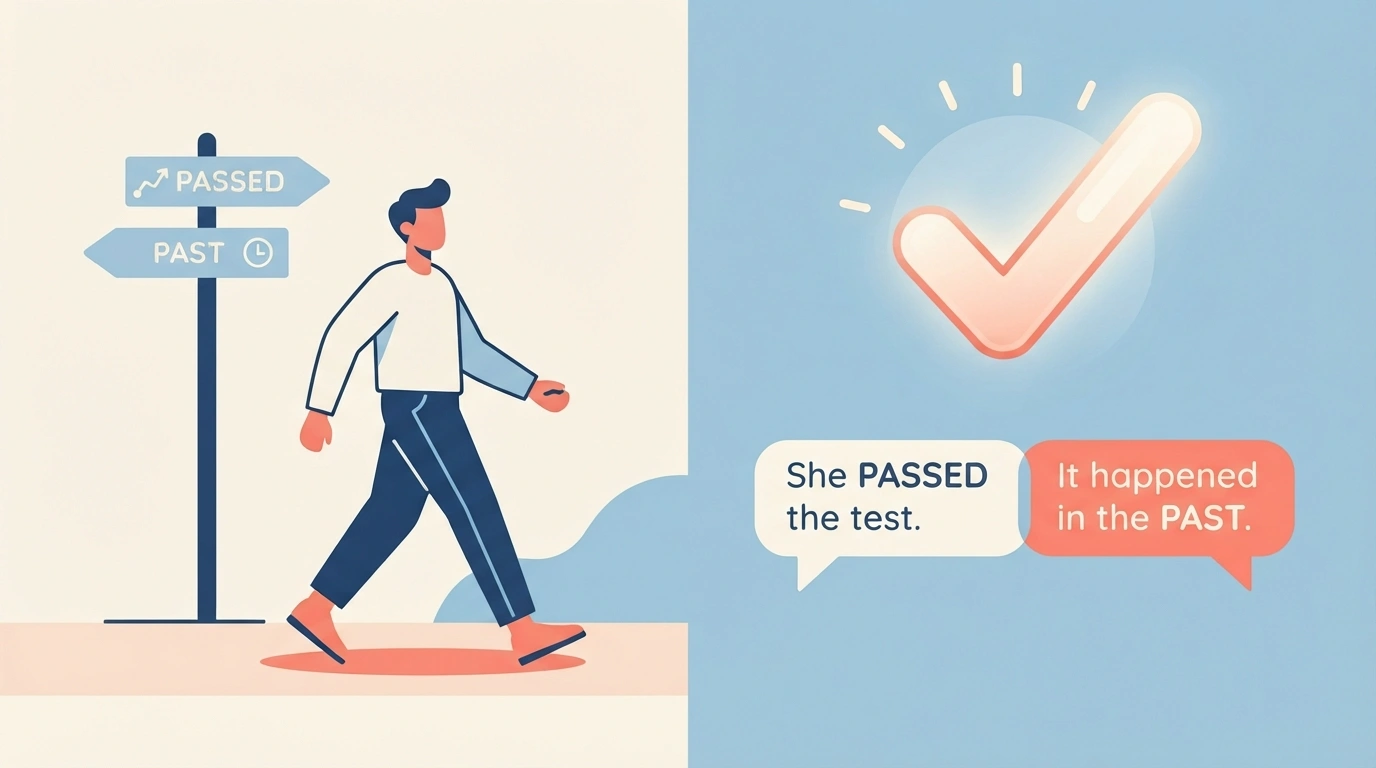
The quick answer is this: “passed” is a verb that shows an action already happened, while “past” is used to talk about time, location, or things that already happened (as a noun, adjective, or preposition). Once you learn this one rule, the mix-up almost never happens again.
In this guide, you will learn what each word means, how to use them correctly, and how to avoid the most common mistakes people make. You will also see real examples, a simple comparison table, and answers to the questions people ask most about “passed or past.”
Quick Answer: Passed vs Past
Here is the short version before we dig deeper.
- Passed is always a verb. It is the past tense of “pass,” and it describes an action that someone or something did.
- Past is never a verb. It works as a noun (the past), an adjective (past experience), or a preposition (walked past the store).
A simple trick: if you can replace the word with another action verb, like “moved” or “finished,” then you need “passed.” If the word describes time or location instead of an action, you need “past.”
Example test:
- “She the exam.” → She finished the exam. So it’s “passed.”
- “He walked the school.” → He walked by the school. So it’s “past.”
Meaning and Definition
Let’s break both words down clearly, because understanding the meaning is the fastest way to stop confusing them.
Passed comes from the verb “to pass.” This verb has several meanings, including to move by something, to succeed at something, to hand something to someone, or for time to go by. Whenever any of these actions happen, and you are talking about something that already occurred, you use “passed.”
For example:
- The car passed the truck on the highway.
- I passed my driving test on the first try.
- She passed the salt to her brother.
- An hour passed before the doctor arrived.
Past, on the other hand, is not an action word at all. It describes something related to time that has already gone by, or a location that something moves beyond. It can act as three different parts of speech:
- Noun: “The past is behind us.” (referring to time before now)
- Adjective: “Her past experience helped her get the job.” (describing something)
- Preposition: “He drove past the gas station.” (describing location or movement beyond something)
The easiest way to remember the difference is this: passed = action, past = everything else.
Grammar and Correct Usage
Understanding the grammar rules behind these words makes them much easier to use correctly, even under pressure, like during a timed writing test or a work email.
“Passed” is a verb, and specifically, it is the simple past tense and past participle of “pass.” This means it always shows that an action happened. Because it’s a verb, it needs a subject to perform the action. Someone or something must be doing the passing.
Study these patterns:
| Sentence Type | Correct Word | Example |
| Subject + verb (action happened) | Passed | The team passed the ball quickly. |
| Time expression (action of time moving) | Passed | Three years passed since we last spoke. |
| Referring to location or direction | Past | The bus drove past our house. |
| Referring to time before now (noun) | Past | We should learn from the past. |
| Describing something that happened earlier (adjective) | Past | This is based on past performance. |
| Expressing a time (like “half past two”) | Past | It’s half past two. |
Notice something important: “past” never changes form. It does not have a different version for different tenses because it isn’t a verb. “Passed,” however, is only used in the past tense form. The present tense version is “pass,” and the future version uses “will pass.”
Here’s another helpful grammar note. When you see “past” describing a time on a clock, like “quarter past nine,” this is a fixed expression, and it is always “past,” never “passed.” This trips up a lot of writers because it feels like an action related to time.
Common Mistakes
Even skilled writers slip up here sometimes, mostly because the words sound the same when spoken out loud. Let’s look at the most frequent errors so you can catch them in your own writing.
Mistake 1: Using “past” instead of “passed” as a verb.
Incorrect: She past the test with flying colors. Correct: She passed the test with flying colors.
Mistake 2: Using “passed” instead of “past” for time or location.
Incorrect: He walked passed the library on his way home. Correct: He walked past the library on his way home.
Mistake 3: Confusing “past” with “passed” in phrases about time.
Incorrect: It’s ten passed six. Correct: It’s ten past six.
Mistake 4: Forgetting that “past” can describe something without any action.
Incorrect: In passed years, things were different. Correct: In past years, things were different.
A good habit is to read your sentence slowly and ask, “Is something doing an action here?” If yes, you likely need “passed.” If the sentence is describing a location, time, or something that already exists without an action being performed, “past” is the better choice.
Real-Life Examples
Seeing these words used in everyday situations makes the difference much clearer. Here are examples from common, real-world contexts.
At school:
- My daughter passed her spelling test this morning.
- The teacher talked about events from the past.
- Please walk past the gym to reach the cafeteria.
At work:
- He passed the project report to his manager before the deadline.
- Based on past performance reviews, she earned a promotion.
- The delivery truck drove past our office twice today.
In daily conversation:
- Time passed so quickly during our vacation.
- We should stop living in the past and focus on today.
- It’s half past seven, so we need to leave soon.
In sports:
- The quarterback passed the ball for a touchdown.
- His past records were broken this season.
- The runner sprinted past everyone in the final lap.
Notice how in every single example, “passed” always connects to an action that someone or something performed. “Past” always connects to time, description, or location, without describing a direct action happening in that moment.
Tips or Best Practices
Here are a few simple, reliable tricks that writers, students, and professionals use to get this right every time.
First, try the substitution test. Replace the word with a synonym. If words like “moved,” “finished,” “handed,” or “went by” fit naturally, you need “passed.” If words like “beyond,” “earlier,” “former,” or “previous” fit better, you need “past.”
Second, remember that “passed” always has “-ed,” which is a common signal for past tense verbs in English, just like “walked,” “talked,” or “jumped.” This visual clue can help you remember that “passed” behaves like a normal action verb.
Third, think about sentence structure. Verbs usually come right after the subject and show what that subject is doing. If your word follows this pattern, “passed” is likely correct. Prepositions and adjectives usually describe something instead of showing direct action, which points toward “past.”
Fourth, when writing about time on a clock, always default to “past.” Phrases like “quarter past,” “ten past,” and “half past” are fixed expressions in English and never use “passed.”
Fifth, when in doubt, read your sentence out loud and ask a simple question: “Did someone do something?” If the answer is yes, use “passed.” If the sentence is only describing time, location, or a state, use “past.”
| Helpful Signal | Points To | Example |
| Action performed by subject | Passed | He passed the exam. |
| Word ending in “-ed” pattern needed | Passed | They passed through the tunnel. |
| Describes time before now | Past | Those events are in the past. |
| Describes location beyond something | Past | She jogged past the park. |
| Used with clock times | Past | It’s twenty past noon. |
| Describes former or previous state | Past | His past job was in sales. |
Practicing with real sentences, like the ones above, is one of the best ways to make this rule feel automatic over time.
FAQs
1. What is the main difference between “passed” and “past”?
“Passed” is a verb showing an action that already happened, such as passing a test or passing someone on the road. “Past” describes time, location, or a previous state, and it is never a verb.
2. Is “past” ever used as a verb?
No. “Past” is used only as a noun, adjective, or preposition. It never functions as a verb in standard English grammar.
3. How do I remember which one to use in a sentence?
Try replacing the word with another action verb, like “moved” or “finished.” If it fits naturally, use “passed.” If it doesn’t, use “past” instead.
4. Why do people confuse “passed” and “past” so often?
Both words sound identical when spoken, which is called a homophone. Because English learners and native speakers rely heavily on sound, it’s easy to pick the wrong spelling in writing.
5. Is it “walked passed” or “walked past” the store?
It is always “walked past the store.” Since “past” describes location here, “passed” would be incorrect in this sentence.
6. Which word do I use for telling time, like “It’s ten five”?
Always use “past” for telling time, as in “It’s ten past five.” This is a fixed expression in English.
Conclusion
Learning the difference between “passed” and “past” comes down to one simple idea: passed is an action, and past is everything else, like time, location, or description. Once this idea clicks, the confusion tends to disappear for good.
Whenever you’re unsure, pause and ask yourself if someone or something is actively doing something in your sentence. If the answer is yes, “passed” is almost always the right choice.
If you’re describing time gone by, a place someone moved beyond, or something from before, “past” is the word you need. With a little practice using real sentences, this grammar rule becomes second nature, and your writing will read more clearly and confidently every time.
Read More

Fazal Abbas
Fazal Abbas is a passionate English grammar writer with over 2 years of experience creating clear, helpful, and easy-to-understand grammar content. He specializes in confusing words, common grammar mistakes, word usage, sentence structure, and practical English tips.
With a simple teaching style, Fazal explains difficult grammar topics in easy English that students, writers, and everyday learners can understand. His goal is to make English grammar less confusing and more useful in real-life communication.
Through GrammarBook, Fazal shares practical examples, clear explanations, and useful tips to help readers improve their English with confidence. He believes that learning grammar should be simple, friendly, and enjoyable.