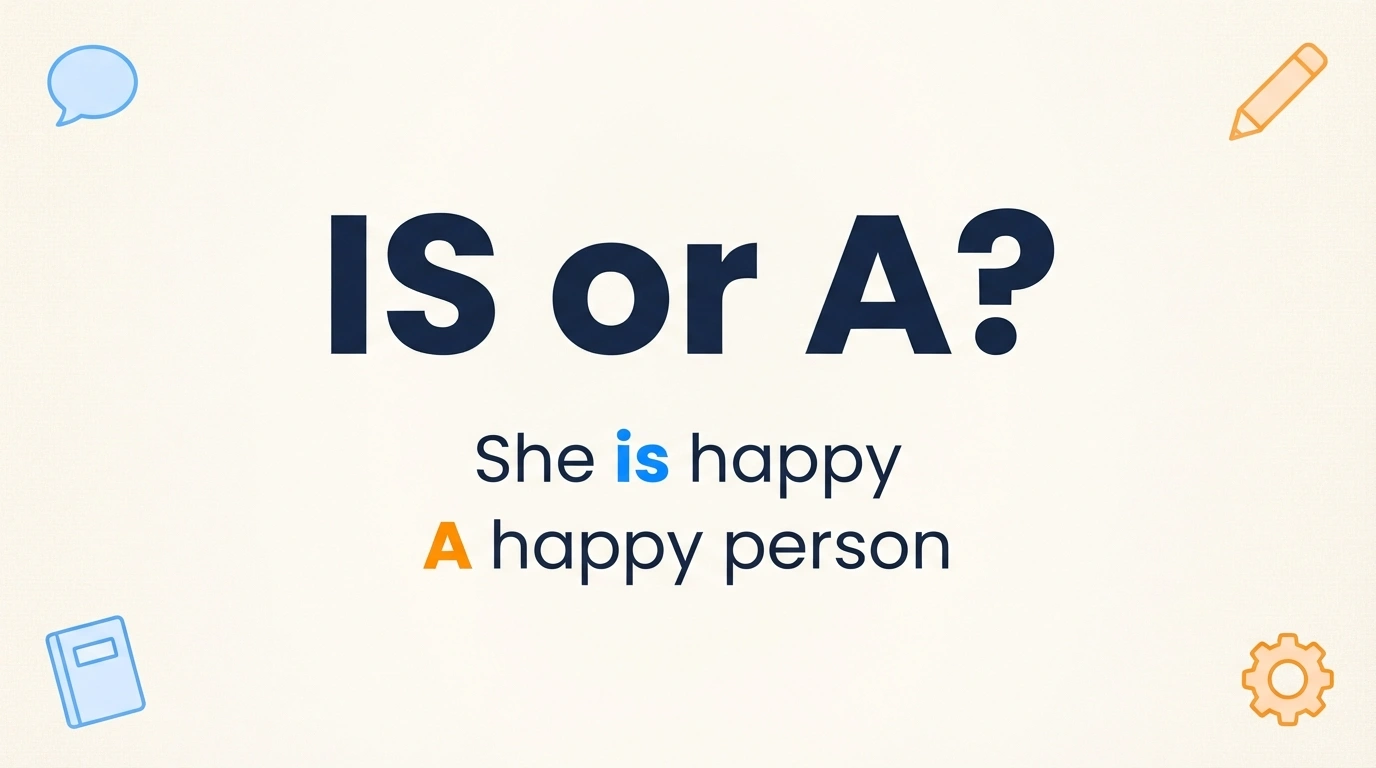
Use “is” when you need a verb to show a state of being, action, or condition (as in “She is happy”). Use “a” when you need an article to point to one single, non-specific thing (as in “a happy person”). These two words look like they might belong to the same family, but they do completely different jobs in a sentence.
This mix-up trips up a lot of English learners, and even some native speakers slow down when they try to explain the difference out loud.
If you’ve ever paused mid-sentence wondering If to write “is a good day” or just “a good day,” you’re not alone. This guide breaks down exactly when to use each word, why people confuse them, and how to fix common mistakes for good. By the end, you’ll know the rule so well that you won’t even have to think about it anymore.
Quick Answer
“Is” is a verb. “A” is an article. They almost never replace each other correctly, because a verb tells you what something does or how it exists, while an article tells you which noun you’re talking about.
In most sentences, you actually need both words together, like in “This is a book” or “He is a teacher.”
The confusion usually happens because these two short words often sit right next to each other, making it easy to drop one or use the wrong one when writing quickly.
Meaning or Definition
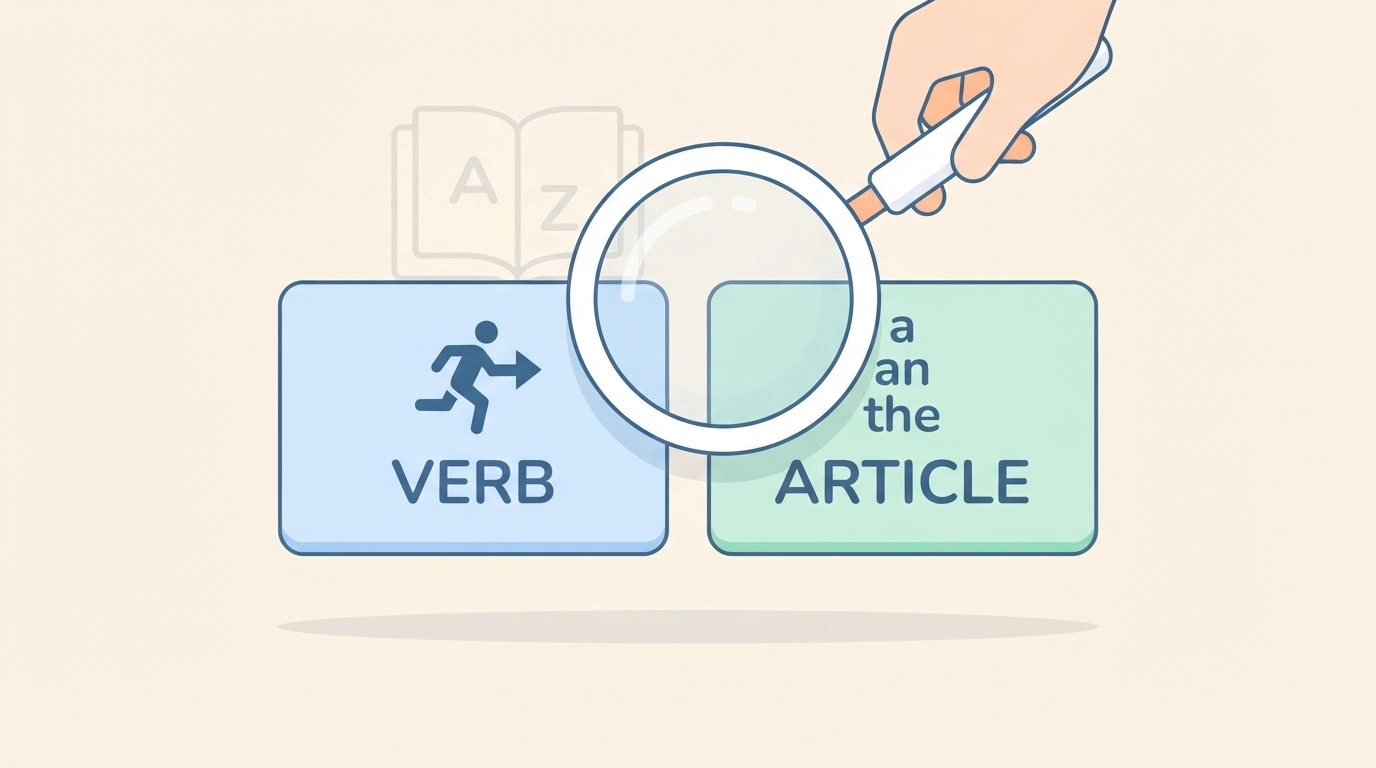
Let’s break these two words down separately, since they come from completely different parts of grammar.
“Is” is a verb. Specifically, it’s a form of the verb “to be,” used with singular subjects like “he,” “she,” “it,” or a person’s name. It shows existence, identity, or a state of being. For example:
- She is tired.
- The dog is brown.
- Paris is beautiful.
“A” is an indefinite article. It comes before a singular, countable noun when you’re not talking about one specific item, just any one item from a group. For example:
- I saw a bird.
- She wants a cookie.
- He is a doctor.
Here’s the key difference in plain terms: “is” tells you something exists or is true. “A” tells you which type of noun you’re pointing to, without naming a specific one. They serve totally different purposes, which is why swapping one for the other usually breaks the sentence.
Grammar or Correct Usage
Understanding grammar rules gets a lot easier when you see them side by side. Here’s a simple table to show how “is” and “a” function differently in a sentence.
| Feature | “Is” | “A” |
| Part of speech | Verb (form of “to be”) | Indefinite article |
| Job in a sentence | Shows action, state, or existence | Points to a noun, non-specific |
| Used with | Singular subjects (he, she, it) | Singular, countable nouns |
| Example | The sky is clear. | I need a pen. |
| Can stand alone? | Yes, as the main verb | No, must attach to a noun |
Notice that “a” can never work by itself. It always needs a noun to attach to, like “a dog,” “a chair,” or “a plan.” “Is,” on the other hand, works as the main verb of a sentence and doesn’t need an article to make sense.
Now, here’s where it gets interesting. Many correct sentences use both words together, right next to each other. Look at these:
- This is a great idea.
- My brother is a firefighter.
- That is a long story.
In each case, “is” comes first because it’s linking the subject to what follows, and “a” comes second because it introduces a singular noun (idea, firefighter, story). Removing either word here would make the sentence incomplete or grammatically wrong.
One more grammar note: “a” changes to “an” when the following word starts with a vowel sound. So you’d say “an apple” instead of “a apple,” but this rule never applies to “is,” since “is” isn’t an article and doesn’t shift form based on sound.
Common Mistakes
Even careful writers slip up with “is” and “a.” Here are the most common errors people make, along with quick fixes.
Mistake 1: Leaving out “is” entirely.
Wrong: “She a nurse.”
Right: “She is a nurse.”
This happens most often when English isn’t someone’s first language, especially if their native language doesn’t require a linking verb in this kind of sentence.
Mistake 2: Using “a” when “is” is needed.
Wrong: “The weather a nice today.”
Right: “The weather is nice today.”
Here, no noun follows the missing word, so “a” doesn’t belong at all. Only “is” fits, since the sentence describes a state (the weather being nice), not a specific object.
Mistake 3: Using “is” instead of “a” before a noun.
Wrong: “I want is sandwich.”
Right: “I want a sandwich.”
This error usually comes from rushing while typing or speaking. The sentence needs an article before “sandwich,” not a verb.
Mistake 4: Repeating “is” unnecessarily.
Wrong: “It is is a nice day.”
Right: “It is a nice day.”
This is usually just a typing slip, but it’s worth double-checking your sentences before hitting publish or send.
A simple trick to catch these errors: read your sentence out loud. If it sounds like something is missing, or like you’re stumbling, that’s usually a sign one of these small words got dropped or duplicated.
Real-Life Examples
Seeing these words in everyday context can make the rule stick better than any explanation alone. Here’s a table comparing sentences that use “is,” “a,” or both together.
| Sentence | Uses | Why |
| The cat is sleeping. | Is only | No noun follows, just an action |
| I have a cat. | A only | “Cat” is a singular, non-specific noun |
| That is a cat. | Both | “Is” links subject to noun, “a” introduces it |
| He is kind. | Is only | Describes a quality, not a noun |
| She bought a house. | A only | Introduces the object she bought |
| This is a house. | Both | Identifies what “this” is |
Here are a few more natural examples pulled from everyday speech and writing:
- “Is there a doctor in the building?” (both words appear, but in a question)
- “That is a wonderful painting.”
- “My neighbor is a really funny guy.”
- “Can you grab me a glass of water?”
- “This is a tricky problem to solve.”
Notice how “is a” often shows up together in sentences that identify or describe something, like naming a job, an object, or a quality. Meanwhile, “a” pops up alone in sentences that simply mention or request something, like “grab me a glass of water.”
Tips or Best Practices
Here are a few simple habits that will help you use “is” and “a” correctly every time.
- Ask what job the word is doing.
- If it’s showing action or existence, you need “is.” If it’s introducing a noun without pointing to something specific, you need “a.”
- Check for a noun right after the word.
- If a singular noun follows, “a” (or “an”) likely belongs there. If no noun follows, and instead you have an adjective or another verb form, “is” is probably correct.
- Read sentences aloud before finalizing them.
- Your ear will often catch a missing or misplaced word faster than your eyes will.
- Remember that “is a” is a valid combo.
- Don’t assume these words are competing for the same spot. Often, the correct sentence needs both.
- Watch out for autocorrect and speech-to-text errors.
- These tools sometimes swap similar-sounding words, so a quick proofread catches mistakes before they go public.
- Practice with flashcards or quick drills.
- Writing ten quick sentences using “is,” ten using “a,” and ten using both together can build lasting muscle memory.
Building this kind of awareness takes just a little practice, but it pays off fast. Once you internalize the different roles these words play, the right choice becomes automatic.
FAQs
1. Can “is” and “a” ever mean the same thing?
No. “Is” is a verb showing existence or state, while “a” is an article introducing a noun. They serve different grammar functions and are not interchangeable.
2. Why do “is” and “a” often appear together in a sentence?
They frequently appear together because “is” links a subject to a noun phrase, and “a” introduces that noun. A sentence like “He is a teacher” needs both to be grammatically complete.
3. Is it ever correct to drop “is” from a sentence?
In formal writing, no. Dropping “is” usually creates an incomplete or grammatically incorrect sentence, such as “She a nurse” instead of “She is a nurse.” Informal speech sometimes drops it casually, but writing should include it.
4. When do I use “an” instead of “a”?
Use “an” before words that start with a vowel sound, like “an apple” or “an hour.” Use “a” before words starting with a consonant sound, like “a banana” or “a house.”
5. Is “a” only used with singular nouns?
Yes. “A” (and “an”) only pairs with singular, countable nouns. Plural nouns or uncountable nouns, like “water” or “furniture,” don’t take “a” at all.
6. How can I quickly check if I’m using “is” or “a” correctly?
Read the sentence aloud and ask if it describes a state or action (use “is”) or introduces a specific singular noun (use “a”). If both apply, you likely need both words together.
Conclusion
Getting “is” and “a” right comes down to understanding what job each word does. “Is” acts as a verb, showing existence or a state of being, while “a” works as an article, introducing a singular, non-specific noun.
Once you recognize that these words often team up rather than compete, sentences like “This is a great plan” or “She is a talented artist” start to feel natural instead of confusing.
Keep practicing by reading your writing aloud and checking If a noun follows the word in question. With a little attention, this grammar rule becomes second nature, and your writing will sound clearer and more polished every time.

Hi, I’m Iqra, a passionate writer and grammar enthusiast dedicated to making English grammar simple, clear, and easy to understand. Through my work on grammar books and educational content, I help students, writers, and English learners improve their vocabulary, sentence structure, punctuation, and everyday communication skills. My goal is to turn confusing grammar rules into practical, easy-to-follow lessons that readers can confidently use in real life. I believe learning grammar doesn’t have to be difficult—it can be simple, useful, and even enjoyable. Through helpful guides, examples, and carefully explained grammar tips, Iqra aims to make learning English more accessible for everyone.